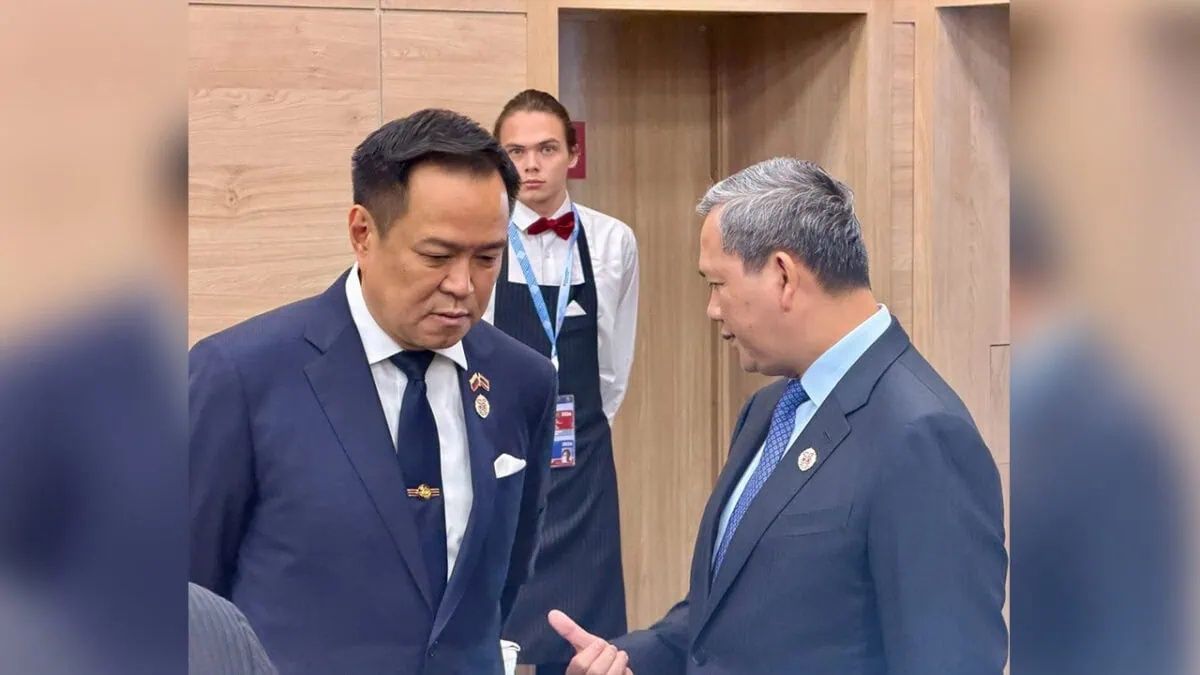
Cambodia's leadership is pushing Thailand to move forward with long-stalled border demarcation efforts, according to an informal exchange between Prime Minister Hun Manet and his Thai counterpart Anutin Charnvirakul held on the sidelines of an Asean-Russia summit in Kazan. The conversation, which Hun Manet characterised as a brief encounter squeezed into the margins of the broader diplomatic gathering, centred on accelerating the appointment of leadership for the Joint Boundary Commission and initiating joint survey operations along the contested frontier separating the two nations.
Hun Manet's public statement following the Kazan meeting underscores Phnom Penh's deliberate strategy of managing its territorial disagreements with Bangkok through established institutional channels rather than unilateral measures. The Cambodian premier reiterated his government's commitment to resolving boundary questions via peaceful means, anchoring this position firmly in international legal frameworks and the bilateral mechanisms that both countries have constructed over decades. His emphasis on fidelity to existing agreements reflects a broader Southeast Asian diplomatic norm whereby nations seek to manage disputes without destabilising regional security architecture.
The appointment of a JBC chief represents a critical procedural step that has remained unfulfilled despite both governments' stated commitments. By calling directly for Thailand to fill this vacancy, Hun Manet is signalling that Cambodia views administrative delays as impediments to substantive progress on demarcation work. This functional frustration carries particular weight given that point three of a December 2025 bilateral statement explicitly obligates both sides to commence joint survey and demarcation operations, a commitment that remains contingent on Thailand establishing its delegation leadership.
Thai Prime Minister Anutin's characterisation of the encounter as merely "pulling each other aside by the elbow" deliberately minimised expectations of breakthroughs, a rhetorical choice common in Southeast Asian diplomacy when leaders wish to avoid domestic political complications. His casual reference to the brevity and informality of their discussion served dual purposes: tempering speculation about significant developments while indicating that the conversation carried personal weight despite its spontaneity. For Anutin, acknowledging border discussions requires careful domestic calibration, a reality underscored by his light-hearted deflection when asked about reopening border crossings, stating that Thai citizens would be deeply displeased by such discussions.
Both leaders affirmed their nations' opposition to confrontation and mutual preference for dialogue-based approaches, yet their statements revealed subtly different emphases that merit examination. Cambodia's public positioning prioritises the bilateral JBC mechanism for terrestrial boundary issues whilst simultaneously maintaining engagement with the United Nations Convention on the Law of the Sea compulsory conciliation process for maritime disputes. This dual-track strategy reflects Phnom Penh's assessment that maritime and land boundary questions require differentiated diplomatic and legal approaches tailored to each domain's complexities.
Thailand's commitment encompasses the JBC, the General Border Committee, and UNCLOS frameworks—a formulation that suggests Bangkok views border management as requiring multiple institutional layers rather than single-track resolution. The inclusion of the GBC in Anutin's statement points to Thailand's preference for mechanisms involving broader regional stakeholder participation, though the JBC remains the primary bilateral mechanism for technical boundary work. This institutional pluralism reflects both countries' desire to preserve optionality whilst publicly emphasising stability.
The broader context of Cambodia-Thailand border tensions has intensified regional awareness of Southeast Asian maritime and terrestrial vulnerability to unresolved boundary claims. The two nations have experienced previous military confrontations and continue to maintain significant troop deployments in disputed areas, making even routine diplomatic exchanges subjects of careful public interpretation in both countries. For Malaysia and other regional states observing these dynamics, the Cambodia-Thailand situation serves as a cautionary demonstration of how boundary issues, if mismanaged, threaten ASEAN cohesion and regional confidence.
Hun Manet's insistence that border crossing reopening discussions remain premature suggests a deliberate sequencing of diplomatic moves whereby boundary demarcation advances would logically precede normalisation of commercial and civilian movement. This ordering reflects a sophisticated understanding that establishing agreed boundary delineations creates the legal and administrative foundation upon which cross-border movement can be safely regulated. Conversely, Anutin's avoidance of the checkpoint issue reflects domestic political sensitivities around perceived Thai concessions on border matters, a factor that consistently constrains Thai government flexibility on boundary questions.
The institutional architecture of Cambodia-Thailand border management rests on agreements accumulated across decades of sometimes fraught diplomatic engagement. The December 2025 joint statement referenced by Hun Manet represents the most recent attempt to inject momentum into chronically slow demarcation processes. For both governments, fulfilling the stated commitments to the JBC chieftaincy appointment and initiating surveys would demonstrate to domestic constituencies and regional observers that diplomatic channels are functioning, even if progress remains incremental.
Regional implications of Cambodia-Thailand border developments extend beyond bilateral concerns, as unresolved boundary disputes anywhere in Southeast Asia complicate ASEAN's collective efforts to maintain the Code of Conduct framework and prevent flashpoints from destabilising broader trade and security arrangements. Malaysia, which has its own boundary agreements and disputed maritime zones with neighbouring states, watches the Cambodia-Thailand experience as a potential template for either successful institutional diplomacy or cautionary lessons about the costs of stalled boundary work. The preference for existing legal mechanisms and bilateral negotiations expressed by both leaders aligns with ASEAN norms emphasising dialogue over unilateral assertions.
The timing of Hun Manet's public statements following the Kazan encounter suggests calculated messaging designed to demonstrate progress whilst managing expectations realistically. By publicising Thailand's outstanding administrative obligation—the JBC chieftaincy appointment—Cambodia places international focus on Thai performance of concrete commitments rather than vague assurances of goodwill. This approach leverages diplomatic transparency as a subtle pressure mechanism, a tactic common among smaller nations seeking to hold more powerful interlocutors accountable to publicly stated positions.
Looking forward, the Cambodia-Thailand border question will likely remain contingent on whether Thailand can successfully navigate its domestic political constraints to appointment a JBC chief and initiate joint surveys. For Cambodia, maintaining emphasis on legal mechanisms and bilateral frameworks whilst avoiding inflammatory rhetoric serves the dual purpose of demonstrating reasonableness to international observers whilst protecting against accusations of weakness from domestic constituencies concerned about territorial sovereignty. The mutual reaffirmation of peaceful resolution preferences, though diplomatically routine, nevertheless carries significance in a region where border tensions have historically escalated with alarming speed.