Cambodia is making a calculated push to reshape its industrial base by attracting South Korean capital into advanced manufacturing and technology sectors, marking a significant departure from its decades-long reliance on labour-intensive garment production. The strategic initiative became visible during a recent investment promotion mission to South Korea, where Deputy Prime Minister Sun Chanthol, serving as first vice-chairman of the Council for the Development of Cambodia, led a high-level delegation through a series of company engagements and an investment roadshow in Incheon on June 16. The visit crystallised Cambodia's ambition to progress beyond its traditional economic model and position itself as an anchor for complex, higher-value industrial activities across Southeast Asia.
The timing of this outreach reflects broader economic realities facing the Kingdom. For generations, Cambodia's manufacturing engine has been powered by garments, footwear, and travel goods, sectors that provided employment and export revenue but increasingly struggle with labour cost competition and shifting global consumer preferences. Government planners recognise that sustained growth requires upgrading the quality of investment and the skill levels of the workforce. By targeting South Korean companies operating in automotive components, electric vehicle systems, logistics, energy, construction, and digital healthcare, Cambodia is signalling that it intends to become integrated into higher-margin supply chains rather than competing solely on wage differentials.
During the Incheon-Cambodia Investment Roadshow, organised jointly by the CDC and the Incheon Chamber of Commerce and Industry, Chanthol underscored the government's commitment to facilitating foreign investment through what he described as attractive fiscal incentives, macroeconomic stability, and robust legal protections under Cambodia's newly revised Investment Law. The roadshow served as a platform to showcase the Kingdom's evolving business environment to South Korea's corporate leadership, positioning Cambodia as a destination capable of supporting not just basic assembly operations but increasingly sophisticated manufacturing and service sectors.
The delegation's visits to specific companies revealed the practical foundation already underpinning Cambodia's ambitions. At Daejoo KC Group, a sprawling South Korean conglomerate with fingers in metallurgy, chemicals, logistics, construction, automotive components, and energy, Chanthol encountered a business already embedded in the Cambodian economy. Through its subsidiary Camko Motor, the company assembles Hyundai vehicles for the domestic market and manufactures automotive wire harnesses for export, generating roughly 500 jobs. A second subsidiary, Camko Infracore, imports and distributes Hyundai vehicles and operates maintenance and spare-parts operations. This existing presence gave Chanthol a credible platform from which to encourage Daejoo KC to deepen and broaden its Cambodian footprint across sectors where it already possesses technical expertise.
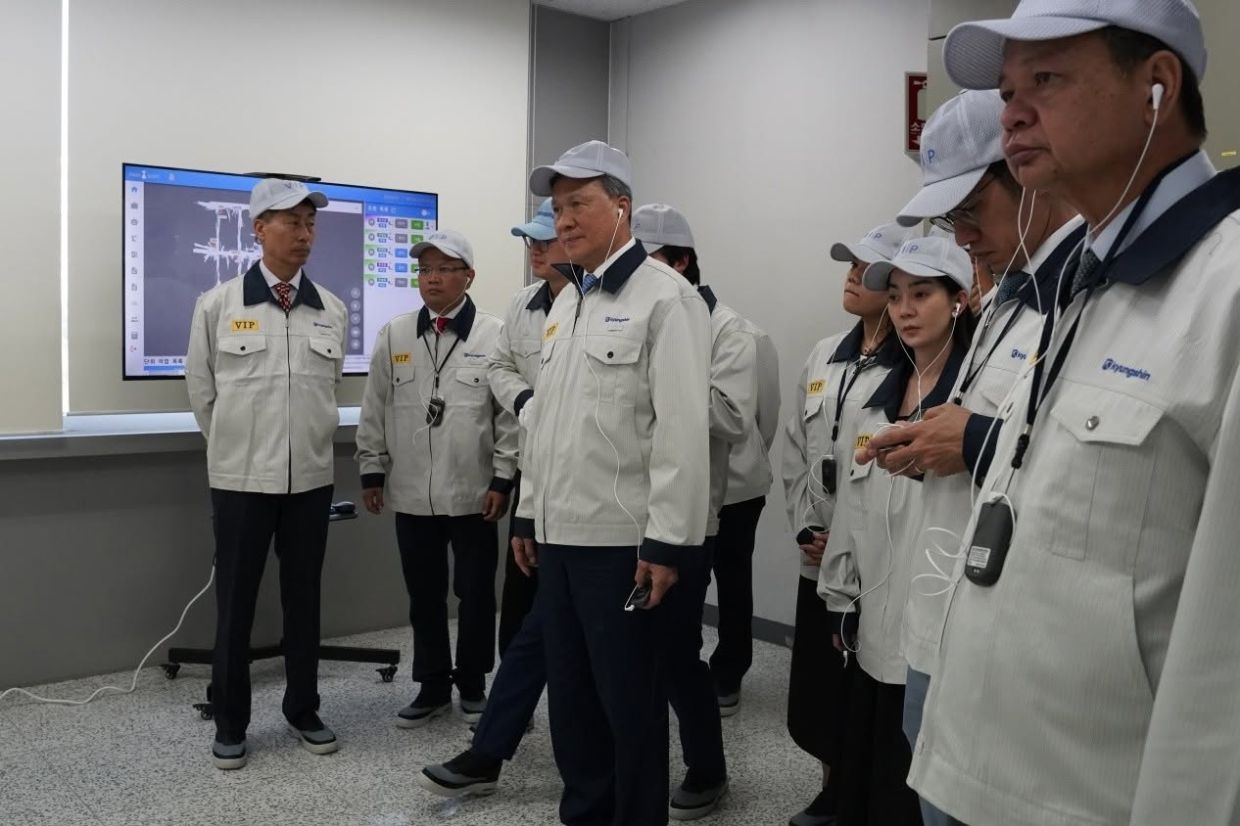
Equally significant was the delegation's engagement with Kyungshin Co., Ltd., a Korean specialist in automotive electronic components and wire harness manufacturing. Founded in 1974, Kyungshin has built a reputation for producing wiring harnesses, connectors, junction blocks, and electrical systems tailored for electric vehicles, alongside advanced technologies supporting future mobility solutions. The company has operated in Cambodia since 2012 through a wire harness factory in Kandal province, representing approximately US$20 million in invested capital and employing 1,467 workers. The factory's long operational presence and substantial workforce provide concrete evidence that Cambodia can support the kind of labour-intensive yet technically skilled manufacturing that EV supply chains increasingly demand, particularly as global automakers transition away from internal combustion engines.
The strategic logic animating these company visits extends beyond traditional production. Cambodia's integration into automotive supply chains carries significant implications for the region's manufacturing ecosystem. As multinational automotive manufacturers shift toward electric vehicles and associated digital systems, the geographical distribution of component suppliers becomes critical for managing costs, reducing carbon footprints in logistics, and ensuring supply-chain resilience. By positioning itself as a receptive home for Korean automotive suppliers, Cambodia offers companies an opportunity to diversify production away from more saturated or politically sensitive locations while tapping into the broad ASEAN market and supply-chain networks.
The delegation's visit to Incheon Baek Hospital on the final day broadened the scope of Cambodia's investment pitch beyond manufacturing into services and technology transfer. Chanthol identified healthcare and the establishment of internationally accredited hospitals as key government priorities, explicitly requesting the hospital's management to consider providing technical assistance, knowledge transfer, and advanced medical technologies through staff training and specialist exchanges. This segment of the mission underscores that Cambodia is not simply seeking foreign factories that process goods and export them but rather pursuing comprehensive economic partnerships that encompass training, technology absorption, and the development of service sectors that enhance public welfare and support private-sector dynamism.
The composition of the Cambodian delegation itself reinforced the government's integration of diplomatic channels, regulatory authorities, and private enterprise in this investment push. The presence of Cambodia's ambassador to South Korea, officials from the CDC and Ministry of Commerce, representatives of the Korean Chamber of Commerce in Cambodia, members of the Cambodian Oknha Association, and representatives from the Cambodia Chamber of Commerce created a unified front signalling that investment promotion enjoys institutional backing at the highest levels and that Korean investors would face a coordinated, predictable policy environment.
The investment roadshow unfolded against the backdrop of Cambodia's broader economic strategy to reduce vulnerability to external shocks and wage competition. The garment sector, while still critically important for employment and foreign exchange, faces long-term structural headwinds. Labour costs in Cambodia remain competitive but are gradually rising, and automation is eroding the cost advantages that once anchored the sector. Additionally, shifting geopolitical alignments and trade dynamics create uncertainty for export-oriented manufacturing. By cultivating investment in automotive components, EV systems, and healthcare technology, Cambodia is positioning itself to capture higher value-added activities where technical skills, supply-chain proximity to major markets, and the availability of a large, trainable workforce confer comparative advantage.
For South Korean investors, the appeal of Cambodia rests partly on geography and labour costs but increasingly on the prospect of accessing ASEAN markets and positioning themselves within regional supply networks. Cambodia's integration into ASEAN trade arrangements, combined with special trade relationships with several major economies, enhances the attractiveness of the Kingdom as a production and distribution hub. Korean companies already operating in Cambodia, such as Kyungshin and Daejoo KC, serve as anchors that demonstrate the feasibility of scaling operations, recruiting and training a capable workforce, and managing logistics in a manner compatible with global supply-chain standards.
The investment mission also reflects Cambodia's recognition that industrial development in the twenty-first century increasingly hinges on technology transfer, human capital development, and integration into global value chains rather than merely on labour-cost arbitrage. The visits to companies specialising in automotive electronics and medical technology were not incidental but rather central to the message that Cambodia seeks to participate in sectors where innovation, design capabilities, and technical expertise drive profitability. By attracting investments in these fields, Cambodia hopes to gradually build domestic technical expertise, foster entrepreneurial ecosystems, and create a foundation for indigenous innovation that transcends simple assembly operations.
The regulatory environment underpinning this investment push—particularly the revised Investment Law with its package of fiscal incentives and investor protections—signals that Cambodia's government has deliberated carefully about the legal and procedural infrastructure necessary to attract quality foreign direct investment. For investors accustomed to navigating developed markets with their attendant regulatory complexity and costs, the combination of relatively streamlined procedures, strategic incentives, and political commitment to economic opening can prove compelling, particularly when paired with proximity to major regional markets and a stable macroeconomic outlook.
Looking forward, the success of Cambodia's pivot toward high-tech manufacturing will depend on several interconnected factors: the government's ability to sustain policy consistency and regulatory predictability; the development of technical education systems capable of producing workers with skills matching the demands of advanced manufacturing; infrastructure investments in ports, roads, and digital connectivity that support integrated supply chains; and the willingness of global companies to expand operations in Cambodia despite geopolitical uncertainties and competitive pressures from other Southeast Asian nations. The investment roadshow in Incheon represents an opening move in what promises to be an extended strategic campaign to reshape the composition and quality of Cambodia's industrial base.


