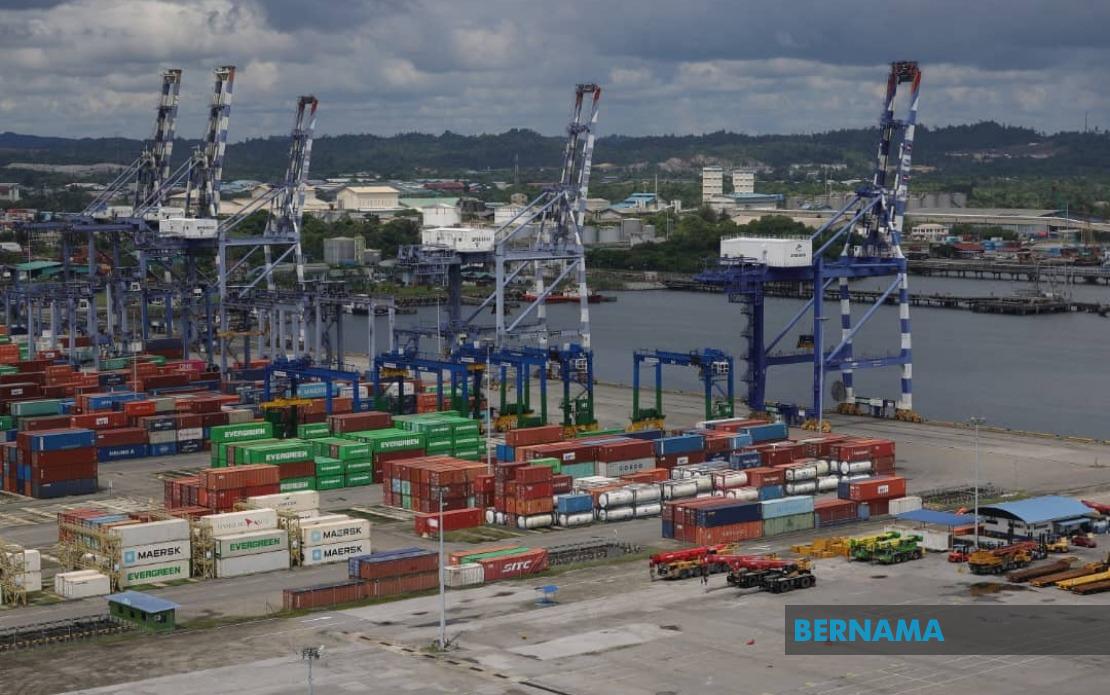
Malaysia's federal government has formally handed over regulatory control of Bintulu Port to the Sarawak state government, marking what officials describe as a landmark achievement in fulfilling the Malaysia Agreement 1963 (MA63). The transition, completed at a ceremony in Bintulu today attended by Prime Minister Datuk Seri Anwar Ibrahim and Sarawak Premier Tan Sri Abang Johari Tun Openg, converts the facility from a federal port to a state-administered one, reshaping governance structures that have defined the facility for decades.
The change signals a deliberate recalibration of the federal-state relationship enshrined in the 1963 agreement that brought Sabah and Sarawak into the Malaysian federation. Datuk Mustapha Sakmud, the Minister in the Prime Minister's Department responsible for Sabah and Sarawak affairs, framed the handover not as a retreat by federal authorities but as a recognition of constitutional rights that Sarawak has long claimed as a founding partner. This distinction matters considerably in the context of ongoing tensions between Kuala Lumpur and Sarawak over the scope and implementation of MA63 provisions.
Bintulu Port's evolution transcends mere administrative change. Once primarily known as the nation's liquefied natural gas export terminus, the facility is transitioning into a diversified industrial complex encompassing logistics operations, renewable energy infrastructure, and manufacturing capabilities. This repositioning reflects broader regional economic shifts, particularly the accelerating global transition toward decarbonised industries and clean energy supply chains. Sarawak's abundance of hydroelectric resources places the state in a strategically advantageous position to attract multinational enterprises seeking to reduce carbon footprints, a consideration increasingly influencing investment decisions across the Asia-Pacific region.
For Malaysian policymakers, the move carries implications extending well beyond Sarawak's borders. The successful devolution of port management to a state government sets a precedent that could influence similar discussions regarding resource management and economic control in other areas. It demonstrates that the federal structure can accommodate greater state autonomy without necessarily undermining national economic interests—a principle that becomes particularly relevant as Malaysia attempts to position itself competitively within regional supply chains and green energy markets.
The Bintulu facility's geographic positioning along Southeast Asia's strategic shipping lanes and its proximity to resource-rich areas make it increasingly valuable in the context of regional trade dynamics. Control over such infrastructure traditionally confers substantial economic and political leverage, and the transfer reflects calculations by federal leadership that Sarawak's stewardship may generate superior outcomes for both state and national economies. The presence of the Prime Minister at the handover ceremony underscored the political significance attached to the transition.
Mustapha's characterisation of the handover as demonstrating MA63's implementability through cooperation addresses a persistent narrative of contention. Sarawak has historically voiced grievances regarding what it perceives as federal overreach and inadequate recognition of its constitutional prerogatives. By framing this transfer as a cooperative achievement yielding mutual benefit, the federal government seeks to reset the tone of these discussions and establish momentum for addressing other outstanding MA63 provisions that remain contested or unresolved.
The economic dimension of this transition merits particular attention. Bintulu Port generates substantial revenue through LNG exports, petrochemical operations, and increasingly, diversified cargo handling. Sarawak's control over these revenue streams and port governance decisions enhances the state's fiscal autonomy and its capacity for independent economic planning. However, this autonomy also carries responsibilities regarding infrastructure maintenance, operational efficiency, and integration with broader national maritime and trade policies.
Regional observers, particularly in Indonesia and other ASEAN nations, are likely monitoring this development as an indicator of Malaysia's trajectory regarding federalism and devolution. The Southeast Asian region contains several federal systems with varying degrees of state autonomy, and Malaysia's experience implementing constitutional arrangements could inform discussions elsewhere about balancing centralisation and local governance.
The Bintulu transition also reflects Sarawak's positioning within Malaysia's broader energy strategy. As the nation grapples with decarbonisation pressures and seeks to transition away from carbon-intensive industries, Sarawak's renewable energy resources become increasingly strategically important. Port facilities capable of supporting green technology exports and clean energy-related manufacturing become nodes in the emerging low-carbon economy, making their governance arrangements consequential for national energy security and economic competitiveness.
For Malaysian businesses and investors, the shift introduces a new layer of complexity in port operations and administrative engagement. State-level port management may produce divergent policies, fee structures, and operational procedures compared to federal administration, requiring companies to navigate potentially different regulatory environments. The announcement suggests that Sarawak intends to leverage this autonomy to enhance the facility's competitiveness and attractiveness to investors pursuing sustainable operations.
The broader MA63 implementation agenda remains populated with unresolved issues, including disputes over oil royalties, immigration protocols, and representation in federal institutions. The Bintulu Port transfer represents movement on one front, but significant negotiations persist on numerous others. The success with which Sarawak manages this transferred responsibility may influence dynamics surrounding future MA63 discussions, as demonstrated competence in port administration could strengthen arguments for expanded state authority in other domains.
Looking forward, the transition's long-term implications will depend substantially on Sarawak's administrative capacity, investment decisions, and ability to position Bintulu as an attractive destination for green industries and high-value manufacturing. Success could validate arguments for further devolution and cooperative federalism, while difficulties might reverse momentum toward greater state autonomy. The coming years will likely determine whether this arrangement becomes a template for future federal-state cooperation or remains an isolated achievement.