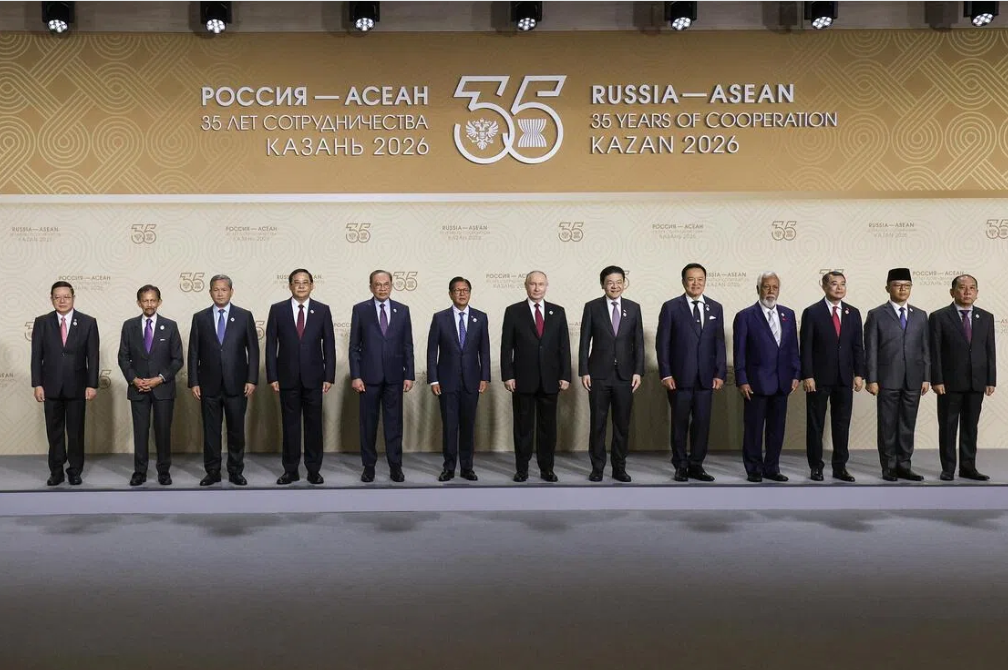
Asean and Russia have reaffirmed their commitment to strengthening bilateral ties through a series of landmark agreements concluded at the Asean-Russia Commemorative Summit held in Kazan on June 17 and 18. The gathering, hosted by Russian President Vladimir Putin, marked a significant diplomatic moment in Southeast Asian engagement with Moscow, commemorating three and a half decades of formal relations and thirty years of structured dialogue partnership between the region and the Eurasian power.
The summit produced three major policy documents designed to guide the relationship forward. The Kazan Declaration serves as a comprehensive review of bilateral progress over the past 35 years while establishing a roadmap for future engagement. The declaration emphasizes expanded cooperation across multiple sectors including maritime affairs, trade and investment, energy resources, infrastructure connectivity, security matters, educational initiatives, and cultural affairs. This broad sweep reflects the ambition of both sides to develop a multifaceted partnership extending well beyond traditional diplomatic channels.
Complementing these efforts, Asean and Russia adopted a Joint Statement on Cultural Cooperation that prioritises strengthening people-to-people connections and fostering deeper cultural exchanges. The symbolic importance of this document lies in its recognition that sustainable international relations rest upon foundations of mutual understanding and interpersonal networks. Additionally, the two sides unveiled the Asean-Russia Comprehensive Plan of Action spanning 2026 to 2030, which transforms these aspirational commitments into concrete operational guidance for government agencies and implementing institutions across both blocs.
Singapore's Prime Minister Lawrence Wong articulated a nuanced approach to the relationship, acknowledging that Asean and Russia possess distinct interests while emphasising areas where cooperation serves mutual advantage. Wong particularly highlighted initiatives that promote dialogue, build confidence, and contribute to regional peace and stability. His remarks underscored a sophisticated diplomatic balancing act, recognising Russia's role in Asean-led mechanisms such as the Asean Regional Forum and East Asia Summit while maintaining consistent principles regarding international law and dispute resolution.
The Prime Minister's statements carried particular significance given Singapore's well-documented position on major international conflicts. While emphasising the importance of dialogue and engagement despite disagreements, Wong reiterated Singapore's principled stance on Ukraine, framing it not as alignment with any particular bloc but as an unwavering commitment to the foundational principles of national sovereignty and territorial integrity enshrined in international law. He also welcomed recent developments in Middle Eastern diplomacy, specifically the peace agreement between the United States and Iran, expressing hope for permanent resolution of conflicts and the restoration of free navigation through critical international waterways including the Strait of Hormuz.
Practical cooperation mechanisms featured prominently in discussions between senior leaders. Asean and Russia identified disaster management and drug trafficking suppression as priority areas for joint action, recognising that these transnational challenges demand coordinated regional responses. Educational exchanges formed another cornerstone of the agenda, with Russian officials regularly participating in civil service training programmes across Asean member states, building institutional capacity and fostering professional networks that transcend political differences.
Wong emphasised that Asean's twin priorities of deepening internal integration while expanding external partnerships assume heightened relevance in an increasingly unpredictable geopolitical environment. This framing reflects Southeast Asian anxieties about great power competition and regional instability. The Prime Minister stressed that upholding international law and the rules-based global order becomes more critical precisely when international relations grow more volatile and strategic uncertainty increases. For maritime nations like Singapore and other Asean members, this principle extends to protecting unimpeded transit rights through key shipping lanes in accordance with the United Nations Convention on the Law of the Sea, a matter of existential economic and strategic importance.
The bilateral meetings between Wong and Putin, held at Russia's request, provided opportunities for candid discussions on regional and international developments. Wong's engagement with Russian leadership demonstrated Singapore's pragmatic approach to diplomacy, recognising that maintaining channels of communication and cooperation with all major powers serves the broader interest of regional stability. His subsequent bilateral meeting with Rustam Minnikhanov, the Rais of the Republic of Tatarstan, reflected continuity in relationships established through historical high-level visits, including the 2007 visit by Lee Kuan Yew to the region. These discussions encompassed cultural, educational, and people-to-people dimensions of cooperation between Singapore and Tatarstan.
Looking ahead, Wong expressed optimism about future engagement, particularly anticipating Russia's participation in the Asean Regional Forum and East Asia Summit scheduled for the Philippines later in 2024, and welcoming Russia's continued support during Singapore's assumption of the Asean rotational chairmanship in 2027. This forward-looking perspective suggests that despite profound differences on certain international issues, particularly regarding Ukraine where Singapore imposed sanctions and restrictions on Russia in 2022, the pragmatic recognition of shared interests and the value of sustained dialogue remains operative in Asean-Russia relations.
The summit outcomes reflect a broader Southeast Asian strategy of maintaining relationships with all major powers while advancing region-specific interests through structured mechanisms. Asean's traditional emphasis on non-interference, consensus-building, and engagement rather than confrontation provides a framework within which even geopolitically divergent powers can cooperate on concrete issues. The five-year Comprehensive Plan of Action operationalises this approach, converting ambitious declarations into specific cooperative projects and institutional arrangements. For Malaysia and other Asean members, the summit demonstrated that regional organisations can accommodate different perspectives on international conflicts while advancing pragmatic collaboration on maritime safety, economic development, disaster response, and people-to-people connections that benefit all participants.
The reaffirmation of commitment to Asean Centrality proved particularly significant, with Russian officials acknowledging their support for Southeast Asia's desire to maintain strategic autonomy and shape regional architecture. This principle has gained salience as Asean nations seek to navigate great power competition without becoming subordinate to any single external actor. The Kazan summit outcomes suggest that Russia, despite its current international isolation on certain matters, remains invested in maintaining meaningful engagement with Southeast Asia through established dialogue mechanisms and new cooperative frameworks. The diplomatic exercise itself, regardless of immediate practical outcomes, affirms the continuing relevance of Asean as a significant actor in international relations and the value of patient, sustained engagement across ideological and strategic differences.