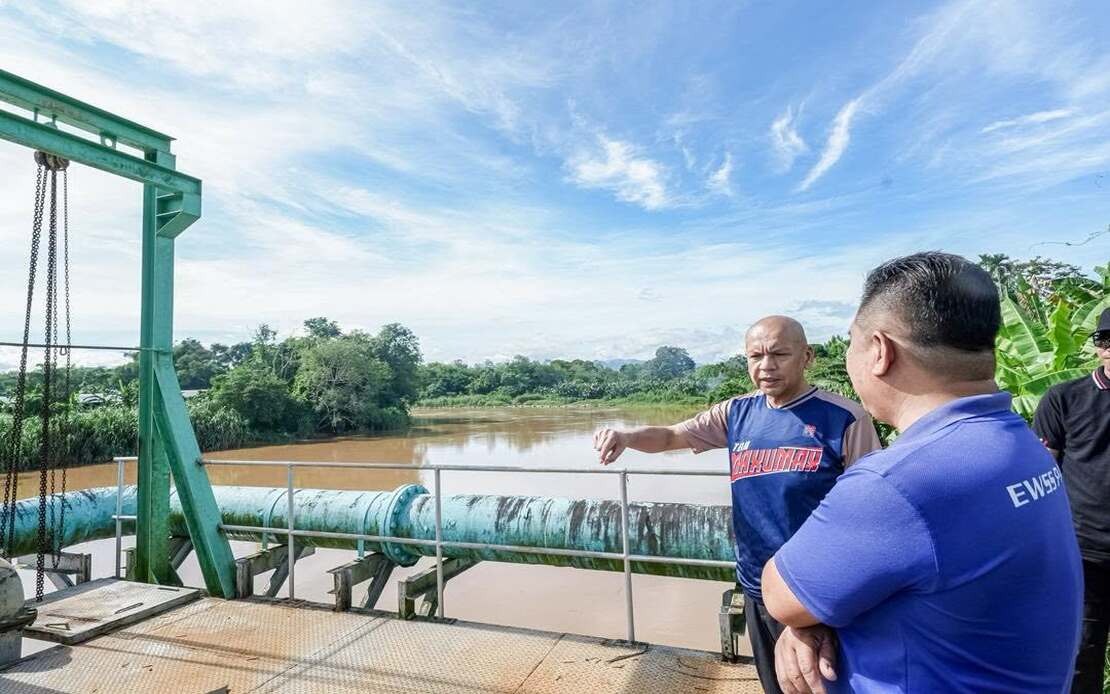
Datuk Armizan Mohd Ali, the Domestic Trade and Cost of Living Minister and Member of Parliament for Papar, conducted an on-site inspection of water infrastructure projects in the district this week to assess progress and ensure initiatives remain on track to resolve persistent supply challenges facing residents. The visit follows a coordination meeting held on June 15 where officials presented updates on multiple water stabilization efforts designed to bolster the reliability of Papar's water distribution network.
Two major infrastructure undertakings currently dominate the district's water development agenda. The Kogopon Water Treatment Plant is undergoing a significant capacity upgrade that will nearly double its output from 40 million litres per day to 80 million litres per day, while simultaneously, improvements to the Kampung Kabang intake system are advancing to enhance water sourcing capabilities. These parallel projects represent a deliberate strategy to address mounting pressure on Papar's water systems as the region experiences steady growth in consumer demand.
The timing of Armizan's inspection highlights growing concerns about water quality issues that have recently disrupted operations at two critical treatment facilities. Both the EWSS Plant and JETAMA Limbahau Plant experienced forced shutdowns during the previous week due to elevated nephelometric turbidity unit (NTU) readings in their raw water supplies. High turbidity values, which indicate suspended particles and sediment content, can compromise treatment effectiveness and potentially threaten water safety, forcing plant operators to halt processing until incoming water quality improves to acceptable treatment standards.
The turbidity complications underscore a recurring operational headache for Papar's water authorities. When raw water entering treatment facilities becomes too cloudy or sediment-laden, existing filtration and purification processes may prove insufficient, necessitating temporary plant closure until natural conditions improve or upstream interventions reduce sediment loading. This reactive posture places supply reliability at the mercy of weather patterns and hydrological conditions, making infrastructure resilience a critical concern for consumers dependent on consistent water access.
Armizan emphasized that physical site visits and direct observation remain essential components of effective project management and problem-solving in water infrastructure. Rather than relying solely on written reports or remote assessments, hands-on evaluation enables decision-makers to identify operational bottlenecks, understand practical constraints that technical documentation might obscure, and formulate pragmatic solutions grounded in field reality rather than theoretical models.
The minister's inspection strategy reflects a broader approach increasingly adopted by Malaysian policymakers managing essential services—embedding oversight directly within project environments rather than maintaining distance from implementation challenges. This methodology proves particularly valuable in the water sector, where technical complexity combines with geographic variation and weather dependency to create unpredictable operational dynamics.
Parap's water challenges resonate across Sabah and parts of Peninsular Malaysia where similar supply pressures exist. Districts experiencing rapid residential or commercial development frequently discover that water infrastructure struggles to keep pace with consumption growth, creating periodic shortages and supply interruptions that frustrate consumers and strain government credibility. The Papar projects therefore carry implications beyond the district itself, demonstrating how state and federal authorities coordinate responses to infrastructure deficiencies.
The capacity doubling at Kogopon represents a significant capital investment reflecting recognition that existing systems require substantial enhancement rather than incremental improvement. Such expansion projects typically require 18-36 months for completion, meaning Papar residents should anticipate continued supply constraints until the upgraded facility commences full operations. During this transition period, effective management of existing assets and prompt resolution of operational disruptions becomes even more critical.
Turbidity management presents a particularly vexing challenge because it often originates upstream in water sources beyond direct treatment plant control. Sedimentation in rivers and reservoirs during heavy rainfall or due to land erosion can suddenly degrade raw water quality regardless of treatment facility preparedness. Addressing this requires coordination with environmental and land management authorities to reduce sediment generation through soil conservation, vegetation protection, and watershed management—interventions that operate on longer timelines than immediate water treatment responses.
The visit signals that federal and state authorities recognize Papar's water situation as requiring sustained attention rather than episodic intervention. Armizan's status review, conducted following a ministerial meeting merely four days prior, suggests recognition that multiple stakeholders need alignment on implementation timelines, budget allocation, and responsibility delineation to prevent projects from stalling. In Malaysian infrastructure delivery, such high-level monitoring often correlates with improved project momentum and reduced bureaucratic delays.
Looking forward, Papar's path toward water security appears contingent on three simultaneous achievements: completing the Kogopon and Kampung Kabang upgrades on schedule, stabilizing raw water quality to reduce operational disruptions, and implementing longer-term watershed management to prevent future turbidity crises. The minister's engagement suggests political will exists at the federal level to support these objectives, though successful execution ultimately depends on sustained funding, technical expertise, and coordination across multiple government departments and commercial water operators.