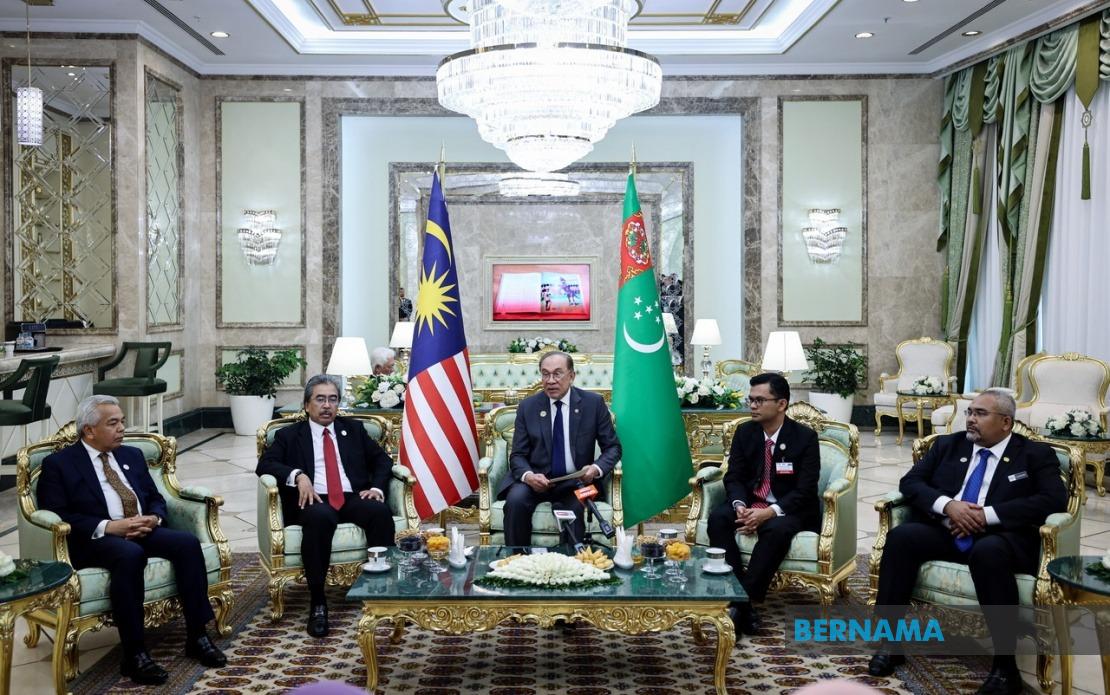
Prime Minister Datuk Seri Anwar Ibrahim has characterised his official working visit to Turkmenistan as a successful engagement that has solidified friendly relations and expanded strategic cooperation between Malaysia and the Central Asian nation. The two-day mission, which commenced on June 18, marks the first time Anwar has visited Turkmenistan in an official capacity since assuming office as Malaysia's 10th prime minister in November 2022, arriving at the formal invitation of Turkmenistan's President Serdar Berdimuhamedov.
In a Facebook statement released on June 19, Anwar emphasized that the visit had realised its fundamental objectives, particularly in establishing a firmer foundation for bilateral engagement across multiple sectors. He underscored the strategic importance of exploring opportunities within the energy domain, where both nations possess complementary interests and untapped collaborative potential that could yield significant benefits for their respective economies and populations.
The energy sector represents a natural focal point for Malaysia-Turkmenistan cooperation, given Turkmenistan's substantial reserves of oil and natural gas and Malaysia's established expertise in petrochemical refining, liquefied natural gas processing, and energy infrastructure. For Malaysian readers, this development carries relevance as it positions domestic energy companies, particularly national oil corporation PETRONAS, to access new supply sources and strengthen regional energy security amid global market volatility. The visit signals Kuala Lumpur's commitment to diversifying energy partnerships beyond traditional Middle Eastern suppliers, a prudent strategy as geopolitical uncertainties continue to reshape global commodity flows.
Anwar's delegation reflected the multi-sectoral nature of the engagement, comprising economic and trade decision-makers alongside senior government officials. Minister of Investment, Trade and Industry Datuk Seri Johari Abdul Ghani and Minister of Economy Akmal Nasrullah Mohd Nasir both travelled with the Prime Minister, indicating that the discussions extended beyond ceremonial exchanges to encompass tangible commercial and investment frameworks. The inclusion of PETRONAS representatives among the travelling party further underscores the centrality of energy partnerships to Malaysia's strategic calculus in engaging Turkmenistan.
In his remarks, Anwar extended gratitude to President Berdimuhamedov for the reception extended to the Malaysian delegation, acknowledging the warm diplomatic welcome that characterised official proceedings. Such courtesies, whilst often ceremonial in nature, carry substantive meaning within bilateral relations as they establish the interpersonal rapport necessary for sustained high-level engagement and demonstrate mutual political will to advance shared interests.
The Prime Minister also commended the collaborative efforts of multiple Malaysian institutions that facilitated the visit's execution. The Ministry of Foreign Affairs, the Malaysian Embassy in Ashgabat, PETRONAS representatives, security details, and accompanying media personnel all contributed to ensuring the logistical and diplomatic success of the engagement. This acknowledgment reflects the whole-of-government approach increasingly common in contemporary statecraft, wherein multiple agencies coordinate to maximise the effectiveness of high-level diplomatic missions.
Turkmenistan's strategic location along the historic Silk Road corridor, coupled with its substantial hydrocarbon reserves, has long positioned it as a significant actor in Central Asian geopolitics and regional energy markets. For Malaysia, establishing strengthened relations with Turkmenistan opens potential avenues for trade expansion, investment opportunities, and enhanced diplomatic influence within Central Asian forums. Southeast Asian nations have historically maintained limited formal engagement with Central Asia, leaving considerable room for expanding mutually beneficial partnerships that could enhance Malaysia's global diplomatic footprint.
The characterization of this visit as having opened a new chapter in bilateral cooperation suggests that previous engagements between the two countries may have been limited or intermittent. By framing the visit as initiating a fresh phase of relationship-building, Malaysian leadership signals its intention to move beyond episodic diplomatic contact toward sustained institutional engagement. This could eventually encompass regular high-level exchanges, sectoral working groups, and perhaps trade agreements formalising commercial frameworks between Malaysian and Turkmenistani enterprises.
The visit also carries implications for Malaysia's positioning within broader regional and global frameworks. As Malaysia continues repositioning itself as a middle power with significant economic and diplomatic influence, engagement with resource-rich nations outside its traditional geographic orbit demonstrates strategic diversification. Such outreach complements Kuala Lumpur's existing commitments to ASEAN, its partnerships within the Indo-Pacific region, and its historical ties to the Muslim-majority world, presenting Malaysia as a bridge-builder capable of facilitating dialogue across diverse geopolitical constituencies.
Moving forward, the success of this inaugural visit will likely be measured not merely by the diplomatic statements exchanged but by the tangible outcomes that materialise in subsequent months and years. Whether formal bilateral agreements emerge, whether energy supply contracts advance toward implementation, and whether regular high-level visits continue will determine whether this engagement evolves into a substantive strategic partnership or remains a notable but ultimately isolated diplomatic gesture. Malaysian stakeholders, particularly in the energy and investment sectors, will closely monitor developments emanating from the discussions held during this visit.