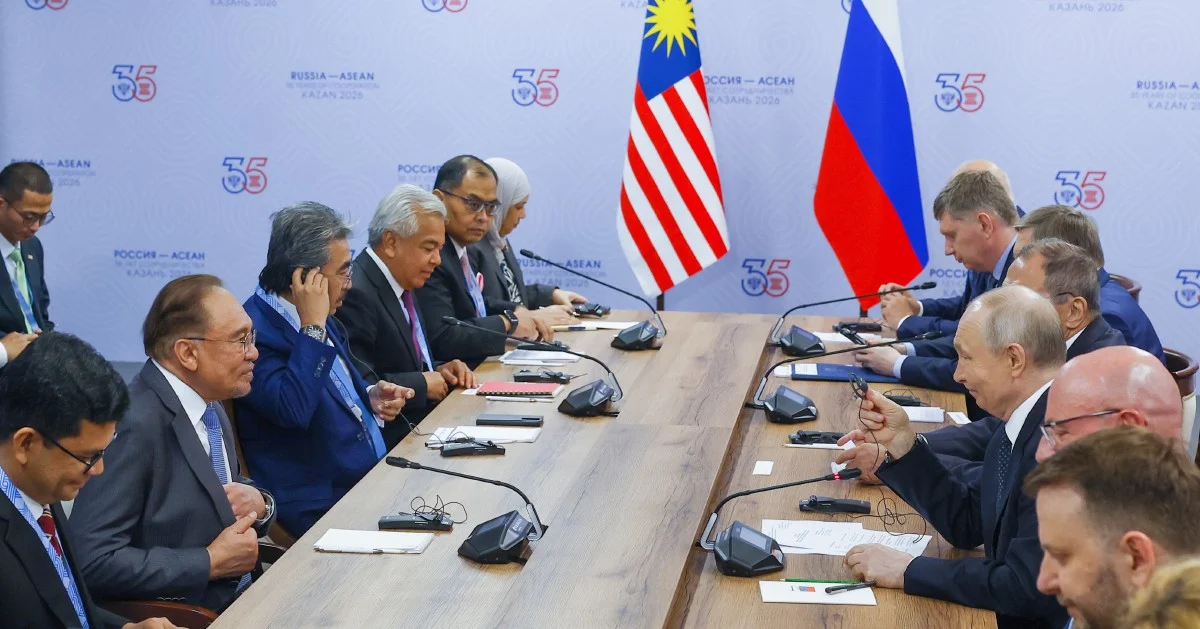
Prime Minister Datuk Seri Anwar Ibrahim conveyed his appreciation to Russian President Vladimir Putin during talks in Kazan for backing Malaysia's efforts to expand energy sector cooperation, with particular emphasis on strengthening partnerships involving Petroliam Nasional Bhd, the country's national oil and gas corporation. The exchange underscores Malaysia's strategic pivot toward broadening its energy relationships beyond traditional Western partners and deepening ties with major global energy producers in Asia and beyond.
The acknowledgement of Russian support reflects a broader diplomatic realignment within Malaysia's energy policy framework. Petronas, which operates as a global integrated energy company and serves as a critical revenue pillar for the Malaysian government, stands to benefit from enhanced collaboration opportunities with Russian counterparts. Such partnerships could span exploration and production ventures, liquefied natural gas projects, and technology transfer arrangements that would strengthen Malaysia's hydrocarbon capabilities in an increasingly competitive global energy marketplace.
Russia's endorsement of these energy initiatives carries significance beyond immediate commercial transactions. As one of the world's leading energy exporters, Russia's backing provides diplomatic credibility to Malaysia's energy ambitions and signals willingness among major energy-producing nations to cooperate with Southeast Asian players. This positioning allows Malaysia to leverage its geographical location in one of the world's busiest shipping lanes and its established expertise in petroleum engineering and project management to attract additional international investment and collaboration.
For Petronas specifically, expanding cooperation with Russian entities could accelerate access to advanced exploration technologies and operational expertise, particularly in challenging offshore environments and deep-water drilling operations where Russian companies have demonstrated considerable competence. Additionally, collaboration on downstream operations and petrochemical developments could create new value streams for the corporation and supporting Malaysian industries, potentially generating employment and economic growth across the energy supply chain.
The Kazan meeting context adds weight to these discussions. The Russian city, located in the Volga region and traditionally an important hub for Russia's energy sector operations, suggests deliberate choices about venue and framing for these bilateral conversations. Meeting in Russia's energy heartland rather than in neutral territory underscores Malaysia's seriousness in pursuing substantive energy partnerships with Moscow rather than merely exchanging courtesies.
From a broader Southeast Asian perspective, Malaysia's active engagement with Russia on energy matters reflects the region's growing economic interdependence with multiple global powers. As countries throughout Southeast Asia seek to diversify their energy sources and supplier relationships, Malaysia's diplomatic efforts to engage with Russia, China, and other global energy producers offer a template for balancing geopolitical interests while pursuing concrete economic benefits. This multipolar approach to energy diplomacy has become increasingly important as regional nations navigate between major power competition and the need for stable, affordable energy supplies.
The timing of these expressions of appreciation also matters in Malaysia's broader foreign policy context. As the country works to maintain stable relations with multiple international actors while pursuing its own development agenda, demonstrating substantive cooperation in strategic sectors like energy reinforces Malaysia's status as a pragmatic partner willing to engage with various global powers on mutually beneficial terms. Energy cooperation, by its very nature, creates lasting interdependencies that extend beyond single transactions and build sustained diplomatic relationships.
Petronas itself operates in numerous countries and has built a reputation for operational excellence in complex environments. Russian collaboration could enhance the corporation's competitive positioning in Arctic and sub-Arctic resource development, areas where Russian companies possess unique expertise and where global energy demand continues to evolve. As the world energy landscape transforms with renewable energy transitions occurring globally, partnerships between Petronas and Russian counterparts could also explore joint ventures in hydrocarbon-based derivatives and specialty products where traditional fossil fuel expertise translates into long-term market demand.
The emphasis on energy cooperation also reflects practical realities of Malaysia's economy. As a significant petroleum and natural gas exporter, Malaysia maintains strong institutional interests in ensuring robust energy markets and secure international partnerships. Petronas contributes substantially to government revenues and foreign exchange earnings, making energy sector expansion a matter of significant national economic importance. Putin's public backing, therefore, carries real implications for investment certainty and business confidence in energy sector development.
For Malaysian policymakers, securing commitments from leading global energy producers like Russia helps ensure that the country remains competitive in attracting international capital and technical expertise to its energy projects. With global energy markets increasingly influenced by geopolitical considerations, having publicly acknowledged support from major energy producers enhances Malaysia's negotiating position in future energy agreements and projects.
Looking forward, the nature of this cooperation will likely evolve across multiple dimensions. Beyond traditional oil and gas collaboration, partnerships may extend into renewable energy infrastructure development, where Russian technological capabilities in nuclear and hydroelectric sectors could complement Malaysia's tropical climate advantages for solar and wind energy development. Such diversified cooperation would position both nations to benefit from global energy transition trends while maintaining their core hydrocarbon interests.