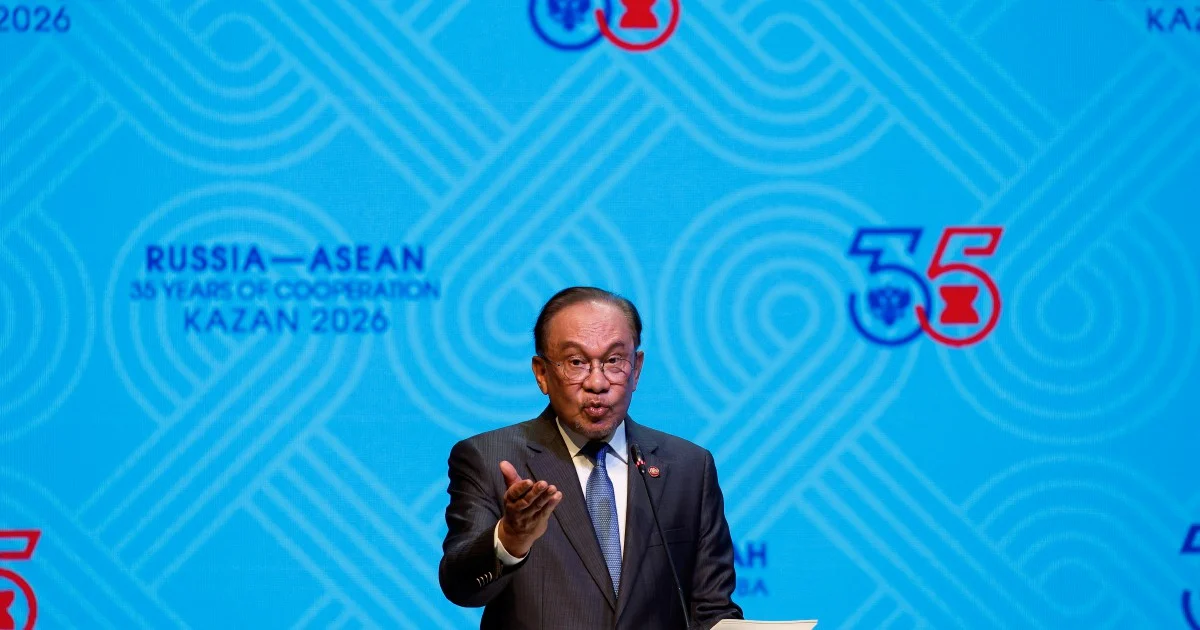
Prime Minister Datuk Seri Anwar Ibrahim has hailed the completion of the Asean-Russia Strategic Programme on Trade and Investment Cooperation 2026-2035 as a meaningful advancement for the region's economic trajectory. Speaking in Kazan, Anwar characterised the finalised framework as an important catalyst for deepening commerce and investment partnerships between the ten-member Association of Southeast Asian Nations and Russia over the next decade. However, his remarks underscored a critical distinction: the existence of a strategic blueprint, while necessary, remains insufficient without the establishment of practical conditions that allow such aspirations to translate into tangible outcomes.
The timing of this agreement carries particular significance for Southeast Asia, a region increasingly focused on economic resilience and diversification. Over the past several years, Asean nations have sought to strengthen ties with major economies beyond traditional Western partners, recognising that a balanced approach to international commerce serves their collective interests. Russia, despite international sanctions and geopolitical tensions, remains an important supplier of energy resources and a potential market for regional products. The strategic programme thus represents an attempt by Asean to maintain pragmatic economic relationships across a complex global landscape.
Anwar's emphasis on the need for an "enabling environment" reflects experienced understanding of why trade frameworks frequently fall short of their potential. Historical precedent within Southeast Asia demonstrates that bilateral and multilateral trade agreements often struggle during implementation phases. Bureaucratic obstacles, regulatory inconsistencies between nations, insufficient infrastructure for cross-border commerce, and fluctuating geopolitical circumstances can all impede the realisation of negotiated targets. The Prime Minister's acknowledgment of this gap suggests Malaysia, which holds considerable influence within Asean forums, will advocate for practical measures to support the framework's execution.
For Malaysia specifically, improved Asean-Russia cooperation could offer meaningful benefits. The country's manufacturing sector might find expanded export opportunities in the Russian market, particularly in electronics, palm products, and processed foods. Conversely, Malaysia's heavy dependence on energy imports could see modest diversification if Russian suppliers become more competitive and reliable partners. The framework's success would also reinforce Malaysia's positioning as a key bridge between diverse economic blocs—a role that has become increasingly central to the nation's strategic foreign policy.
The investment component of the strategic programme deserves particular attention. Russian capital has historically been concentrated in specific sectors such as energy and resources, yet the 2026-2035 framework appears designed to encourage broader economic engagement. This could potentially include technology transfer, infrastructure development, and joint ventures in emerging industries. However, investment flows depend heavily on investor confidence, which is fragile when international relations remain uncertain and sanctions regimes create complications for cross-border financial transactions.
Anwar's measured optimism reflects the delicate balancing act required in contemporary Asean diplomacy. Southeast Asian nations collectively seek to maintain productive relationships with all major powers, including Russia, while also respecting international norms and managing relationships with Western nations that remain crucial trading partners. The explicit framing of the trade roadmap as merely a starting point rather than a guaranteed success demonstrates diplomatic realism—it acknowledges that good intentions and signed agreements cannot guarantee outcomes without sustained commitment and favourable external circumstances.
The broader context includes Asean's ongoing effort to position itself as a central node in regional geopolitics and economics. The bloc has pursued dialogues with Russia through mechanisms such as the East Asia Summit and Asean Regional Forum, viewing engagement rather than isolation as the path to maintaining regional stability. A functioning trade programme with Russia could contribute to this objective, provided implementation does not create friction with Asean's other major partners, particularly China, Japan, South Korea, the United States, and the European Union.
Infrastructure development emerges as a critical enabler that Asean and Russia must address collaboratively. Ports, transportation networks, and logistics systems in Southeast Asia and across routes to Russia require substantial investment and modernisation. The strategic programme's success will depend partly on whether both sides commit resources to removing physical and logistical barriers to trade. Malaysia, as a nation with significant port infrastructure and established trading networks, could serve as a natural hub facilitating broader Asean-Russia commerce.
Anwar's statement also carries implications for Malaysia's broader economic strategy. The country has pursued increasingly active engagement with major powers, seeking to leverage its geographic position and established trade relationships. A successful Asean-Russia trade framework would add another layer to Malaysia's international economic architecture, reducing dependency on any single region and enhancing the nation's ability to negotiate advantageous terms with all partners. This approach aligns with Malaysia's stated objective of becoming a high-income nation by carefully managing its global relationships.
Looking forward, the true test of the strategic programme lies not in its signing but in the subsequent years of implementation. Anwar's caution reflects this reality—frameworks are merely documents until governments, businesses, and financial institutions actively engage with their provisions. The next phase will require both Asean and Russia to demonstrate political will through concrete policies, regulatory reforms, and investment decisions that translate the 2026-2035 roadmap from aspirational text into functioning economic partnership.


