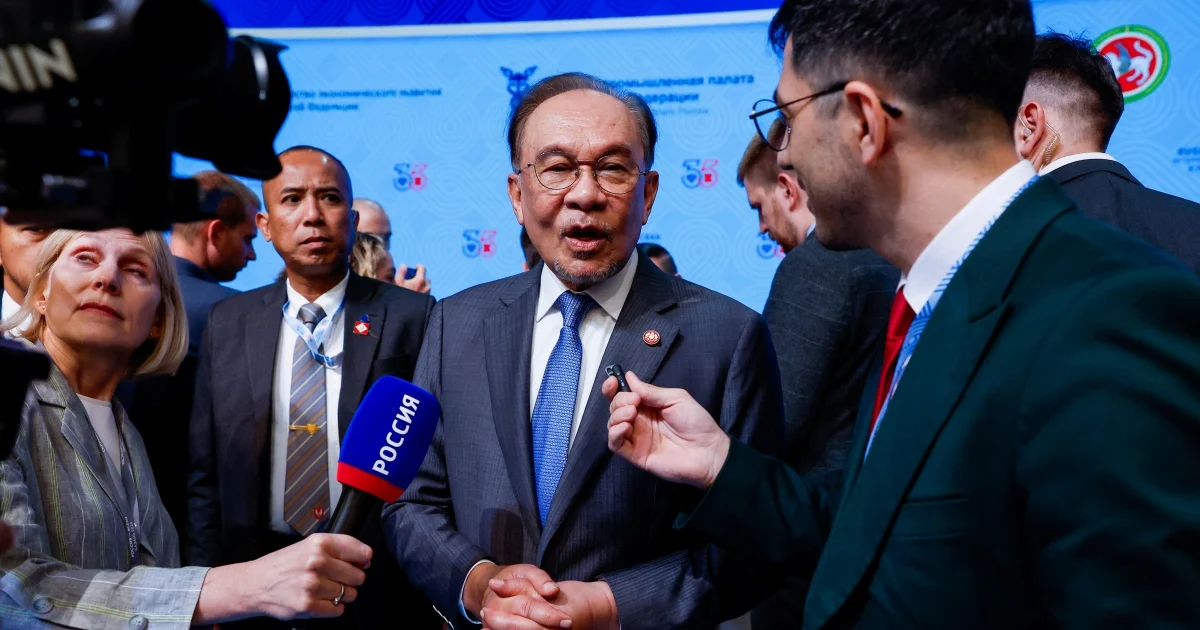
Prime Minister Datuk Seri Anwar Ibrahim has put a personal face on Malaysia's diplomatic outreach by disclosing his appreciation for Russian cultural contributions, particularly music and literature, during remarks in Kazan. His comments underscore a strategic pivot towards broadening the nation's engagement with Russia beyond the conventional framework of trade and investment, positioning cultural understanding as a cornerstone of bilateral friendship.
Anwar's candid acknowledgment of his affinity for Russian artistic traditions reflects a growing recognition within Malaysian leadership circles that soft power and people-to-people connections play vital roles in contemporary international relations. By publicly articulating these cultural preferences, the Prime Minister signals that Malaysia's diplomatic engagement is grounded not merely in transactional economic interests but in genuine appreciation for the diverse civilisations with which the nation interacts. This approach carries particular significance in Southeast Asia, where cultural diplomacy has historically served as a bridge during periods of geopolitical tension.
The remarks made in Kazan, a major cultural and economic hub in Russia's Volga region, demonstrate Anwar's understanding of the symbolic power embedded in such personal revelations. Rather than limiting the conversation to bilateral trade figures or investment protocols, the Prime Minister's focus on shared cultural heritage creates space for authentic dialogue that transcends immediate commercial considerations. Russian literature, in particular, has long exercised considerable intellectual influence across the global south, and Malaysia's historical engagement with Russian cultural products positions the nation advantageously for deepening these connections.
Anwar's emphasis that cultural exchanges carry comparable weight to economic cooperation represents a deliberate recalibration of Malaysia's diplomatic messaging. In an era when nations increasingly compete for soft power and cultural influence, positioning Malaysia as a nation that values artistic expression and intellectual traditions elevates the country's standing among global audiences. For Malaysian readers and observers, this signals that their Prime Minister views national development through a lens that encompasses not just material prosperity but also cultural enrichment and civilisational dialogue.
The timing of these comments merits consideration within the broader context of Malaysia-Russia relations, which have traditionally centred on defence, trade, and energy cooperation. By introducing cultural dimensions to this relationship, Anwar broadens the base of mutual understanding and creates multiple channels through which the two nations can strengthen their bonds. This multi-faceted approach potentially creates resilience within the bilateral relationship, ensuring that fluctuations in economic conditions or geopolitical circumstances need not destabilise the overall partnership.
Russian literature's global resonance—from Tolstoy and Dostoevsky to contemporary authors—has made it an accessible entry point for cross-cultural engagement. The Prime Minister's willingness to publicly acknowledge his personal reading interests and musical preferences humanises his diplomatic persona while simultaneously validating Russia's cultural contributions on a global stage. For Malaysian audiences, such gestures reinforce the idea that their country's leadership is intellectually engaged and culturally literate, qualities increasingly valued in an interconnected world.
The distinction Anwar draws between economic and cultural cooperation also reflects evolving thinking about what constitutes meaningful national development. While economic metrics remain important, the Prime Minister's framing suggests recognition that societies seeking genuine partnership must build relationships at multiple levels simultaneously. Cultural exchanges—whether through music, literature, film, or academic collaboration—create enduring foundations that survive political disagreements or market downturns. This perspective aligns with broader Southeast Asian traditions that have historically valued harmony and mutual respect across diverse cultural contexts.
For Malaysia's diplomatic corps and cultural institutions, Anwar's pronouncements carry practical implications. Official support for cultural programming related to Russia, expansion of academic exchanges, and translation initiatives targeting Russian literature may well receive renewed emphasis. Such developments could position Malaysia as a regional hub for Russian cultural engagement in Southeast Asia, an outcome that would enhance both the nation's soft power and its economic prospects through cultural tourism and creative industries.
The Prime Minister's personal engagement with Russian arts also sends a message to Malaysia's own creative communities about the importance of accessing and engaging with global cultural traditions. In an age of rapid globalisation, the ability to appreciate and interpret cultural products from distant civilisations represents a form of intellectual capital that enriches national discourse and broadens individual horizons. By modelling this openness at the highest political level, Anwar implicitly encourages similar curiosity throughout Malaysian society.
Looking forward, the normalisation of cultural diplomacy as a component of Malaysia's foreign policy engagement—rather than as an afterthought or decorative element—could reshape how the nation approaches its international relationships more broadly. This framework proves particularly valuable in contexts where deep historical or ideological differences exist, as cultural dialogue provides channels for mutual understanding that circumvent more contentious political conversations. For Malaysia navigating complex regional and global dynamics, this represents both a practical tool and a philosophical commitment to inclusive and multifaceted engagement.
Anwar's articulation of appreciation for Russian cultural traditions, grounded in his personal scholarly interests, ultimately reinforces a vision of Malaysia as an intellectually engaged nation open to learning from and collaborating with diverse civilisations. In positioning cultural exchange as coequal with economic cooperation, the Prime Minister articulates a development philosophy that refuses to reduce nations to their trading value or investment potential, instead recognising the intrinsic worth of shared human cultural expression.