Prime Minister Datuk Seri Anwar Ibrahim has publicly commended Russian President Vladimir Putin and Chinese President Xi Jinping for championing peace initiatives and condemning violence against civilians across Gaza, Iran and Lebanon. Speaking during an exclusive interview with Russian state television network RT in Kazan, Anwar articulated Malaysia's distinctive diplomatic positioning on the escalating Middle Eastern crises, underscoring his administration's determination to chart an independent course regardless of pressure from global superpowers.
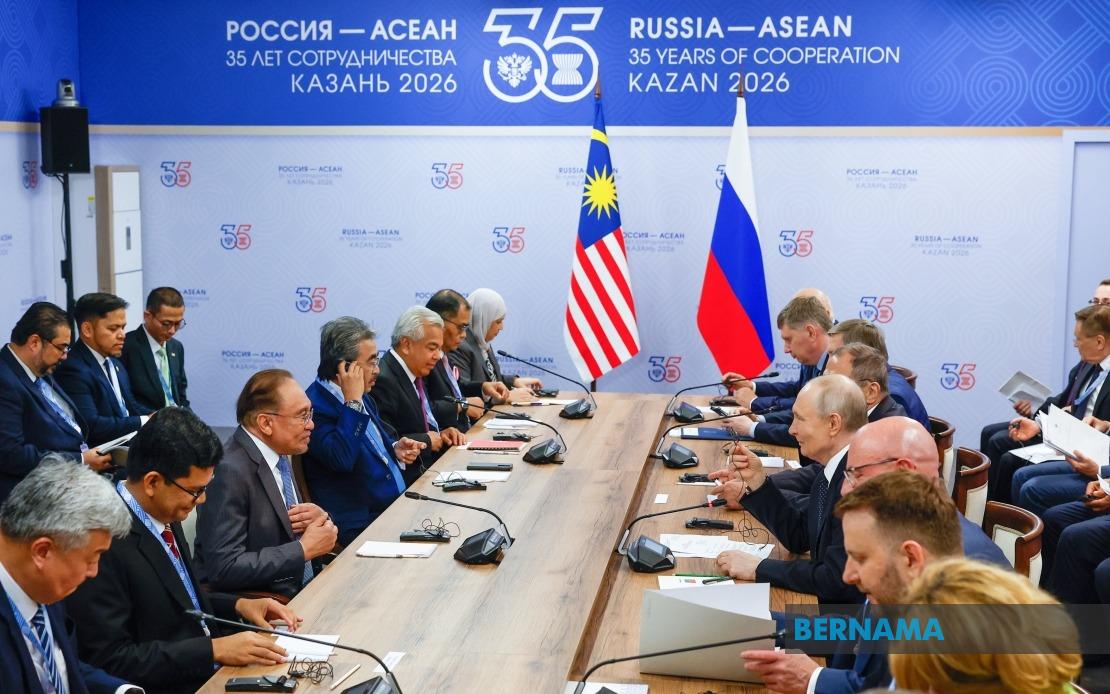
The remarks came as Anwar attended a commemorative summit in Kazan marking 35 years of formal diplomatic relations between ASEAN and Russia. This venue provided a significant platform for the Prime Minister to articulate Malaysia's nuanced approach to international affairs during a period of intensifying geopolitical fragmentation. His statements reflected a broader effort to position Malaysia as an honest broker capable of engaging meaningfully with multiple power centres without compromising its foundational principles on human rights and international law.
Anwar detailed how Malaysia has maintained consistently firm positions against what he termed attacks by the "Zionist regime," emphasising that this stance draws strength from parliamentary consensus rather than executive decree alone. He highlighted that Malaysia pursued a bipartisan approach within Parliament to address Middle Eastern developments, demonstrating that concern for regional peace and civilian protection transcends domestic political divisions. This parliamentary dimension carries particular significance for Malaysian audiences, as it suggests serious institutional deliberation on foreign policy matters affecting millions of people across Southeast Asia and beyond.
A central theme of Anwar's commentary involved distinguishing Malaysia's foreign policy philosophy from conventional interpretations of neutrality. He explained that ASEAN and Malaysia consciously reject the terminology of neutrality, instead embracing what he calls "centrality"—a framework that permits principled positions on humanitarian concerns without requiring alignment with any particular superpower bloc. This distinction carries profound implications for how Southeast Asian nations navigate the increasingly polarised global order, offering an alternative to the false binary of choosing sides between Washington and Beijing.
Anwar's framing of centrality as incompatible with silence on atrocities represents an effort to rebrand Malaysia's international engagement from passive non-alignment toward active moral positioning. He contended that Malaysia could simultaneously avoid ideological subordination to major powers whilst maintaining unwavering opposition to violations of human rights and targeted assaults on civilian populations. This approach attempts to resolve the tension that many developing nations face when trying to preserve strategic autonomy whilst responding to humanitarian imperatives.
The Prime Minister emphasised that Malaysia had conducted extensive diplomatic outreach across multiple regional actors, including leaders from Gulf states, Pakistan, Turkey and Iran. These engagement efforts reflected Malaysia's conviction that durable regional stability could only emerge through inclusive dialogue incorporating diverse perspectives rather than through great power dictates. His willingness to engage directly with Iranian leadership, despite potential complications with certain Western allies, underscores Malaysia's commitment to genuine centrality rather than selective principle application.
Anwar launched pointed criticism at what he characterised as Western hypocrisy regarding Israeli actions and American support for Israeli military operations. He questioned how the international community could simultaneously espouse democratic values and humanitarian norms while tolerating what he described as the subjugation of independent nations. His rhetorical challenge exposed the contradictions he perceived between stated Western principles and actual geopolitical conduct, a critique that resonates broadly across the Global South.
Particularly significant was Anwar's assertion that international responses to aggression against Iran demonstrate dangerous double standards within the global order. He observed that whilst some commentators scrutinise Iranian responses to provocations, the underlying aggression targeting Iran receives minimal international censure or commentary. This asymmetry in global attention and accountability, Anwar suggested, reflected deeper structural problems within international relations frameworks that privilege certain actors over others.
The Prime Minister's position on Gaza specifically highlighted Malaysia's long-standing commitment to Palestinian self-determination and civilian protection. Rather than employing abstract humanitarian language, Anwar framed Malaysian concern for Gaza residents as flowing naturally from Malaysia's foundational principles regarding national sovereignty and protection of civilian populations. This grounding in fundamental values rather than temporary geopolitical calculations lends consistency to Malaysia's Middle Eastern positions across multiple administrations.
Anwar acknowledged the genuine difficulty of maintaining independent positions whilst navigating intricate relationships with influential global actors. He nevertheless insisted that Malaysia would persist in articulating principled positions on conflicts affecting populations across West Asia, viewing such consistency as essential to Malaysia's credibility within both Southeast Asia and the broader developing world. His statements suggested that foreign policy independence, whilst demanding, remained achievable for mid-sized powers willing to accept diplomatic complexity and potential friction with powerful states.
The broader implications of Anwar's remarks extend beyond Malaysian domestic politics to encompass Southeast Asia's collective positioning within an increasingly multipolar yet fractious international system. By publicly praising Russian and Chinese leaders whilst simultaneously criticising Western conduct, Anwar demonstrated that ASEAN nations could maintain substantive relationships with multiple centres of power without endorsing any single great power's complete worldview. This balancing act, whilst delicate, offers Southeast Asian societies possibilities for preserving strategic manoeuvre that purely ideological alignment would foreclose.
Anwar's emphasis on parliamentary involvement in foreign policy decisions carries additional weight given regional trends toward executive dominance in diplomatic matters. His invocation of bipartisan parliamentary consensus on Middle Eastern issues suggests that Malaysian decision-making on international affairs benefits from broader institutional participation, potentially strengthening both the legitimacy and durability of chosen diplomatic courses. For other Southeast Asian democracies grappling with foreign policy challenges, Anwar's model offers lessons regarding the value of institutional pluralism in international engagement.
Ultimately, Anwar's Kazan remarks represent a sophisticated articulation of how smaller nations can exercise meaningful agency within asymmetrical international systems. By coupling explicit praise for Russia and China with forthright criticism of Western conduct, whilst simultaneously emphasising principled opposition to atrocities regardless of perpetrator, Anwar attempted to demonstrate that genuine centrality remains possible despite global polarisation. Whether this approach generates tangible diplomatic results or merely provides rhetorical cover for essentially constrained choices will become apparent only through sustained observation of Malaysian foreign policy implementation across coming months.