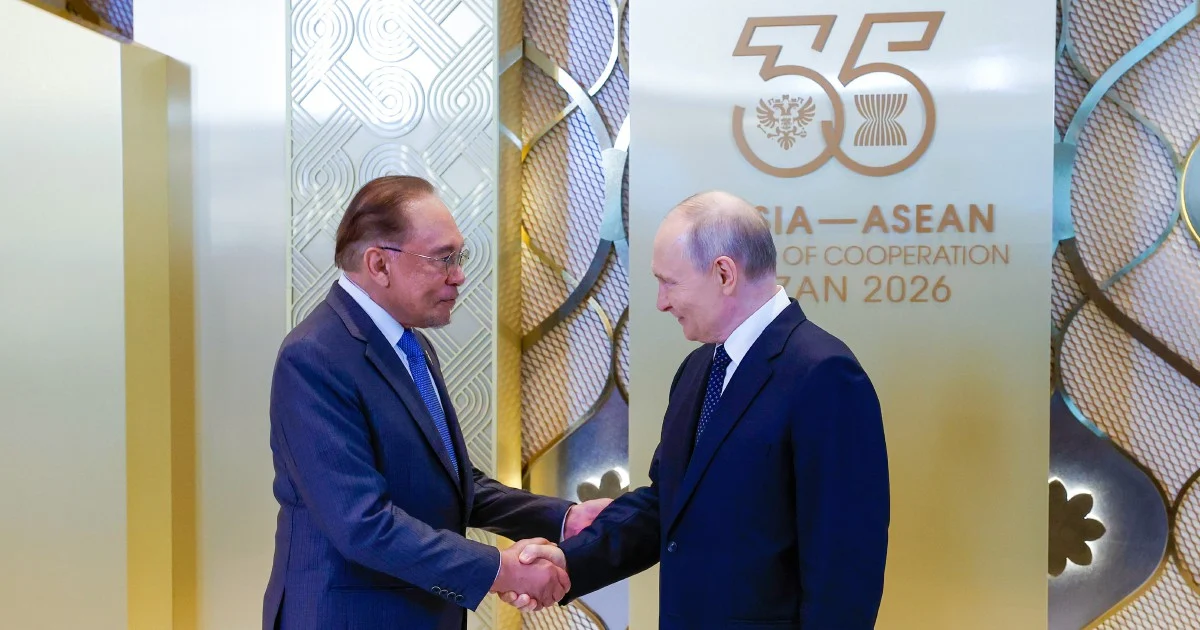
Prime Minister Datuk Seri Anwar Ibrahim and Russian President Vladimir Putin convened in Kazan to explore avenues for strengthening the longstanding partnership between Malaysia and Russia, with discussions centred on two critical pillars of mutual interest: energy security and the expansion of bilateral commerce through non-traditional payment mechanisms.
The meeting represents a significant moment for Malaysia's engagement with Russia, particularly as both nations navigate an increasingly multipolar global economic landscape. Kazan, a major hub in Russia's Volga region, served as an appropriate venue for high-level diplomacy, underscoring the breadth of Russia's economic geography beyond its western centres. The choice of location signals the two leaders' commitment to exploring partnerships that extend beyond conventional energy corridors and established trade routes.
Energy security remains a persistent challenge for Malaysia, a nation with growing energy demands driven by its expanding manufacturing sector and development initiatives. Although Malaysia possesses oil and natural gas reserves, the country remains attentive to global energy market dynamics and supply chain resilience. Russia's position as one of the world's largest hydrocarbon producers makes it a strategically important partner for Malaysia's long-term energy planning. The discussion on energy security likely encompassed potential cooperation on liquefied natural gas supplies, technological collaboration in petroleum exploration and refining, and coordination on energy market stability—issues of pressing concern throughout Southeast Asia as the region balances industrial growth with energy independence.
The deliberate inclusion of trade conducted in local currencies reflects evolving financial pragmatism among non-Western nations seeking to reduce dependency on traditional reserve currencies for international commerce. This approach gains particular relevance for Malaysia, whose ringgit-denominated transactions with Russia could streamline bilateral trade, reduce currency conversion costs, and shield both economies from external monetary policy shocks. Such arrangements have gained traction among developing economies and represent a broader shift in global financial architecture that regional observers are monitoring closely.
Malaysia's commercial engagement with Russia encompasses diverse sectors beyond energy. The agricultural, manufacturing, and technology sectors present untapped opportunities for mutual benefit. By exploring trade settlement in ringgit and ruble, both nations position themselves to facilitate smoother transactions and build deeper commercial relationships less vulnerable to international currency volatility. This model aligns with Malaysia's broader engagement strategy in East Asia, where countries are increasingly exploring bilateral currency arrangements to strengthen economic ties.
The timing of Anwar's visit to Kazan carries additional significance within the context of Malaysia's foreign policy orientation. The country maintains a reputation for balanced diplomacy, engaging constructively with major powers across geopolitical divides. Discussions with Putin demonstrate Malaysia's commitment to pragmatic statecraft centred on national economic interests rather than ideological positioning. This approach reinforces Malaysia's role as a bridge-builder in Southeast Asian affairs and its capacity to maintain cordial relations with diverse international partners.
Beyond immediate bilateral concerns, the Anwar-Putin dialogue occurs against the backdrop of Russia's evolving engagement with Asia-Pacific nations. As Russia seeks to strengthen its economic and diplomatic presence in the region following geopolitical tensions with Western nations, Malaysia represents a valuable partner with significant influence within ASEAN. Enhanced Malaysia-Russia cooperation carries implications for regional dynamics, potentially encouraging deeper Russian involvement in Southeast Asian affairs through trade, investment, and technological collaboration.
The emphasis on energy security during these talks reflects wider Southeast Asian vulnerabilities and opportunities. Nations throughout the region face similar pressures regarding energy supply diversification and price stability. By strengthening energy partnerships with Russia, Malaysia not only secures its own energy future but potentially establishes frameworks that could benefit other ASEAN members seeking to diversify their energy sourcing beyond traditional suppliers. Such developments could reshape regional energy markets and strengthen Asia's collective bargaining position in global commodity negotiations.
Trade expansion through alternative currency mechanisms also demonstrates Malaysia's sophistication in financial innovation and economic statecraft. The ringgit's role in bilateral trade settlements enhances the currency's international utility and contributes to Malaysia's aspirations as a financial centre. This approach simultaneously supports Russian financial interests by providing an alternative to restricted transaction channels, creating mutual benefits that extend beyond simple commercial exchange to encompass currency internationalisation objectives.
The bilateral discussions in Kazan underscore Malaysia's enduring strategic flexibility in navigating contemporary geopolitical complexities. By engaging seriously with Russia on substantive economic matters, Anwar reinforces Malaysia's independent foreign policy trajectory and its commitment to advancing national interests through pragmatic international engagement. The focus on energy security and trade modernisation signals that Malaysia views Russia not merely as a distant partner but as a substantial player in Asia's economic future.