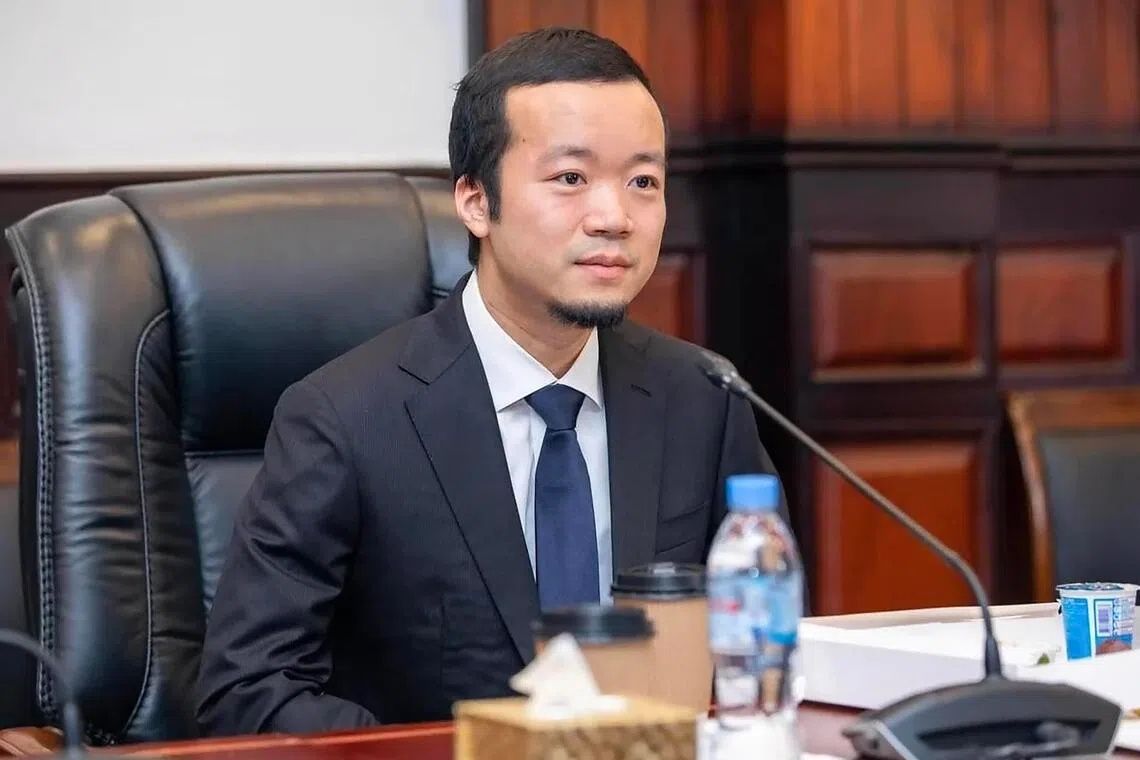
A six-month joint investigation by The Straits Times and the Organised Crime and Corruption Reporting Project has identified Chen Sokly as the primary co-conspirator and lieutenant of scam kingpin Chen Zhi, revealing how he accumulated a sophisticated portfolio of assets across Singapore, the United States, and Cambodia while orchestrating the criminal syndicate's most sensitive operations. Sokly, born in Shanghai in 1986, entered Cambodian citizenship in late 2017 under his adopted name and operated through multiple aliases, including the persona "Martin Chen," which he cultivated in Singapore's business circles. The revelation emerges from a sprawling criminal indictment filed in New York on October 8, 2025, that resulted in the American government's forfeiture of 127,271 bitcoins—worth approximately US$15 billion at the time of seizure—and marked one of the largest financial fraud takedowns in history.
Sokly's role within the Prince Holding Group extended far beyond standard corporate hierarchy. Prosecutors identified him as overseeing the syndicate's risk control function, a euphemism that masked his true responsibilities: monitoring law enforcement investigations globally, engaging in systematic bribery of foreign officials, and ensuring the group's interests remained protected through corrupt arrangements. Documents obtained during the investigation revealed that Sokly maintained an extensive network of contacts within government agencies, particularly in China, where he cultivated relationships that he believed granted immunity from prosecution. In May 2023, Sokly allegedly communicated with a Chinese government official who promised to shield Prince Group associates from legal jeopardy in exchange for Sokly's assurance that he would personally look after the official's son, demonstrating the transactional nature of his corruption operations.
The scale of Sokly's influence within the criminal enterprise became evident through intercepted communications and financial records seized by US authorities. Documents showed that Chen Zhi and Sokly regularly discussed the breadth of their official contacts, with Sokly demonstrating considerable confidence in his ability to manage legal threats and police interference. He was so assured of his connections that he dismissed concerns about Cambodia's crackdown on scam compounds operating within the country, confidently asserting that the Prince Group would face no consequences. A bribery ledger kept by Chen Zhi and recovered by investigators documented Sokly's willingness to deploy substantial sums to maintain these corrupt relationships—in 2019 alone, he purchased a yacht valued in excess of US$3 million as a gift for a foreign government official, a gesture designed to deepen the obligation binding that official to the syndicate's interests.
Beyond his role as corruptor-in-chief, Sokly served as the syndicate's enforcer and protector. When Prince Group members threatened the organisation's stability—such as when an associate absconded with funds—Chen Zhi would delegate the problem to Sokly for resolution through whatever means he deemed necessary. This dual responsibility as both diplomat and muscle-man positioned Sokly as Chen Zhi's most trusted lieutenant, the individual tasked with maintaining order within a sprawling criminal operation. Sokly occasionally indulged in public boasting about the syndicate's capabilities, once claiming that the global network was generating US$30 million daily through its illicit activities—a figure that provides perspective on the enormous scale of the operation's financial footprint.
Sokly's property acquisitions across the United States reveal how he converted criminal proceeds into legitimate-appearing real estate holdings. In 2019, he purchased a California home from Fang Zhizhen, a member of the Knight Attack Group, a Chinese cybercriminal syndicate that predated and eventually merged into the Prince Group's operations. This transaction connected Sokly's financial networks to earlier iterations of organised crime in the region. Five years later, in 2024, Sokly sold that same property for approximately US$4.5 million, a sale that occurred in the period leading up to the sweeping sanctions imposed against the entire Prince Group network. Shortly after the October 2025 sanctions were announced, Sokly executed a strategic transfer of a separate US$4 million property to his wife on November 4, 2025—a manoeuvre designed to shield assets from potential seizure. The property was subsequently placed into a trust operated by his wife in December, further complicating any future efforts to recover assets obtained through criminal activity.
Singapore functioned as Sokly's primary operational and financial base in Southeast Asia, where he cultivated a public persona as a wealthy businessman while managing the syndicate's commercial infrastructure. In 2017, he announced his arrival in the city-state with the acquisition of an S$11 million apartment spanning 5,694 square feet at 10 Leedon Heights, a premium residential address that signalled his wealth and status to Singapore's financial community. The apartment purchase was followed within months by the incorporation of M Capital Global Holdings, a Singapore company in which Sokly and his wife invested just over S$5 million in equal proportions, establishing themselves as continuing shareholders to the present day. Over the subsequent two years, Sokly registered himself as a director of at least sixteen Singapore firms, though most directorships were terminated between 2020 and 2023—a pattern suggesting either a deliberate effort to reduce his visible footprint or an internal reorganisation of the Prince Group's Singapore operations.
The Singapore companies overseen by Sokly shared a common address in Shenton Way, the nation's major financial district, though investigators who visited the building found that the office space listed in official records was occupied by unrelated entities with no apparent connection to Sokly. Former employees who worked within Sokly's Singapore network, speaking on condition of anonymity, revealed that he maintained a part-time residential schedule, typically spending between two and three months annually in the city-state while conducting business. During his evenings, Sokly socialised extensively with associates within the Prince Group's Singapore contingent, including Chen Zhi himself, suggesting that Singapore functioned as both a financial operations centre and a place of leisure for the syndicate's senior members. His personal vehicle collection—which included a Bentley and a luxury seven-seater—was maintained at his Leedon Heights residence, visible symbols of the wealth he had accumulated through his criminal activities.
Sokly's acquisition of Cambodian citizenship in late 2017 provided him with geographic and legal flexibility essential for managing the syndicate's operations in Southeast Asia. Cambodia's scam compounds, which exploited thousands of foreign workers coerced into fraudulent activities, generated substantial portions of the Prince Group's estimated multi-billion-dollar revenue streams. By obtaining Cambodian citizenship while maintaining residences in Singapore and the United States, Sokly positioned himself as a geographically distributed manager of the enterprise, able to move between jurisdictions and operate through local legal systems that offered varying degrees of susceptibility to corruption. The use of multiple identities—Chen Xing in official documents, Chen Sokly for Cambodian authorities, and Martin Chen in Singapore's social circles—reflected a sophisticated understanding of how to compartmentalise his presence across legal jurisdictions and limit his exposure to unified law enforcement action.
The Straits Times and OCCRP's investigation confirms that at least nine individuals and twenty-six entities connected to Sokly's financial networks were designated under American sanctions targeting the Prince Group and its affiliates. This designation extends beyond Sokly himself to encompass his family members, business associates, and the corporate structures through which the syndicate laundered its illicit proceeds. The breadth of these sanctions illustrates how thoroughly the criminal enterprise had infiltrated legitimate business channels across multiple economies. Sokly's strategic asset transfers to his wife in the weeks following the October 2025 sanctions announcement suggest an ongoing attempt to preserve some portion of the syndicate's wealth by exploiting trusts and spousal ownership structures—a common tactic employed by financially sophisticated criminals seeking to insulate themselves from asset forfeiture.
For Malaysian and Southeast Asian observers, Sokly's case demonstrates the sophisticated methods through which international crime syndicates exploit regional vulnerabilities and establish operational bases in financial centres. Singapore's appeal as a financial hub extends beyond legitimate businesses to those seeking to launder criminal proceeds through real estate, company incorporation, and professional networks. The ease with which Sokly incorporated multiple companies, acquired premium properties, and maintained residence without triggering comprehensive law enforcement scrutiny underscores the challenges facing regional authorities in combating transnational organised crime. While the American government has taken decisive action through sanctions and asset forfeiture, the investigation reveals that substantial assets remain concealed through trusts, spousal transfers, and shell company networks that continue to operate in the present.
The US decision to drop sanctions against Chen Zhi and the Prince Holding Group just six days after the October 8, 2025 indictment raises questions about diplomatic negotiations and potential cooperation agreements that may have influenced American enforcement priorities. This timing suggests possible negotiations concerning other matters of geopolitical or economic significance, or potentially an arrangement where Chen Zhi or other senior figures provided intelligence valuable to American interests. For Southeast Asian governments, the interplay between the indictment and the subsequent sanctions removal demonstrates how criminal investigations at the international level may be subject to diplomatic considerations that extend beyond traditional law enforcement objectives. The revelation of Sokly's networks in Singapore also underscores the necessity for enhanced information-sharing between ASEAN nations and Western law enforcement agencies to prevent high-level financial criminals from establishing operational bases within the region.
The investigation's findings carry direct relevance to Malaysia's financial sector and regulatory environment. If Sokly or other Prince Group operatives established Malaysian assets or corporate structures, the financial infrastructure that enabled their operations across Singapore, Cambodia, and the United States may similarly exist within Malaysian jurisdiction. The sophistication of asset concealment techniques documented in this investigation—trusts, spousal transfers, shell companies with deliberately obscured connections—represents the precise methodologies that Malaysian financial regulators and law enforcement agencies must be equipped to detect. Enhanced due diligence on property purchases by foreign nationals, particularly those acquiring multiple properties in rapid succession or establishing trusts shortly after international sanctions announcements, may serve as early warning indicators of asset-concealment activity. The investigation demonstrates that international cooperation, sustained documentary research, and cross-jurisdictional coordination remain essential tools for dismantling the financial networks through which transnational organised crime perpetuates itself.

