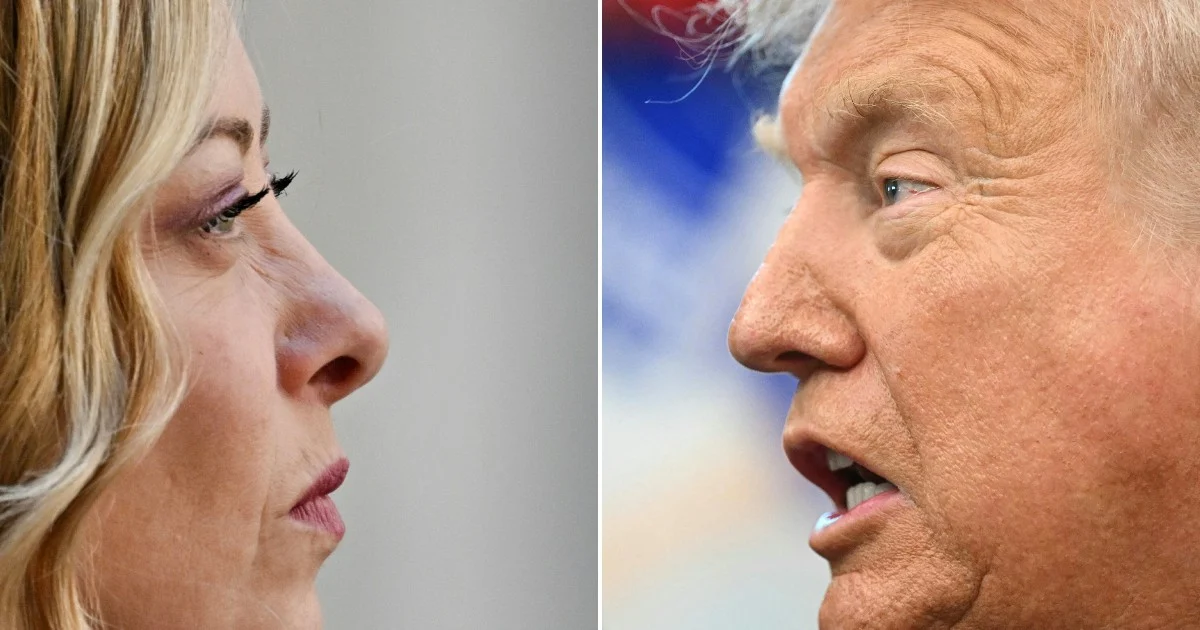
The relationship between the United States and Italy has deteriorated into a visible public spat, with American President Donald Trump taking aim at Italian Prime Minister Giorgia Meloni over what he characterizes as persistent requests for photographs. Trump's Saturday escalation marks a notable deterioration in bilateral relations between two significant Western allies, introducing an unusual personal element into what is ostensibly a G7 partnership.
At the centre of Trump's grievance is his assertion that Meloni has made repeated overtures for a photograph opportunity with him. Rather than treating this as a routine diplomatic courtesy, Trump has weaponized the claim as part of a broader criticism, suggesting that Meloni's eagerness for such imagery belies some deeper strategic miscalculation or insincerity in Italy's alignment with American interests.
What distinguishes this public quarrel from typical political disagreements is Trump's decision to link a seemingly trivial matter of photographic documentation to substantive foreign policy disagreements. In doing so, the American president has connected tensions over Iran policy and NATO obligations to what might otherwise appear as minor protocol irritants. This rhetorical move reflects a pattern where personal grievances and policy disputes become intertwined in Trump's diplomacy.
The invocation of Iran policy suggests that disagreements exist regarding how Italy should position itself on broader Middle Eastern strategy and American sanctions regimes. Italy, as a European Union member state and NATO ally, must balance its commitment to transatlantic partnership with its own strategic autonomy and European policy frameworks. Such tensions are not unique to the Meloni government but have plagued US-European relations for years, particularly when American administrations adopt more unilateral approaches to international challenges.
NATO tensions add another layer of complexity to the deteriorating relationship. Questions regarding European defence spending, the distribution of military responsibilities, and the degree to which European nations should develop independent strategic capacity have long created friction within the alliance. Trump's criticism of NATO members for insufficient military expenditure has been consistent across multiple administrations, and his latest remarks suggest that Italy, under Meloni's leadership, has not satisfied his expectations in this domain.
For Malaysian observers and Southeast Asian policymakers, this American-Italian dispute carries indirect implications. The cohesion of Western alliances, particularly NATO and the broader G7 framework, influences the regional balance of power that affects the Indo-Pacific. When core Western relationships fracture or become strained, it creates opportunities for other powers to expand their influence and potentially alters the strategic calculations upon which regional security arrangements depend.
Meloni's government, since assuming office in 2022, has positioned itself as a staunch defender of traditional values and European sovereignty, while maintaining alliance commitments. The tension with Trump may reflect differing visions of how Italy should exercise its geopolitical agency within the Western framework. Trump's criticisms suggest he views Meloni as insufficiently aligned with American positions on key issues, whether regarding Iran, Russia, or NATO burden-sharing.
The public nature of this dispute is particularly significant because it occurs within the G7 context, an informal gathering of the world's major industrialized democracies. G7 cohesion has been tested repeatedly in recent years, with trade wars, climate policy disagreements, and differing approaches to Russia all creating visible fissures. A visible rupture between the American and Italian leaderships at this level can undermine the collective messaging and decision-making capacity of this influential grouping.
Italy's strategic position within Europe adds another dimension to this quarrel. As a Mediterranean power with historical influence over Middle Eastern affairs and as a central European economy, Italy's alignment or misalignment with American priorities reverberates across the continent. European capitals are likely observing this dispute carefully to assess whether Trump intends to pursue similar confrontational approaches with other NATO allies and EU members.
The photograph dispute, while superficially trivial, may serve as shorthand for deeper frustrations. In diplomatic vernacular, such public objections often mask substantive disagreements about resource commitments, policy priorities, or fundamental strategic orientations. Trump's willingness to air such grievances publicly suggests either a deliberate strategy to pressure Meloni into policy concessions or a genuine personal irritation that he believes warrants public airing.
For countries like Malaysia, which benefit from predictable Western alliance structures and a rules-based international order, such deteriorations in American-European coordination represent potential sources of instability. When established partnerships become strained, the resulting strategic uncertainty can create openings for alternative arrangements and power configurations that may not serve regional interests as favourably.
The resolution of this dispute will likely depend on whether Meloni's government is willing to adjust its positions on Iran, NATO spending, or other strategic issues to satisfy Trump's demands, or whether Italy will maintain its current posture and absorb whatever diplomatic costs result from the American president's displeasure. Either outcome will provide signals about the future trajectory of Western alliance dynamics and Italy's place within them.
%22%2F%3E%3C%2Fpattern%3E%3C%2Fdefs%3E%3Crect%20width%3D%22100%25%22%20height%3D%22100%25%22%20fill%3D%22url(%23ph57m3vg)%22%2F%3E%3Crect%20width%3D%22100%25%22%20height%3D%22100%25%22%20fill%3D%22url(%23ph57m3vp)%22%2F%3E%3Ctext%20x%3D%2250%25%22%20y%3D%2250%25%22%20text-anchor%3D%22middle%22%20dominant-baseline%3D%22central%22%20fill%3D%22rgba(255%2C255%2C255%2C0.95)%22%20font-family%3D%22Georgia%2C%20'Times%20New%20Roman'%2C%20serif%22%20font-weight%3D%22700%22%20font-size%3D%22151%22%20letter-spacing%3D%22-0.02em%22%3EMalaysian%3C%2Ftext%3E%3C%2Fsvg%3E)
%22%2F%3E%3C%2Fpattern%3E%3C%2Fdefs%3E%3Crect%20width%3D%22100%25%22%20height%3D%22100%25%22%20fill%3D%22url(%23ph504jeg)%22%2F%3E%3Crect%20width%3D%22100%25%22%20height%3D%22100%25%22%20fill%3D%22url(%23ph504jep)%22%2F%3E%3Ctext%20x%3D%2250%25%22%20y%3D%2250%25%22%20text-anchor%3D%22middle%22%20dominant-baseline%3D%22central%22%20fill%3D%22rgba(255%2C255%2C255%2C0.95)%22%20font-family%3D%22Georgia%2C%20'Times%20New%20Roman'%2C%20serif%22%20font-weight%3D%22700%22%20font-size%3D%22320%22%20letter-spacing%3D%22-0.02em%22%3EMOH%3C%2Ftext%3E%3C%2Fsvg%3E)