Jalan Burma represents one of George Town's most compelling intersections of heritage and contemporary food culture, a nearly 5-kilometre arterial road that serves as a living chronicle of Penang's multicultural past while functioning today as a gateway to the city's internationally recognised dining scene. The street exemplifies how heritage cities can maintain their historical character while embracing modern recognition—in this case, the Michelin Guide's presence, which has identified 74 eateries across Penang, including two one-star establishments, 33 Bib Gourmand venues, and 39 Michelin Selected spots, many clustered within George Town itself. For visitors navigating the city's complex geography, Jalan Burma offers an accessible introduction to both architectural conservation and street-food authenticity that define contemporary Penang tourism.
The road's significance as a heritage corridor stems partly from its proximity to the George Town UNESCO Historic Site, which encompasses major arteries including Beach Street, Armenian Street, Lebuh Carnavon, Lebuh Chulia and Pengkalan Weld. These interconnected thoroughfares contain meticulously restored colonial structures and well-maintained historical buildings that draw daily streams of tourists. Yet Jalan Burma functions differently—it extends beyond the compact heritage precinct, serving as a transitional artery that gradually shifts from the intense tourist activity of the conservation zone into quieter residential and neighbourhood commercial spaces. This gradient makes it ideal for visitors seeking authentic experiences without sacrificing comfort or accessibility.
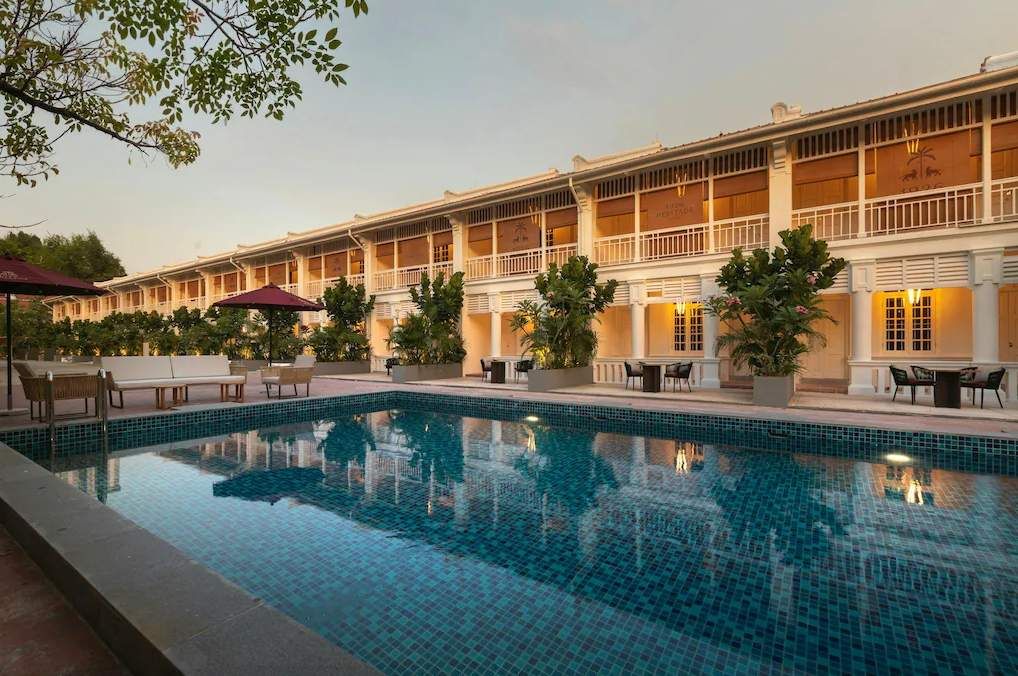
The newly renovated Komtar hotel, situated prominently along Jalan Burma, exemplifies the preservation-meets-modernisation approach increasingly common in George Town. Built in 1926, the property marks its centenary year as a historic landmark, originally constructed as residential quarters for British and local government officials. Its architectural vocabulary blends Anglo-Malay design principles characteristic of early 20th-century Penang, reflecting an era when colonial governance shaped the island's urban fabric. The original structure comprised 24 interconnected link houses that underwent transformation when the Penang Development Corporation converted the property into a hotel in 1999. This adaptive reuse preserved the building's external heritage character while creating 78 contemporary rooms across six categories, from the Heritage Room designed for solo travellers to the expansive Straits Suite, demonstrating how conservation-minded renovation can meet modern hospitality expectations.
Food discovery along Jalan Burma reveals the layered complexity of Penang's hawker culture, where established reputation, Michelin recognition, and local consensus sometimes diverge in revealing ways. Duck Blood Curry Mee operates a few doors from the Komtar hotel, offering its signature white curry noodles to both casual passers-by and deliberate seekers of authentic Hokkien-influenced hawker cuisine. Nearby, Restoran Old Green House houses the original Green House Prawn Mee & Loh Mee stall, which carries Bib Gourmand recognition—that crucial intermediate tier of the Michelin system that celebrates consistently excellent street food at accessible prices. A satellite Green House location further along Jalan Burma toward the Komtar roundabout creates occasional confusion among visitors, yet locals reliably direct enquirers to the original establishment, exemplifying how community knowledge and official recognition operate on separate but occasionally overlapping planes.
The Michelin recognition system, with its emphasis on quality ingredients, technique, and consistency, tends to favour these kinds of food-court and coffeeshop venues over isolated fine-dining establishments when evaluating Penang's culinary landscape. For many visitors, the appeal of Bib Gourmand stalls transcends merely eating economical excellent food; it encompasses the multisensory theatre of hawker environments. The accumulated aromas of multiple stalls creating a complex olfactory palimpsest, the visual engagement of watching cooks prepare dishes with practiced efficiency, and the convivial energy of communal eating spaces combine to enhance the subjective pleasure of meals beyond what private dining rooms typically offer. This experiential dimension explains why food-famous destinations like Penang attract visitors specifically to navigate informal eating venues rather than formal restaurants, even when staying at heritage properties offering their own dining facilities.
Jalan Burma's historical nomenclature reveals the layered migration patterns and cultural formations that shaped Penang's pluralistic urban landscape. Originally designated Burmah Road during the colonial period, the street subsequently acquired multilingual designations reflecting Penang's linguistic diversity: three Malay names, two Hokkien variants, and two Cantonese renderings. These translations often indexed specific historical functions—Jalan Tarek Ayer or Water Cart Road referred to the street's original role transporting water via bullock carts during the pre-modern period. The emergence of a significant Burmese settlement in the adjacent Pulau Tikus neighbourhood during the 19th century eventually standardised the English name, and contemporary Burmese cultural markers remain embedded in the vicinity's geography. Rangoon Road, Mandalay Road, and Moulmein Close perpetuate this heritage, while the Dhammikarama Burmese Temple, established two centuries ago along one of Jalan Burma's lanes, continues functioning as a religious and cultural anchor for Penang's Burmese community.
Navigating Jalan Burma as a pedestrian requires modest planning, particularly for visitors unfamiliar with George Town's layout. The approximately 4-kilometre walk between the Komtar roundabout landmark and the heritage zone's concentrated attractions on Lebuh Campbell, Lebuh Kimberley, and Beach Street encompasses generally safe, walkable terrain, though one or two segments lack dedicated pedestrian pathways. The ambient heat of tropical Penang necessitates practical preparation—borrowed umbrellas from accommodations, portable water containers, and modest towels become essential accessories rather than optional comforts. Modern hotels increasingly provide sophisticated amenities that enhance such explorations; some offer WiFi-enabled water filtration systems in guest rooms, enabling travellers to maintain hydration without disposable plastic waste. This infrastructure supports the growing cohort of sustainability-conscious tourists who wish to explore cities actively while minimising environmental impact.
The road's extension toward Pulau Tikus marks a transition into Penang's more affluent residential neighbourhoods, where boutique establishments like Root House by Gen introduce contemporary interpretive dining into heritage contexts. This modern Chinese restaurant, operated within heritage hotel properties, represents how Penang's culinary identity increasingly encompasses reinterpreted traditional cuisines alongside street-food authenticity. Such venues attract visitors seeking elevated experiences without abandoning the cultural specificity that defines the island's gastronomic reputation. The ability to move seamlessly from Michelin-recognized hawker stalls to chef-driven contemporary restaurants within single walking expeditions distinguishes Penang from many Asian destinations, where such culinary gradients typically require transportation between disparate neighbourhoods.
The broader George Town experience extends beyond Jalan Burma proper into complementary cultural venues that activate heritage conservation on weekends and special occasions. The Hin Bus Depot marketplace, operational primarily during weekends, functions as a cultural gathering space where local artisans, food entrepreneurs, and service providers converge to create temporary communities. Curio vendors, artwork sellers, homemade fashion producers, and live musicians establish an informal economy operating alongside formal retail and hospitality sectors. These periodic activations demonstrate how heritage conservation increasingly encompasses community participation and contemporary creative practice rather than merely preserving buildings as static monuments. The ability to consume homemade foods while witnessing live music performances situates eating within broader cultural participation, transforming meals into social events rather than mere nutritional transactions.
For Malaysian and Southeast Asian visitors accustomed to reading travel guidance through familiar lenses—heritage preservation, hawker authenticity, Michelin recognition, neighbourhood character—Jalan Burma encapsulates the contemporary complexity of managing historic cities amid globalised tourism systems. The road itself embodies this negotiation: anciently named after agricultural water-transport systems, renamed for immigrant communities, subsequently developed as colonial infrastructure, and now functioning as a curated heritage corridor where international culinary rankings intersect with local consensus about authentic food venues. The street demonstrates that contemporary George Town tourism succeeds not through artificial homogenisation or sterile preservation, but through maintaining productive tensions between different value systems—official recognition and community knowledge, heritage conservation and modern adaptation, street-food informality and contemporary restaurant culture. Such multiplicity provides genuine choices rather than predetermined narratives, enabling visitors to construct personalised itineraries reflecting their particular interests and comfort levels.
%22%2F%3E%3C%2Fpattern%3E%3C%2Fdefs%3E%3Crect%20width%3D%22100%25%22%20height%3D%22100%25%22%20fill%3D%22url(%23ph49f10g)%22%2F%3E%3Crect%20width%3D%22100%25%22%20height%3D%22100%25%22%20fill%3D%22url(%23ph49f10p)%22%2F%3E%3Ctext%20x%3D%2250%25%22%20y%3D%2250%25%22%20text-anchor%3D%22middle%22%20dominant-baseline%3D%22central%22%20fill%3D%22rgba(255%2C255%2C255%2C0.95)%22%20font-family%3D%22Georgia%2C%20'Times%20New%20Roman'%2C%20serif%22%20font-weight%3D%22700%22%20font-size%3D%22226%22%20letter-spacing%3D%22-0.02em%22%3EExists%3C%2Ftext%3E%3C%2Fsvg%3E)

%22%2F%3E%3C%2Fpattern%3E%3C%2Fdefs%3E%3Crect%20width%3D%22100%25%22%20height%3D%22100%25%22%20fill%3D%22url(%23ph4a4w5g)%22%2F%3E%3Crect%20width%3D%22100%25%22%20height%3D%22100%25%22%20fill%3D%22url(%23ph4a4w5p)%22%2F%3E%3Ctext%20x%3D%2250%25%22%20y%3D%2250%25%22%20text-anchor%3D%22middle%22%20dominant-baseline%3D%22central%22%20fill%3D%22rgba(255%2C255%2C255%2C0.95)%22%20font-family%3D%22Georgia%2C%20'Times%20New%20Roman'%2C%20serif%22%20font-weight%3D%22700%22%20font-size%3D%22272%22%20letter-spacing%3D%22-0.02em%22%3ETrump%3C%2Ftext%3E%3C%2Fsvg%3E)