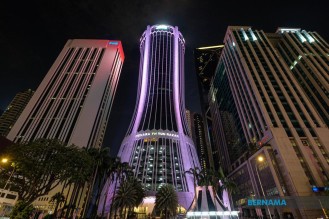
The entire approval sequence for Lembaga Tabung Haji's acquisition of a 30 per cent stake in Putrajaya Perdana Bhd in 2014 unfolded while the construction company remained under the alleged control of Low Taek Jho, the controversial financier at the centre of the 1Malaysia Development Bhd (1MDB) scandal, Finance Minister II Datuk Seri Amir Hamzah Azizan disclosed to Parliament this week. The revelation came during a special parliamentary sitting focused on deliberating the Royal Commission of Inquiry report into Tabung Haji's management practices, laying bare a troubling sequence of decisions that prioritised approvals over fundamental due diligence.
According to sworn testimony presented in the SRC International case—SRC being a former 1MDB subsidiary allegedly controlled by Jho Low through Utama Banking Group Bhd—the acquisition proceeded at every stage whilst Jho Low maintained his grip on the entity. Putrajaya Perdana director Datuk Rosman Abdullah testified that SRC International channelled RM170 million into Putrajaya Perdana's subsidiary, Putra Perdana Construction, across three payments between July and August 2014. The transfer of ownership from Jho Low's business group to Rosman Abdullah did not conclude until April 13, 2015, meaning the entire approval sequence occurred under the previous ownership structure.
The timeline of approvals tells a compressed and troubling story. Tabung Haji's Investment Panel granted its consent on July 24, 2014, followed by board approval on August 25 and ministerial sign-off on August 27 that same year. The sale and purchase agreement was formally executed on December 3, 2014. Every critical decision point fell within the period when Jho Low's influence over the company remained unresolved. While Amir Hamzah emphasised that no court has made a definitive finding that Jho Low was the beneficial owner at that precise moment, the sworn testimony on record presents a damaging chronology that shaped public and parliamentary perception of the transaction's propriety.
The valuation methodology underpinning the transaction raises profound concerns about governance and investor protection. Tabung Haji's Research Division initially valued the 30 per cent stake at somewhere between RM124 million and RM155 million, substantially below the RM206 million valuation eventually proposed. Yet the Investment Panel ultimately approved RM193.5 million without documenting written justification for the dramatic upward revision. The increase in stake size from 25 per cent to 30 per cent was similarly approved without explanation, suggesting a process where institutional safeguards were bypassed or ignored.
More shocking still, the due diligence process—fundamental to any major investment decision—was conducted only after all approvals had been secured and signed. Neither the Investment Panel nor the board of directors reviewed the due diligence findings before the agreement was finalised. This inversion of proper procedure meant decision-makers approved an acquisition of depositors' funds without first understanding the underlying risks, asset quality, or business prospects of Putrajaya Perdana. The 2023 fact-finding assessment subsequently documented that four Tabung Haji investments bypassed required due diligence procedures entirely, indicating a systematic failure rather than an isolated lapse.
A critical disclosure never presented to decision-makers reveals the staggering gap between successive valuations. The seller had acquired the entire equity stake in Putrajaya Perdana for RM260 million in 2012, implying a cost of approximately RM78 million for a 30 per cent holding. Just two years later, Tabung Haji agreed to pay RM193.5 million for the same 30 per cent stake—nearly two and a half times the original acquisition cost. This extraordinary appreciation lacked any transparent business justification, yet somehow satisfied governance processes that should have flagged such anomalies immediately.
The two cornerstone promises underpinning the investment deal never materialised, compounding the losses sustained by Tabung Haji depositors. The seller committed that Putrajaya Perdana would be relisted on a public exchange within twelve months and achieve a profit of RM86 million during 2015. Neither objective was realised. The Royal Commission of Inquiry further noted that Tabung Haji's chairman at the time simultaneously served as chairman of Putrajaya Perdana, creating a potential conflict of interest that should have triggered heightened scrutiny rather than expedited approvals.
When the promised returns failed to materialise, Tabung Haji initially attempted to unwind the investment through a put option exercise in March 2018, demanding that the seller repurchase the shares at RM210.7 million. The seller neither complied with this demand nor negotiated a settlement, leaving Tabung Haji holding a deteriorating asset. By the end of financial year 2024, the entire RM193.5 million investment had been written off entirely as impaired, transforming a paper loss into a permanent destruction of depositor value.
The Investment Panel's July 2024 request for the seller to identify the ultimate shareholder proved prescient but futile. The request itself acknowledged uncertainty about ownership structures, yet management's response was not recorded in panel documents, and the transaction proceeded regardless. This absence of basic information—who ultimately owned the company from which Tabung Haji was purchasing an equity stake—should have halted any transaction, but instead served merely as a procedural footnote in documents never properly reviewed or acted upon.
Tabung Haji has initiated legal action to recover its losses, filing a writ and obtaining a Mareva injunction to freeze the seller's assets. Court-directed mediation occurred recently, but the underlying litigation remains complex and protracted, with trial scheduled for June 23, 2027. The three-year timeline underscores that resolving such corporate disputes requires years of legal proceedings, meaning resolution of these losses remains distant for a religious institution whose deposits represent the savings of Malaysian pilgrims.
The disclosure during this week's parliamentary sitting occurs within the broader context of ongoing accountability efforts surrounding the 1MDB scandal and associated corporate failures. SRC International, the vehicle through which Jho Low allegedly channelled funds into Putrajaya Perdana, exemplified the shadow financial networks that operated during that period. That Tabung Haji's governance structures proved inadequate to resist pressures or detect dubious transactions reflects institutional vulnerabilities that have since prompted the Royal Commission investigation. For Malaysian regulators and the financial sector, the case illustrates how institutional investors can suffer catastrophic losses when approval processes prioritise speed over substance, and when decision-makers lack complete information about the entities from which they are purchasing assets.

