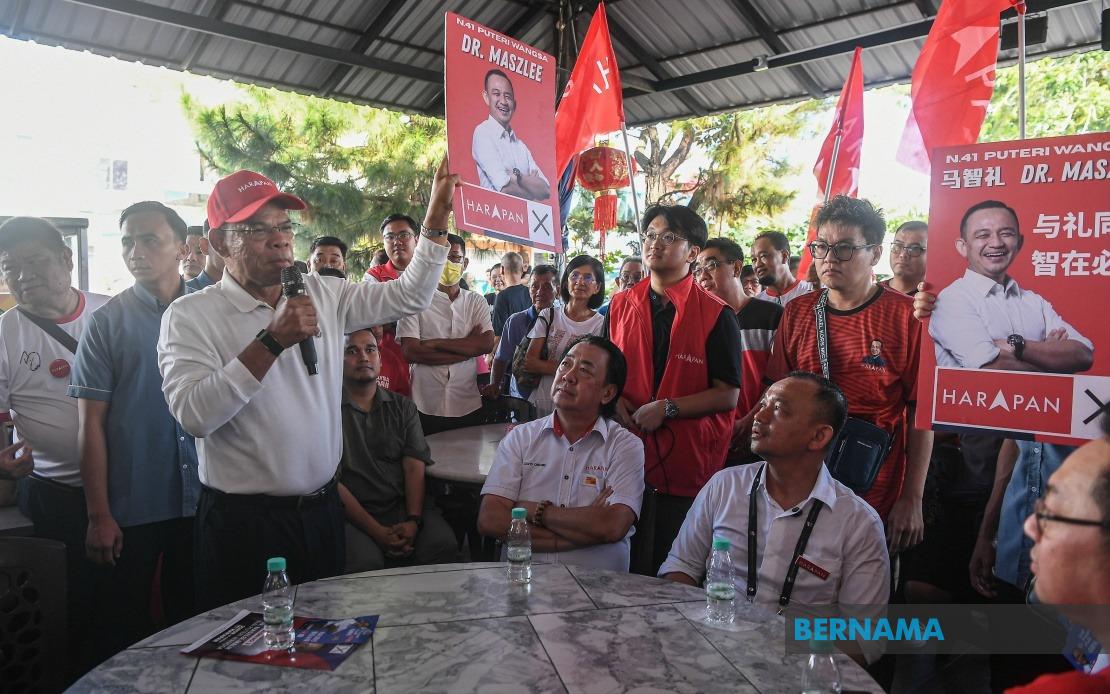
Pakatan Harapan's momentum in the Johor state election campaign reflects a methodical, data-driven approach to seat selection and resource allocation rather than a broad-brush strategy, according to the coalition's leadership. PH secretary-general Datuk Seri Saifuddin Nasution Ismail outlined how the opposition alliance has categorized the 56 contested state seats into distinct tiers based on ground-level support metrics, enabling campaign teams to concentrate efforts where they are most likely to yield electoral gains. This granular classification system acknowledges that voter dynamics, community composition, and political complexities vary substantially across constituencies, necessitating tailored messaging and organizational focus tailored to local realities.
The differentiation in campaign intensity becomes evident when examining constituencies with markedly different demographic and socioeconomic profiles. Puteri Wangsa, a suburban seat with strong Chinese and younger professional voter representation, presents vastly different strategic challenges than Johor Lama, where historical voting patterns and establishment narratives hold considerable sway. Similarly, Larkin's working-class composition contrasts sharply with Endau's rural character, each demanding distinct communication approaches and resource deployment. By assigning priority grades to these varied constituencies, PH effectively ensures that candidates and volunteers concentrate firepower on winnable seats while maintaining competitive presence elsewhere, a pragmatic calculation that maximizes limited campaign resources across a sprawling state with 56 seats.
PH's campaign transparency has emerged as a competitive advantage relative to rival coalitions, particularly in how the alliance has publicly disclosed seat distributions among component parties and articulated its manifesto commitments. The coalition fielded candidates across all 56 seats with a clear allocation: PKR contesting 20 seats, Amanah fielding 19 candidates, and DAP running 17 nominees. This open arrangement signals internal cohesion and provides voters with unambiguous choice architecture, fostering confidence in PH's organizational discipline and governance readiness. The clarity stands in marked contrast to coalition rivals operating with less transparent seat-sharing arrangements or divergent campaign messages.
The opposition's strategic missteps have inadvertently bolstered PH's electoral prospects in ways that transcend the coalition's own organizational efforts. The Islamic Party of Malaysia (PAS), which is contesting only 11 seats in Johor, has instructed its supporters to cast ballots for Barisan Nasional candidates in the remaining 45 seats. This fragmentation of the conservative Muslim-majority vote creates a permissive environment for PH, as voters skeptical of BN but aligned with PAS's religious messaging may find themselves without a clear voting alternative, potentially shifting toward PH candidates as a pragmatic middle ground. The decision effectively concedes substantial electoral ground to competitors while creating voter confusion and weakening overall opposition unity.
Saifuddin Nasution emphasized that this convergence of PH's disciplined campaign architecture and opposition self-inflicted disadvantages generates a compounding electoral advantage that extends beyond mere seat counts. When opposition parties issue conflicting political signals or fail to present a coherent alternative, swing voters and undecided constituencies drift toward the clearer option. PH's unified messaging amplified by this contrast creates psychological momentum that translates into volunteer enthusiasm, media momentum, and ultimately voter mobilization on polling day.
The prominence of former UMNO Supreme Council member Datuk Dr Mohd Puad Zarkashi in recent engagements with Prime Minister Datuk Seri Anwar Ibrahim further illustrates PH's broadening appeal across traditional UMNO constituencies. Puad Zarkashi's visible association with Anwar at Felda Ulu Tiram—a constituency historically aligned with UMNO's agrarian base—signals that PH is capturing disaffected establishment figures and reshaping perceptions of the coalition as a viable governing alternative even among conservative, rural constituencies. The symbolism carries weight beyond individual candidates, suggesting that the UMNO brand itself may face erosion as prominent members increasingly align with PH's political trajectory.
Candidate quality also figures prominently in PH's confidence regarding electoral prospects. The coalition highlighted Dr Maszlee Malik, contesting the Puteri Wangsa seat, as exemplary of its candidate caliber—individuals bringing professional credentials, constituency service records, and policy expertise to legislative roles. When opposition coalitions struggle to field comparably qualified candidates or rely on lesser-known names, the gap in perceived governance capacity becomes palpable to voters evaluating options across diverse constituencies.
Johor's electoral landscape encompasses considerable geographic and demographic complexity that favors an alliance capable of managing multiple voter constituencies simultaneously. The state encompasses urban coastal districts with Chinese and Indian commercial communities, Malay-majority interior constituencies with strong religious constituencies, Felda settlements with distinct agrarian concerns, and rapidly urbanizing satellite towns attracting young professionals. PH's three-party structure—PKR, Amanah, and DAP—provides organizational capacity to address these varied constituencies with component parties bringing specific strengths: DAP's established presence in Chinese communities, Amanah's credibility among progressive Muslim voters, and PKR's broad-based multi-ethnic organization.
The Johor election, scheduled for July 11 with early voting on July 7, will test whether PH's strategic sophistication and messaging discipline can translate into legislative control of Malaysia's most populous state. A total of 172 candidates representing multiple coalitions compete for the 56 seats, indicating a fragmented electoral environment where vote splitting and marginal seat dynamics could prove decisive. The contest carries implications extending far beyond Johor's state government formation, as success would reinforce PH's positioning as the dominant opposition force capable of wresting traditionally BN-controlled territories while validating the coalition's experimental campaign methodologies for future national and state elections throughout Southeast Asia's most developed electoral battleground.

