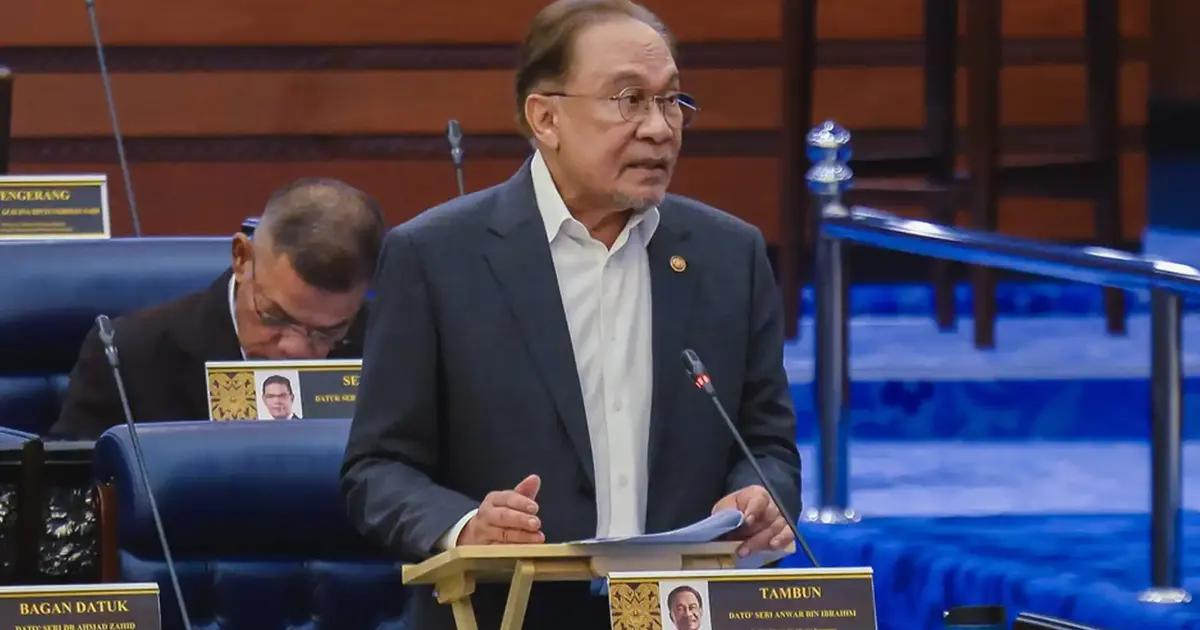
Prime Minister Anwar Ibrahim has drawn a clear line on federal financial responsibility, warning state governments not to anticipate that Putrajaya will underwrite cost overruns arising from their own discretionary choices. The statement represents a significant stance on intergovernmental fiscal discipline and reflects ongoing tensions over how development projects are funded across Malaysia's federal structure.
Anwar's position signals that any appeal for supplementary federal allocations or fresh borrowing arrangements triggered by escalating project expenditures will require comprehensive renegotiation rather than automatic approval. This approach diverges from informal arrangements that may have prevailed previously, establishing a more rigorous framework for evaluating additional funding claims. The shift underscores the current administration's commitment to fiscal prudence amid broader economic pressures affecting federal finances.
The statement carries particular weight given Malaysia's complex intergovernmental fiscal dynamics. States retain considerable autonomy in initiating development projects, yet historically have often turned to federal coffers when budgets prove insufficient. Anwar's declaration suggests this implicit safety net can no longer be assumed, effectively transferring financial accountability to state administrations for their planning and execution decisions.
For state governments, the implication is that project planning must now incorporate more rigorous contingency assessments and cost certainty mechanisms before proceeding. States cannot rely on the assumption that if initial allocations prove inadequate, federal rescue funding will materialize. This compels state-level officials to conduct more comprehensive feasibility studies, secure firmer contractor quotes, and build realistic contingency buffers into their budgets from the outset.
The federal government's hardened stance reflects several converging pressures. Malaysia's fiscal position has tightened considerably following pandemic-related expenditures, while revenue streams remain under pressure. Federal authorities must balance numerous competing demands for capital investment, social spending, and debt servicing, leaving diminishing latitude for absorbing unanticipated state-level expenses. By establishing this boundary, Putrajaya preserves flexibility to prioritize national initiatives and essential services.
From a governance perspective, Anwar's position strengthens accountability mechanisms. State leaders cannot obscure poor project management or cost-control deficiencies by subsequently appealing for federal assistance. This transparency encourages states to implement stronger internal oversight and financial discipline. Projects that cannot be completed within approved budgets risk stalling or cancellation, creating incentives for meticulous planning and realistic estimating before groundbreaking.
The renegotiation requirement introduces procedural safeguards absent from automatic funding arrangements. Any request for additional federal support will face fresh scrutiny, forcing states to justify why circumstances changed, explain cost escalation factors, and demonstrate that remedial measures have been exhausted. This process provides federal authorities with leverage to impose conditions, require project modifications, or insist on revised timelines before releasing supplementary funds.
For Malaysian taxpayers, the announcement offers potential benefits through reduced fiscal waste and more disciplined government spending at all levels. Cost overruns that previously might have been quietly accommodated through federal transfers will now force difficult conversations about project viability, contractor performance, or scope adjustments. This visibility enhances democratic accountability and public understanding of how development investments are actually managed.
Regionally, Malaysia's approach aligns with emerging fiscal orthodoxy in Southeast Asia, where governments increasingly emphasize balanced budgets and controlled debt trajectories. Neighboring administrations facing similar revenue constraints have implemented comparable measures to prevent subnational units from generating unfunded liabilities. Anwar's articulation of this principle brings Malaysian practice into convergence with regional best practices.
The statement also reflects underlying tensions between federal and state-level political entities. Malaysia's mixed-government landscape, with states controlled by various ruling coalitions, complicates fiscal coordination. Federal authorities may view tighter spending controls as necessary to prevent politically-motivated projects in opposition-controlled states from becoming federal liabilities. Conversely, state leaders may perceive the new restrictions as partisan constraints on their development autonomy.
Implementing this policy requires institutional mechanisms to distinguish legitimate renegotiations from those reflecting poor planning or incompetence. The federal government must develop transparent criteria for evaluating supplementary requests, ensuring consistency across states and preventing accusations of political favoritism. Clear guidelines and predictable procedures will reduce friction and provide states with certainty about what circumstances warrant federal reconsideration.
Moving forward, states must fundamentally recalibrate their approach to project development. Enhanced internal financial management, more conservative cost estimation, and greater emphasis on contractor accountability become essential competencies. States that successfully complete projects within budgets will demonstrate capacity for larger initiatives, while those plagued by overruns will face diminished federal confidence and more stringent conditions on future support.
Anwar's declaration ultimately represents a significant recalibration of Malaysia's fiscal federalism framework. By eliminating implicit federal backing for state-level cost overruns, Putrajaya enforces discipline throughout the development system while protecting federal finances from unlimited subnational claims. The approach requires state leaders to exercise greater financial rigor, but promises a more sustainable and accountable intergovernmental fiscal architecture for the nation.

