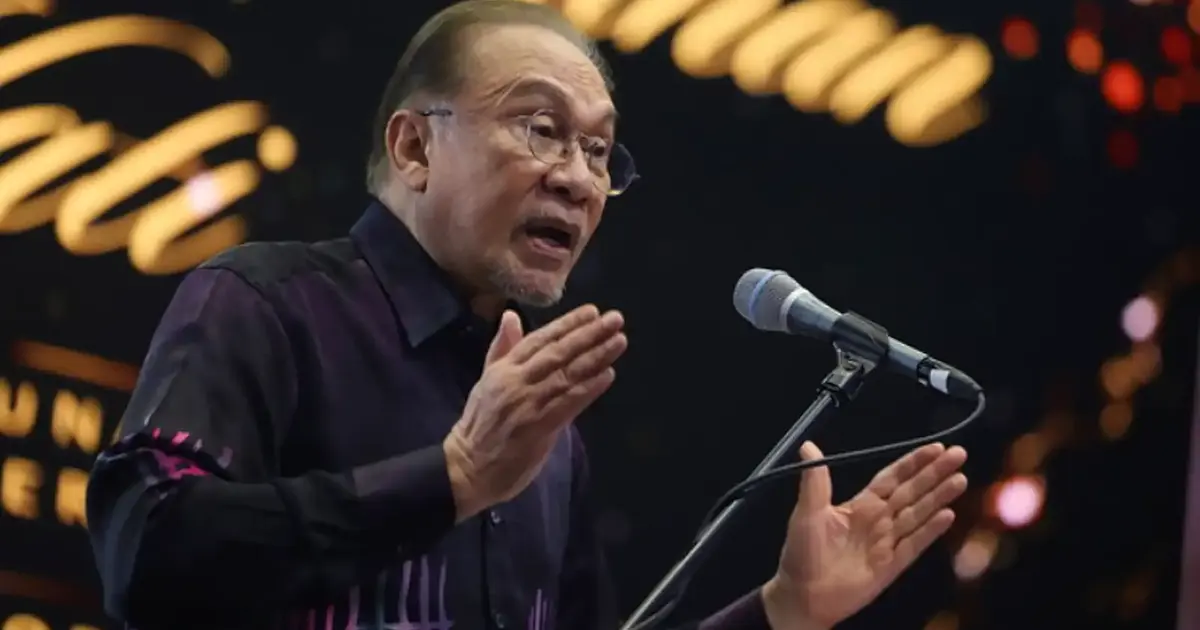
Prime Minister Anwar Ibrahim has made a direct appeal to Malaysians to transcend divisive messaging propagated by specific political figures, underscoring the essential role that the country's multicultural fabric plays in national development. In remarks that reflect broader concerns about polarizing rhetoric in the political sphere, Anwar positioned Malaysia's diversity not merely as a demographic characteristic but as a foundational asset that underpins social cohesion and economic prosperity.
The Prime Minister's intervention signals growing frustration within government circles about the persistence of inflammatory language that seeks to pit communities against one another. Rather than engage directly with individual purveyors of such narratives, Anwar adopted a more elevated framing that appeals to the electorate's better instincts and shared national interests. This rhetorical approach—calling citizens to "rise above" rather than demanding accountability—reflects a deliberate political strategy to shift focus away from contentious exchanges toward constructive nationalism.
Malaysia's trajectory as a multireligious, multiethnic state has long been presented as exceptional within Southeast Asia, a region where identity-based tensions have frequently threatened social stability. The formation of the Federation in 1963 was itself predicated on careful constitutional arrangements designed to accommodate diverse communities while establishing clear frameworks for coexistence. Yet decades later, the management of ethnic and religious sensitivities remains a delicate exercise, particularly during electoral cycles when politicians are tempted to mobilize support along communal lines.
Anwar's emphasis on diversity as a strength carries particular resonance given Malaysia's economic interdependence across ethnic lines. The nation's trading networks, professional sectors, and informal economies all rely on cross-community cooperation and trust. When political rhetoric erodes such trust by essentializing group identities or promoting zero-sum competition, the consequences extend beyond ideological disputes into tangible economic and social costs. Businesses operating across different communities, educational institutions with mixed student bodies, and civil service departments all function more effectively in environments characterized by mutual respect rather than suspicion.
The timing of such remarks frequently reflects underlying tensions not immediately apparent in mainstream media coverage. Political leaders often make statements about national unity in response to specific incidents or campaigns that have generated grassroots anxiety, though such triggers may not be explicitly mentioned in formal public addresses. Anwar's call to reject hate peddling suggests that certain public figures—whether opposition politicians, fringe activists, or social media influencers—have been deploying rhetoric deemed sufficiently corrosive to warrant prime ministerial intervention.
Regional observers note that Malaysia's political system has evolved mechanisms for managing diversity that differ markedly from neighboring democracies. The constitutional settlement, the role of the monarchy, and traditions of consultation within UMNO-led coalitions all provide stabilizing structures. However, these institutions function effectively only when political actors exercise restraint and commit to unwritten norms of acceptable discourse. When such norms erode through repeated violations, even well-designed constitutional frameworks can struggle to maintain equilibrium.
Anwar's tenure as Prime Minister has coincided with unprecedented coalition building, including partnerships with opposition-aligned parties and structures designed to broaden representation beyond traditional UMNO strongholds. This political reconfiguration has both benefits and complications: while it theoretically allows for more inclusive governance, it also creates incentives for certain actors to deploy divisive rhetoric to mobilize traditional constituencies and preserve relevance. The Prime Minister's call to transcend such tactics may partly reflect recognition that his governing coalition's stability depends on subduing identity-based polarization.
The emphasis on diversity as a strength also carries international dimensions. Foreign investors, multinational corporations, and international partners often cite social stability and interethnic harmony as factors influencing their engagement with Malaysia. Perception of rising communal tensions can affect investment flows, tourism patterns, and diplomatic relationships. When prime ministers publicly affirm commitment to pluralism and reject hate speech, they are signaling to external stakeholders that Malaysia remains fundamentally committed to the governance model that has enabled its development over recent decades.
For ordinary Malaysians navigating daily life in diverse communities—neighborhoods, workplaces, religious institutions, and civil society organizations—the political tenor matters profoundly. Rhetoric that characterizes other ethnic or religious groups as inherent threats or competitors for resources creates psychological distance and erodes the casual intercommunal interactions that characterize functioning multicultural societies. Conversely, leadership messaging that celebrates diversity and condemns divisive politics creates permission structures for citizens to prioritize shared interests over group identities.
The challenge facing Anwar and other moderate political voices lies in translating such exhortations into concrete institutional practices and political consequences. Calling citizens to reject hate is rhetorically powerful but administratively vague. Meaningful progress requires sustained investment in educational curricula that promote pluralism, media regulatory frameworks that discourage inflammatory content, and intraparty mechanisms that sanction politicians who deploy divisive tactics. Without such follow-through, even powerful prime ministerial statements risk being perceived as performative rather than substantive.
Looking forward, the sustainability of Anwar's multicultural vision depends substantially on whether political competitors adopt similar standards of discourse or whether they perceive divisive rhetoric as a competitive advantage. In electoral systems where mobilization along communal lines has historically delivered votes, the temptation to abandon restraint remains acute. The Prime Minister's public call to transcend hate peddling thus functions simultaneously as both an appeal to national unity and an implicit warning that certain political boundaries remain operative, even if enforcement mechanisms remain implicit rather than formalized.