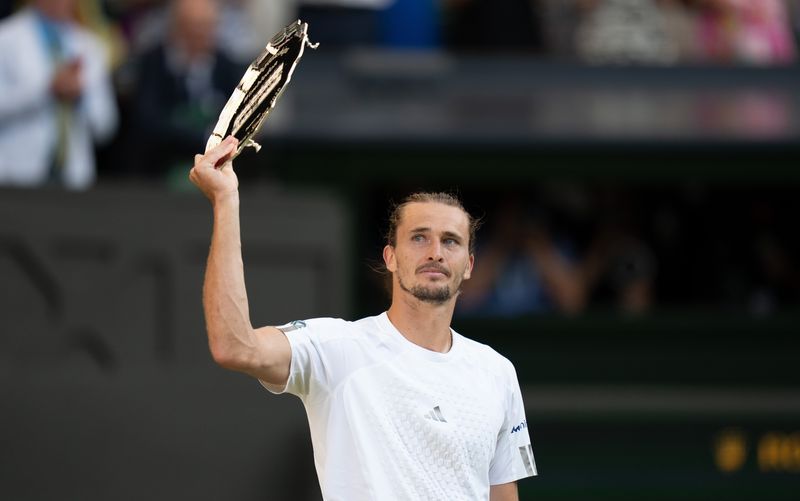
German tennis star Alexander Zverev is set to break into the world's top two on Monday following his impressive performance at the Wimbledon Championships, yet he finds himself still searching for a pathway to consistently compete with the sport's current powerhouses. Despite reaching his first Grand Slam final at the All England Club, Zverev suffered defeat to world number one Jannik Sinner in a closely contested match that extended to four sets. The result extended his head-to-head losing streak against the Italian to ten consecutive defeats, though this particular loss felt fundamentally different—a genuine contest rather than a one-sided affair that might have turned had circumstances aligned differently.
Zverev's journey to the Wimbledon final represented a marked shift in his tactical approach to professional tennis. The 29-year-old German has committed to a more aggressive style of play throughout the year, particularly evident in his use of the forehand, a stroke that historically drew criticism for its passivity. This tactical evolution bore immediate fruit when he captured the French Open title last month—a breakthrough first Grand Slam victory that arrived at his 41st attempt at tennis's major championships. The significance of that Paris triumph extended beyond the trophy itself; it fundamentally altered Zverev's psychological approach to competing at the sport's highest level.
The nature of Zverev's recent advances in major tournament performance cannot be entirely divorced from the circumstances that surrounded them. Jannik Sinner's unexpected second-round exit at Roland Garros and Carlos Alcaraz's absence due to a persistent wrist injury created an unusual configuration at that event. While such observations inevitably invite scrutiny about the legitimacy of his breakthrough victory, Zverev has since demonstrated that his improved form represents genuine tactical development rather than merely capitalised opportunity. His performance against Sinner at Wimbledon, where neither Italian champion nor Spanish competitor were hampered by circumstance, provided validation of his evolved playing style.
The specifics of Zverev's approach reveal a calculated gamble with substantial potential returns. His first serve percentage remained remarkably consistent at approximately eighty percent throughout the Wimbledon final, a critical foundation for aggressive baseline play. More significantly, his forehand—previously a liability that opponents could exploit—transformed into a weapon of considerable destructive capability that repeatedly forced Sinner into defensive positions. Zverev demonstrated willingness to commit entirely to offensive opportunities, accepting the inherent risk that accompanies such uncompromising play. His philosophy centres on maximising aggression when opportunities present themselves, regardless of whether individual shots succeed or fail.
Zverev's candid assessment of his competitive standing within men's tennis reveals both realistic self-appraisal and genuine ambition tempered by current reality. While Sinner and Alcaraz have accumulated twelve Grand Slam titles between them, Zverev recognises that his single major victory, however significant personally, leaves substantial ground to traverse. He characterises his recent efforts against these rivals as approaches that have pushed them to competitive limits without yet delivering victories, particularly noting his four-set loss to Sinner in the Wimbledon final represented an exceptionally tight contest that might feasibly have extended to five sets under marginally different circumstances. This interpretation frames Zverev not as a distant challenger but as someone narrowing the competitive gap through sustained tactical improvement.
The question of whether a third dominant force can genuinely emerge in contemporary men's tennis carries implications extending beyond individual player rivalries. For nearly two decades, the sport has grappled with the reality that elite competitions increasingly become predictable when dominated by a small coterie of exceptional talents. Zverev's emergence as a genuine threat rather than a perennial also-ran would introduce welcome unpredictability to major championships. His self-described role as perpetually "the third guy" who nonetheless remained "far away from those two" now appears poised for recalibration if his tactical evolution continues yielding results at the sport's highest competitions.
Zverev's physical setback during the Wimbledon final, specifically a fall that caused him to over-extend his knee at a critical juncture, introduced an element of speculation about the match's trajectory. The incident occurred at three games to three in the third set, precisely when Zverev held his only break point opportunity against Sinner's service. Following the fall, Zverev's serving velocity noticeably diminished, reflecting the difficulty of generating power when launch mechanics have been compromised. Though he stabilised his performance sufficiently to maintain competitive structure, the injury fundamentally altered the match's momentum at a moment when Zverev possessed maximum leverage for tactical advancement.
The psychological dimension of Zverev's recent trajectory deserves careful consideration alongside purely technical analysis. His breakthrough Grand Slam victory in Paris injected confidence that manifested visibly throughout his Wimbledon campaign, enabling the German to sustain aggressive shot-making against an opponent of Sinner's calibre without reverting to defensive patterns. This psychological resilience represents a critical component of elite tennis performance, particularly when executing high-risk strategies. Zverev's willingness to maintain aggressive positioning and shot selection despite the inherent vulnerability such approaches create suggests fundamental shifts in how he perceives his competitive capability.
Looking forward, Zverev's trajectory will substantially depend on whether his tactical evolution proves sufficiently sustainable and adaptable to diverse playing surfaces and opponent styles. The attacking approach that flourished on Wimbledon's grass courts against Sinner's defensive solidity may require modification when deployed against Alcaraz's aggressive counterpunching or across the varied challenges presented by hard courts and clay surfaces. Nonetheless, Zverev's ascent to world number two and his genuine competitive performance against tennis's dominant figures suggest that men's professional tennis may be entering an era where outcomes depend less on the predictable prevalence of two extraordinary talents and more on genuine competitive parity among the sport's elite competitors.
Zverev's conviction that continued refinement of his aggressive approach will yield increasingly positive results reflects both justified optimism and reasonable self-assessment. The German's position within professional tennis appears fundamentally altered from previous seasons, no longer confined to the peripheral role of perpetual challenger but positioned as someone genuinely capable of winning the sport's most significant competitions. Whether this represents a sustainable reorientation or merely an encouraging interlude will ultimately depend on Zverev's capacity to maintain tactical consistency and physical durability across the demanding schedule that major championship tennis demands throughout the remainder of his career.

