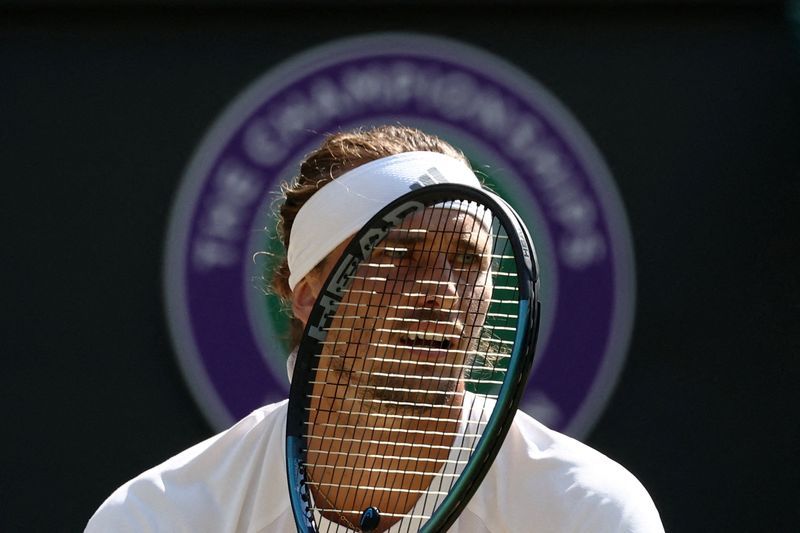
Alexander Zverev has secured his maiden semi-final appearance at Wimbledon by dismantling Taylor Fritz 6-4 6-4 6-2 on Court One, snapping a frustrating two-year losing streak against the American in the process. The result propels the German second seed into the last four, where he will face Britain's Arthur Fery, who defeated Flavio Cobolli in the quarter-finals. With the victory, Zverev maintains his bid for consecutive Grand Slam titles following his triumph at the French Open, though he faces a challenging road ahead against the home favourite.
Zverev's triumph over Fritz represents a significant breakthrough in their head-to-head record. The German had lost his previous seven encounters with the American, including a defeat at the All England Club last year that would have weighed heavily on his mind entering this fixture. Overcoming such a psychological barrier in a quarter-final match demonstrates both mental fortitude and tactical improvement, particularly given the significance of the contest. Zverev's ability to reverse a consistent pattern of failure reflects the kind of resilience required to compete at the highest levels of professional tennis, where momentum and confidence play crucial roles in tournament progression.
The match unfolded with Zverev seizing the initiative from the outset. Under intense heat on Court One, he secured an early break to establish a 5-4 lead in the opening set before consolidating his advantage. Fritz mounted a late charge that threatened to complicate matters, but Zverev successfully defended his position through the tenth game to claim the set. The early aggression set the tone for what would become an increasingly dominant performance as the match progressed, with the German's superior court positioning and serve consistently putting his opponent under pressure.
Fritz's physical struggles during the second set provided Zverev with additional momentum. After receiving medical attention for a right knee issue following three games, the American's movement appeared compromised, allowing Zverev to accelerate his attack. The German capitalised ruthlessly, securing crucial breaks that effectively put the contest beyond reach. News from Centre Court that home favourite Fery had advanced to the semi-finals energised the crowd, though Zverev's controlled play left little doubt about the eventual outcome. By the time Fery's victory was confirmed, Zverev had already moved closer to his own passage through with a comfortable service hold.
Zverev's approach to breaking his curse against Fritz involved meticulous preparation and unwavering focus. Speaking after the victory, the 29-year-old acknowledged the psychological dimensions of facing an opponent who had dominated recent encounters. He admitted to knowing that nearly perfect execution would be necessary to overcome the mental barriers created by the losing streak. Even simple matters, such as holding serve in the opening game against three break points, required intense concentration. This level of mental discipline reflects the difference between talented players and those capable of winning major tournaments on grass and clay surfaces simultaneously.
The German's third-set performance showcased the calibre of tennis that has made him one of the world's elite players. A scintillating backhand winner at 4-1 established a double break advantage, effectively putting the match beyond meaningful suspense. Zverev closed out the set with minimal fuss, completing his 12th major semi-final appearance across his career. The clinical finishing underscored his capacity to convert dominant positions into victories, a quality that separates contenders from champions at Wimbledon.
Zverev's progression to the semi-finals places him among an exclusive group of German male players to achieve the feat. He becomes the fifth German man to reach the Wimbledon semi-finals during the professional era that began in 1968, joining the company of Boris Becker, Michael Stich, Rainer Schuettler, and Tommy Haas. This historical context emphasises both the rarity of deep tournament runs by German players at the All England Club and Zverev's credentials as a genuine title threat. For Malaysian and Southeast Asian fans following the tournament, Zverev's run represents compelling storylines involving nationality, history, and the pursuit of back-to-back major titles.
The upcoming semi-final confrontation with Fery presents an intriguing narrative centred around the home crowd advantage and contrasting career trajectories. While Fery is competing in his maiden Wimbledon semi-final appearance, Zverev brings Grand Slam-winning experience and greater exposure to high-pressure matches on major stages. The British player's path to the semi-finals represents a remarkable achievement for a home player, particularly given the traditional difficulties faced by English competitors at the All England Club. Zverev showed sportsman-like grace in acknowledging this, joking with the crowd about their natural allegiances while expressing confidence in his own preparation and abilities.
Zverev's mental approach to the Fery match will prove decisive given the emotional advantage the crowd will provide the British player. The German's previous experience navigating hostile crowd environments at major tournaments positions him well to absorb the atmospheric challenge. His backhand, which produced the decisive winner in the third set against Fritz, will likely feature prominently in tactical planning for the semi-final. Similarly, his serve has proven reliable under pressure throughout his career, a quality that becomes increasingly valuable when facing an opponent buoyed by home support.
The broader implications for Grand Slam competition extend beyond individual matches. Zverev's pursuit of consecutive major titles across different surfaces demonstrates the versatility required of modern champions. Few players achieve success on the clay courts of Roland Garros and grass courts of Wimbledon in the same season, reflecting the technical and physical adjustments necessary. Should Zverev reach the final and eventually claim the title, he would join an elite cohort of contemporary players capable of such feats. For regional audiences following tennis development, his trajectory offers insights into the pathways required for sustained excellence in professional sport.
The German's comments following victory emphasised the intensity of focus required to overcome established patterns of defeat. He noted that concentration had to begin from the opening serve and continue throughout the match without lapse. This psychological rigour, combined with technical excellence and physical conditioning, separates players capable of winning Wimbledon from those who merely reach the later rounds. As Zverev prepares for his semi-final against Fery, the combination of experience, confidence from defeating Fritz, and determination to complete back-to-back Grand Slam titles will prove instrumental in determining the outcome. The path to championship glory in southwest London narrows further with each successive round, and Zverev has demonstrated the quality and resolve required to navigate these heightening challenges.

