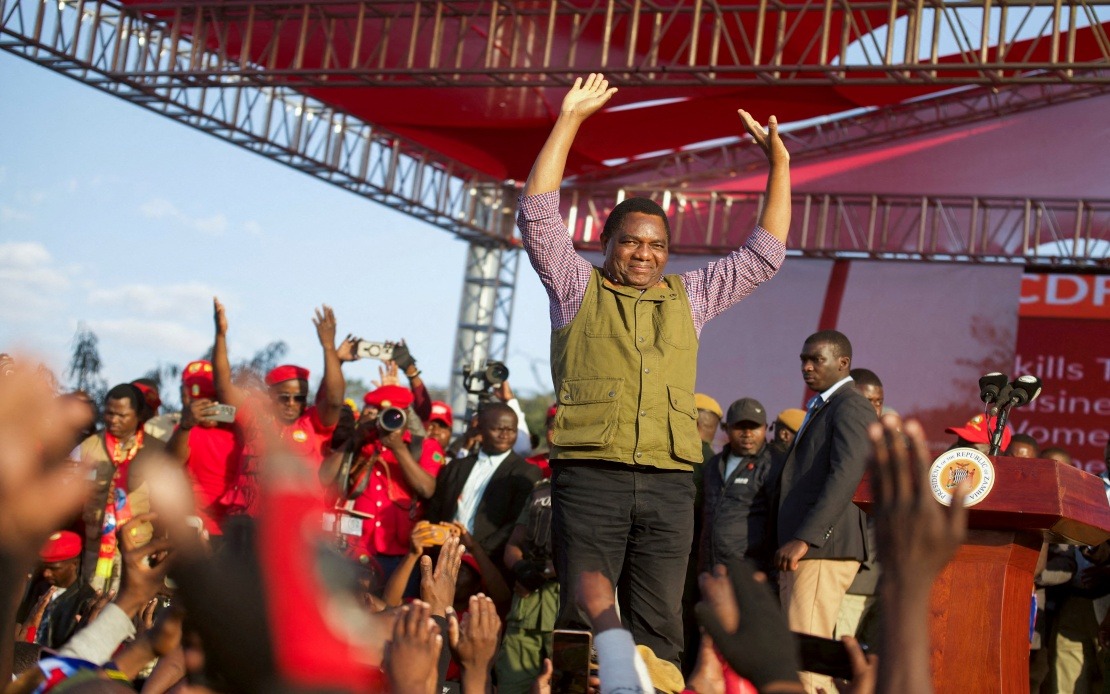
Zambian President Hakainde Hichilema has won re-election for a second term in office, the Electoral Commission of Zambia confirmed early Tuesday, consolidating his grip on power after a decisive victory in voting held the previous Thursday. The 64-year-old incumbent accumulated more than 2.9 million votes, a commanding performance that cleared the constitutional requirement of 50 per cent plus one vote with substantial room to spare, according to electoral authorities in the Southern African nation.
Hichilema's victory margin proved decisive enough that Electoral Commission chairperson Mwanagala Zaloumis declared the outcome sufficiently conclusive to warrant early announcement of results. The electoral official noted that outstanding tallies from certain polling stations across five of Zambia's 226 constituencies would prove immaterial to the final outcome, justifying the premature conclusion of the electoral count. This observation underscores the magnitude of Hichilema's support across the southern African state.
The incumbent substantially outpaced his primary opponent, Brian Mundubile of the National Restoration Party for Unity and Progress, who garnered 1.8 million votes. The margin of approximately 1.1 million votes between the frontrunners demonstrates the scale of Hichilema's electoral advantage and suggests consolidation of support among Zambian voters since the previous presidential contest. Mundubile's performance, while respectable, fell considerably short of mounting a serious challenge to the governing party's control of the executive.
Hichilema's response to his triumph struck a characteristically humble tone, with the president-elect expressing gratitude through social media shortly after his official declaration. Speaking via Facebook following Zaloumis's announcement at the national election centre in Lusaka, he emphasized the responsibility his supporters had entrusted to him and pledged continued service to the nation. The measured rhetoric contrasted with the exuberant celebrations erupting across the capital as citizens converged on city streets in the pre-dawn hours.
Lusaka experienced a festive atmosphere that intensified as voting patterns became apparent and remained animated well into the morning following the announcement. Residents from diverse socioeconomic backgrounds and demographic groups mingled on thoroughfares, celebrating the electoral outcome despite the harsh early-morning conditions. The spontaneous gatherings suggested genuine enthusiasm among segments of the urban population for Hichilema's continued leadership, or at minimum satisfaction with the electoral process itself.
Party leadership echoed calls for continued governance competence, with Collins Maoma, national chairperson of Hichilema's ruling United Party for National Development, urging the president to maintain the performance standards he had established during his initial tenure. Maoma's remarks to journalists highlighted the UPND's interpretation of the electoral result as a popular endorsement of the incumbent's stewardship and a mandate for sustained policy direction. The party functionary framed the outcome as evidence that Zambian voters retained confidence in Hichilema's leadership capabilities and strategic vision for the country.
Hichilema's election represents a significant development within Southern African politics, where leadership transitions and electoral competition vary considerably across the region. Zambia, as a major copper-producing nation with substantial economic influence in the broader African context, typically commands attention from international observers and regional analysts monitoring political stability and democratic processes. The comfortable re-election of an incumbent suggests institutional stability and effective consolidation of governing authority in a region where political transitions sometimes occur amid contentious circumstances.
For Malaysian observers and Southeast Asian analysts tracking African political trends, Hichilema's victory holds implications regarding governance trajectories in resource-dependent economies. Zambia's reliance on copper revenues parallels dynamics affecting several emerging Asian economies similarly vulnerable to commodity price fluctuations. The president's re-election suggests voters either approved of his economic management strategies or perceived no viable alternative among opposition offerings, a calculation relevant to understanding emerging market political economies broadly.
The electoral outcome also reflects broader regional patterns whereby presidential incumbents enjoy inherent structural advantages in re-election campaigns, from media exposure to administrative resources. Hichilema's decisive margin exceeded what might have been anticipated from simple incumbent advantage, however, suggesting either effective governance performance during his initial term, fragmentation among opposition forces, or both factors operating in tandem. Understanding which dynamic predominated requires closer examination of voter motivations and opposition positioning within Zambian political discourse.
Moving forward, Hichilema's second term will confront significant economic and governance challenges characteristic of copper-dependent southern African states. Global commodity market conditions, fiscal sustainability concerns, and structural economic transformation requirements will occupy his second administration's agenda. The electoral mandate he has received provides political capital for pursuing ambitious policy initiatives, though it remains contingent upon delivering tangible improvements in living standards and economic opportunity for constituencies that elevated him to renewed executive authority.

