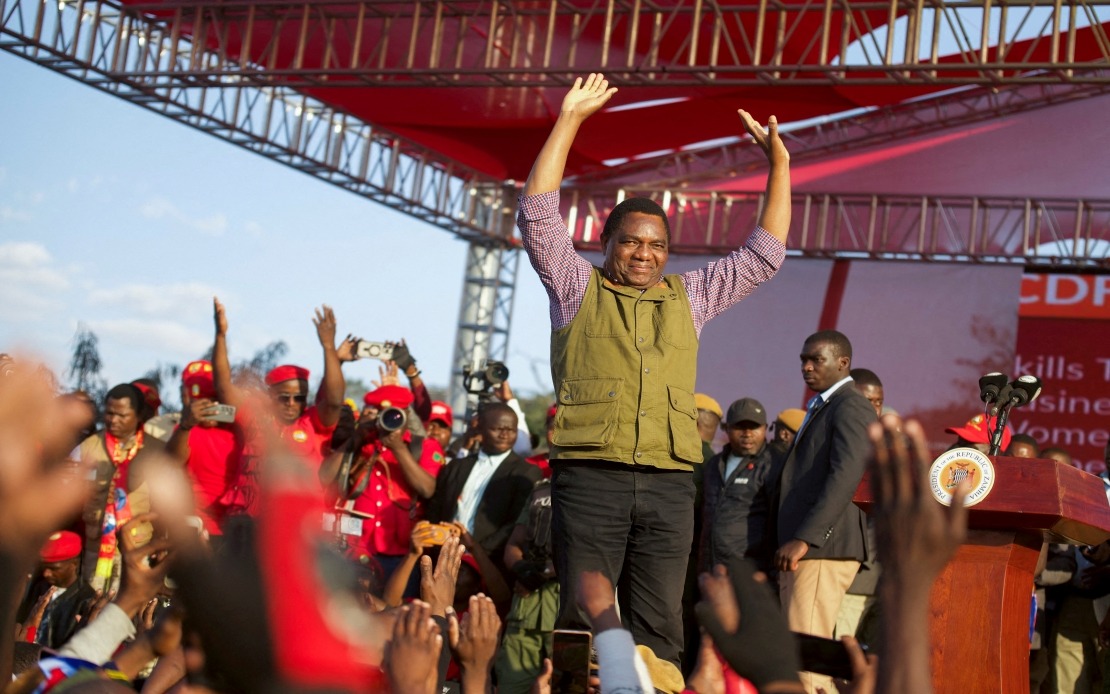
Zambian President Hakainde Hichilema has established a decisive advantage in the country's presidential contest, capturing more than 1.5 million votes as results from 135 of 226 constituencies were counted by Sunday. With 1,544,140 votes already in his corner, the 64-year-old incumbent appears positioned to secure re-election under his party, the United Party for National Development, barring an unexpected reversal in the remaining tallies. The Electoral Commission of Zambia announced the consolidated results at its national centre in Lusaka on Sunday evening, with Chairperson Mwangala Zaloumis overseeing the announcement.
Hichilema's nearest competitor, Brian Mundubile of the National Reconciliation Party for Unity and Prosperity, trails significantly with 1,030,662 votes. Mundubile, a 55-year-old lawyer, stands among thirteen candidates vying for the presidency. The gap between the two frontrunners suggests momentum decisively favours the sitting president, particularly as counting progresses through constituencies that have historically supported his administration. This commanding position represents a stark contrast to the tight competitions that have characterised elections elsewhere in the region, where incumbent advantages have frequently eroded under pressure from organised opposition coalitions.
For Malaysian readers accustomed to multi-party political systems, understanding Zambia's electoral framework proves instructive. The country's constitution stipulates that a presidential victor must secure more than fifty percent of all valid votes cast. This threshold requirement carries significant implications for Hichilema's path forward. Should he maintain his current trajectory, the president could clinch outright victory without triggering a second-ballot runoff between top contenders, expediting the formal conclusion of the contest and allowing his administration to proceed with continuity planning.
Hichilema's first tenure, which commenced in 2021 following a landslide victory over then-President Edgar Lungu with a margin exceeding one million votes, established the foundation for his current political strength. An economist and rancher by background, he has consistently emphasised his administration's accomplishments during the 2021-2025 period. These achievements, as articulated by his campaign, centre upon three principal domains: comprehensive restructuring of Zambia's severely strained external debt burden, revitalisation of the nation's mining sector—historically the engine of economic growth—and expansion of social welfare programmes including the introduction of free education across public primary and secondary institutions.
The debt restructuring programme warrants particular attention for regional observers, as it reflects broader patterns across Southern and East Africa where several nations have grappled with unsustainable public borrowing. Zambia became the continent's first pandemic-era sovereign defaulter, prompting urgent fiscal reforms under Hichilema's watch. Success in stabilising this trajectory would represent a tangible policy achievement capable of translating into electoral support. Similarly, the mining sector's fortunes carry weight extending beyond Zambia's borders; as a major copper exporter competing within global commodity markets, the sector's performance influences the broader Southern African growth narrative and potentially affects supply chains relevant to East and Southeast Asian manufacturing economies.
Mundubile's opposition coalition, whilst trailing substantially at the counting midpoint, has reportedly secured parliamentary representation in several constituencies concentrated along Zambia's urbanised corridor, which spans from Lusaka through the Copperbelt region northward. This geographic distribution matters for interpreting the broader political landscape. Urban constituencies frequently harbour distinct demographic profiles—younger populations, higher education levels, greater connectivity to information flows—making them barometers for alternative political sentiment. That Mundubile's alliance captured parliamentary seats in these areas despite trailing in the presidential race suggests some segmentation between presidential and legislative preferences among certain voter blocs, a pattern increasingly visible across African democracies.
The concentration of opposition strength in the Copperbelt holds historical resonance. This mining region has traditionally served as a crucible for labour activism and political contestation in Zambian politics. Workers' grievances regarding wages, conditions, and resource wealth distribution often crystallise in these localities. Hichilema's administration claims to have addressed such concerns through mining sector reform, yet apparent opposition competitiveness in these areas hints that segments of the working population may remain unconvinced of the government's commitment to equitable benefits distribution from copper revenues.
As results continue flowing in from the remaining constituencies, Hichilema's substantial lead suggests he possesses considerable resilience against adverse swings in remaining tallies. Assuming results from outstanding constituencies broadly mirror the patterns observed thus far, his path to exceeding the fifty-percent threshold appears secure. This would spare the nation a potentially divisive second ballot and provide political stability for addressing governance challenges that extend beyond election season concerns.
For Southeast Asian observers, Zambian electoral stability carries indirect relevance through multiple vectors. Southern Africa's political steadiness influences investment confidence across the broader continent, affecting multinational operations and commodity trading that indirectly involve Asian financial and commercial interests. Additionally, Zambia's debt restructuring outcomes serve as case studies for international financial architecture debates involving emerging market negotiations with creditors, discussions wherein ASEAN nations occasionally participate through multilateral forums and development finance institutions.
The broader implications of Hichilema's likely re-election extend beyond national boundaries. A second term would provide continuity for implementing longer-term structural reforms that require sustained political will and institutional commitment. The president's economist background suggests technocratic governance prioritising measurable economic indicators. Whether such an approach can adequately address underlying concerns about equitable resource distribution and social inclusion—evident from opposition gains in certain parliamentary constituencies—remains an open question. The election results thus far, whilst indicating strong presidential support, do not necessarily reflect uniform approval of all government policies or satisfaction across all demographic segments.
Zambia's democratic process, now in its advanced counting stages, continues demonstrating the continent's capacity for conducting electoral exercises amid institutional frameworks. The Electoral Commission's transparent announcement of intermediate results at the national centre in Lusaka reflects procedural adherence to institutional norms. Such transparency, though not guaranteeing perfect impartiality, establishes foundations for democratic legitimacy that regional counterparts might study and potentially emulate. For ASEAN nations occasionally grappling with questions of electoral credibility and institutional independence, observing how African democracies structure their processes offers comparative perspectives on institutional design and democratic practice.

