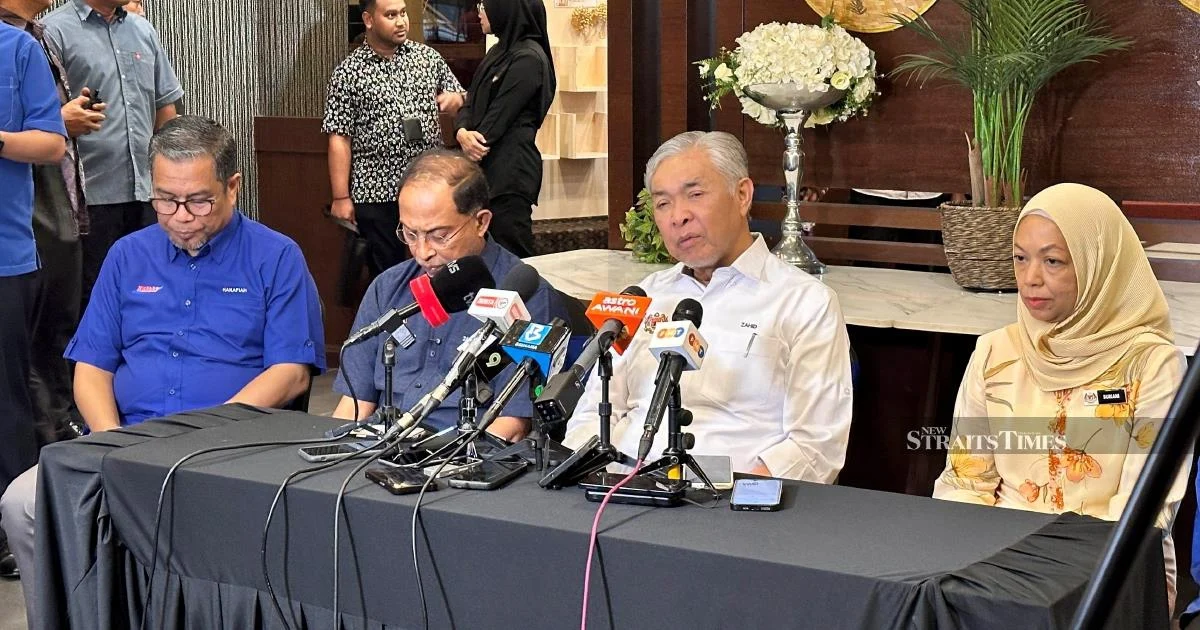
Barisan Nasional's top leadership signalled growing tension within the unity government coalition over campaign strategy in Johor, with chairman Datuk Seri Dr Ahmad Zahid Hamidi publicly cautioning his allies to steer clear of references to former Prime Minister Najib Razak and his wife Datin Seri Rosmah Mansor during the state election push. The apparent rebuke, delivered during a campaign event in Kluang, underscores the delicate balance the ruling coalition must maintain as it seeks to consolidate support across multiple political factions with divergent historical baggage and voter sensibilities.
The cautionary message from Zahid appears directed at component parties within the unity government who have evidently chosen to leverage imagery or references tied to Rosmah in their campaign materials and messaging. This tactical choice reflects broader differences in how coalition members view their electoral positioning ahead of the crucial Johor contest. For some parties, particularly those with strong grassroots presence, invoking familiar political figures from BN's dominant years may resonate with certain voter demographics. However, the BN chairman's intervention suggests such an approach runs counter to the coalition's broader strategic direction and risks undoing efforts to present a fresh, unified face to the electorate.
The tension points to lingering sensitivities within Malaysian politics regarding the Najib era and its consequences. Rosmah has remained a politically divisive figure, facing scrutiny and legal challenges in recent years that have kept the former premier's household under public scrutiny. As a result, her invocation in campaign settings can trigger negative reactions among voters concerned about accountability and governance standards. The political calculus becomes more complex when different coalition members hold varying assessments of how campaign strategies will affect their respective electoral fortunes and base mobilization efforts.
Zahid's intervention carries particular weight given his position at the apex of BN's leadership structure. As chairman, he holds responsibility for coordinating campaign messaging and ensuring component parties align with the coalition's overall strategic direction. His public admonition serves as a corrective signal that certain campaign tactics are viewed as counterproductive or insufficiently aligned with the unity government's broader narrative. The move reflects his effort to enforce message discipline during a critical election period when coalition coherence directly translates into electoral performance.
Johor holds outsized importance for BN's electoral prospects and political trajectory. The state has historically served as a power base for the coalition and remains demographically significant within Malaysia's electoral landscape. A strong performance in the state election would provide crucial momentum heading into future national-level contests. Conversely, setbacks in Johor would amplify questions about BN's ability to command traditional support bases and could embolden opposition parties. This context makes campaign unity and strategic alignment particularly consequential, explaining why leadership takes visible action to correct perceived deviations from the approved approach.
The incident also illuminates the broader challenge facing Malaysia's unity government coalition. Composed of parties with distinct histories, constituencies, and political instincts, the coalition must constantly negotiate shared positioning on contentious historical matters. Some components were part of the previous BN administration during the Najib years, while others joined the unity arrangement more recently or from opposition backgrounds. This heterogeneity creates natural tensions over how to characterize the past, present opportunities, and future direction. Managing these tensions without allowing them to boil over into public disputes remains a core test of coalition discipline.
From a voter perspective, Zahid's intervention sends a message about the unity government's intended campaign tenor. By discouraging references to the Najib-Rosmah era, BN signals its desire to move beyond that chapter and focus instead on current governance performance and future policy commitments. This framing acknowledges that a significant portion of Malaysian voters harbour reservations about the previous administration and its handling of national resources and institutional integrity. By steering away from those references, the coalition aims to avoid reopening debates that could mobilise opposition voters and alienate swing constituencies.
The Johor election thus becomes a microcosm of the broader challenge confronting Malaysia's political leadership: balancing the need for coalition unity with the reality of deeply divided voter preferences and historical grievances. How effectively BN manages internal tensions over campaign messaging will likely influence not only the state election outcome but also the coalition's credibility heading into subsequent contests. Zahid's intervention, while seemingly focused on a specific tactical matter, reflects the intricate choreography required to maintain political momentum across a fragmented electoral landscape.
Looking forward, the unity government will need to develop clearer consensus on how historical references should be handled across different campaign contexts and regions. The Johor episode illustrates that leaving such matters to individual component party discretion risks creating public friction and sending contradictory signals to voters. As the coalition prepares for extended electoral competition, establishing firmer guidelines on campaign messaging will become increasingly important for maintaining the unified front that currently underpins the government's parliamentary majority and electoral viability.

