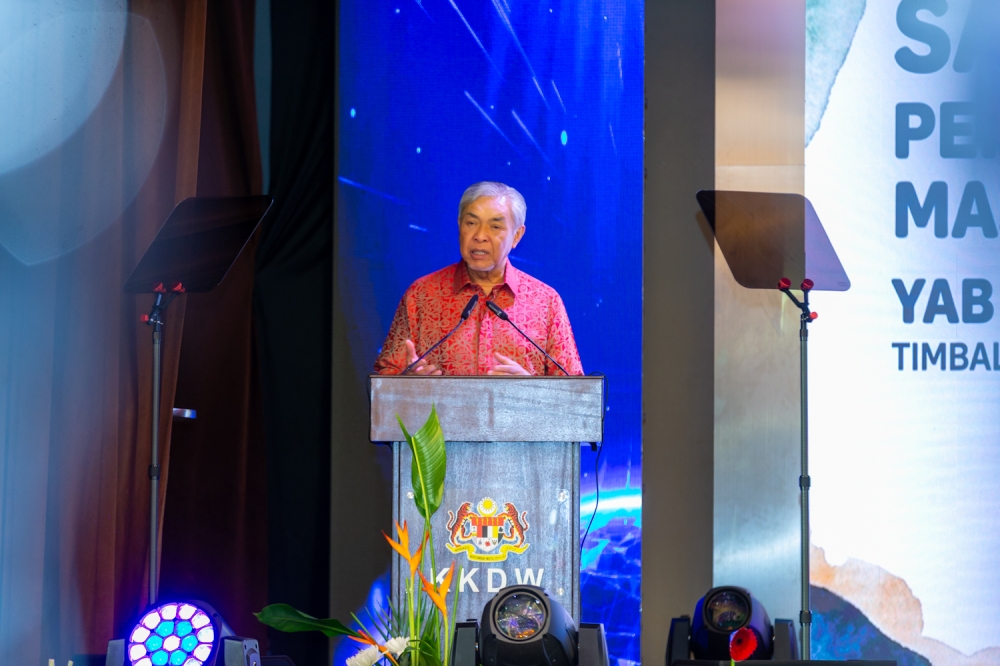
Kuala Lumpur—Deputy Prime Minister Datuk Seri Ahmad Zahid Hamidi has firmly refuted circulating reports suggesting he and other senior political figures met privately to explore alternative coalition arrangements, insisting instead that Malaysia's current unity government framework remains stable and has his full backing.
The DPM's categorical denial came in response to social media speculation that had gained traction in recent days, with claims alleging that luminaries from Barisan Nasional, Perikatan Nasional, Gabungan Parti Sarawak, and Gabungan Rakyat Sabah had gathered to discuss potential realignments at the national level. Zahid made clear that no such conclave occurred, signalling that such rumours appear designed to undermine confidence in the government's coalition arrangements.
Zahid's intervention serves an important stabilisation function at a moment when Malaysia's political landscape continues to experience considerable flux. Since the formation of the unity government following the 2022 general election, various parties have periodically been the subject of speculation regarding possible shifts in allegiance or the exploration of new power-sharing configurations. The Deputy Prime Minister's statement directly addresses these persistent questions by drawing a clear line between fact and unfounded gossip circulating in digital spaces.
The emphasis Zahid placed on his unwavering commitment to the unity government underscores the delicate coalition management required at the highest levels of Malaysian governance. The unity framework, which brought together former political rivals into a single governing coalition, has been credited with restoring institutional stability and ending the pattern of rapid government collapses that characterised Malaysian politics in the preceding years. By publicly reiterating his support, Zahid reinforces messaging from the Prime Minister's office about continuity and predictability in policy direction.
Context matters significantly here. Malaysian politics operates within a complex web of state-level and federal-level considerations, with various regional power bases exerting influence over national coalition dynamics. Sarawak's GPS party and Sabah's GRS represent distinct power centres with considerable autonomy in state affairs, while their federal support remains crucial to maintaining the government's parliamentary majority. Similarly, both Barisan Nasional and Perikatan Nasional maintain extensive grassroots networks and significant numbers of elected representatives. Any genuine realignment involving these actors would carry profound implications for governance stability.
The nature of the claims Zahid rejected deserves closer examination. Social media narratives frequently conflate informal political conversations with formal strategic negotiations. Senior politicians necessarily engage in ongoing dialogue to manage coalition tensions and explore mutual interests—this is standard practice in multi-party governments worldwide. However, the allegations in circulation specifically suggested a coordinated effort to construct an alternative governing coalition, which represents a fundamentally different undertaking from routine political communication.
Zahid's denial also carries weight because coalition changes at the federal level require not merely agreement among party leaders but support from sufficient numbers of Member of Parliament to command a parliamentary majority. Any successful realignment would necessarily involve persuading dozens of elected representatives to shift their allegiances, a process that would likely produce visible signs such as floor crossings and public statements from affected MPs. The absence of such indicators suggests either that the rumours lack foundation or that any discussions remain highly compartmentalised and speculative.
The political economy of unity government maintenance in Malaysia presents ongoing challenges that help explain why speculation about alternative arrangements periodically surfaces. Parties in coalition sometimes harbour differing policy preferences, electoral calendars do not synchronise, and the distribution of ministerial portfolios can generate internal friction. These tensions are natural features of multi-party governance and do not necessarily indicate imminent collapse. However, they do provide fertile ground for speculation and rumour-mongering, particularly among political actors seeking to advance their own factional interests.
For Malaysian observers and international stakeholders monitoring the country's political stability, Zahid's intervention provides reassurance about near-term continuity. The unity government has delivered measurable achievements in areas including infrastructure development, economic stimulus during the pandemic period, and institutional reform. Disrupting this arrangement would risk reintroducing the policy uncertainty and legislative paralysis that characterised earlier periods. The Deputy Prime Minister's strong language rejecting the coalition change speculation implicitly acknowledges these benefits while affirming that the current architecture warrants continued support.
Looking ahead, the trajectory of Malaysian coalition politics will likely remain subject to periodic speculation and media commentary. The unity government's staying power ultimately depends on sustained commitment from its constituent parties and on the government's ability to deliver tangible benefits to the Malaysian public. While Zahid's emphatic rejection of the rumours provides immediate reassurance, the deeper question concerns whether the coalition can sustain cohesion through upcoming state elections and through policy challenges including economic pressures and regional geopolitical shifts that may test the alignment of participating parties.
The Deputy Prime Minister's reaffirmation of commitment to the unity government framework also reflects broader calculations about political risk. In Malaysia's context, governments that project uncertainty about their own stability tend to experience accelerated deterioration, as fence-sitters among backbench MPs begin calculating their own electoral prospects. By moving swiftly to deny speculation and restate solidarity, senior government figures work to prevent the self-fulfilling prophecy whereby rumour cascades into actual defection. Zahid's statement should be read in part as a pre-emptive stabilisation measure rather than merely a reactive denial.

