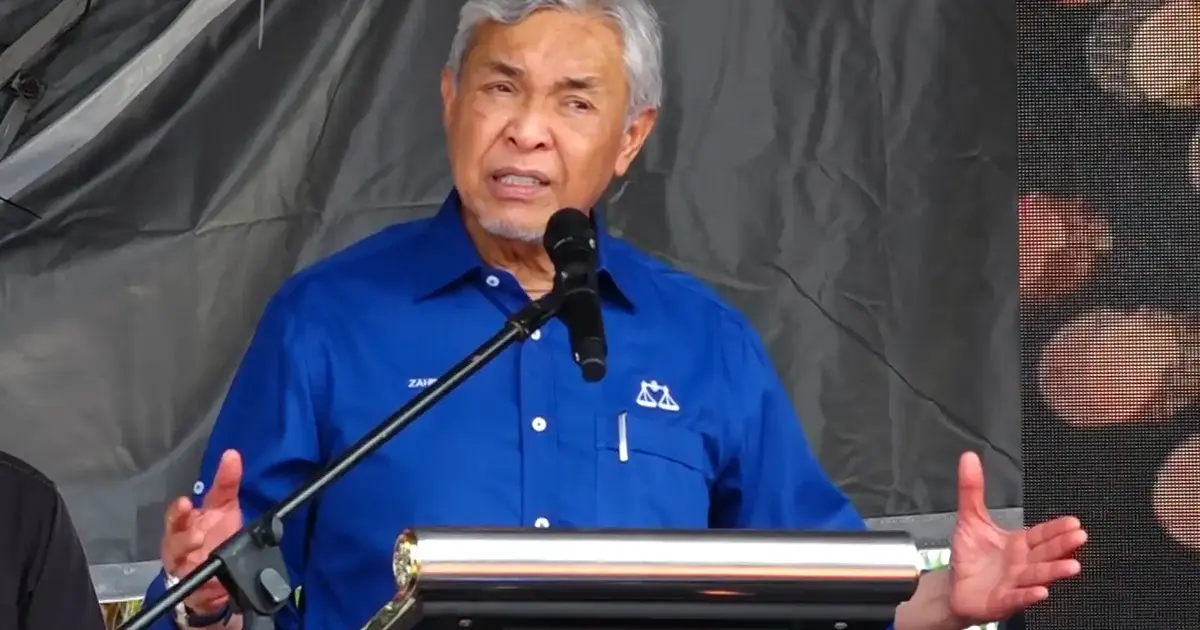
Ahmad Zahid Hamidi, president of the United Malays National Organisation and deputy prime minister, has flatly rejected suggestions that Barisan Nasional convened talks with Perikatan Nasional, Gabungan Parti Sarawak, and Gabungan Rakyat Sabah. Addressing speculation that has circulated in recent weeks about potential coordination between these major political blocs, Zahid stated he has no knowledge of any such gathering, signalling that reports of behind-the-scenes negotiations among opposition and regional players lack foundation.
The denial comes as Malaysian politics remains in a state of considerable flux. The current administration, formed under the Madani framework after the 2022 general election, has faced ongoing questions about its stability and the durability of its parliamentary majority. Zahid's firm statement serves to quell anxieties about coalition realignment that could undermine the government's foundation, though the very fact that such rumours circulate underscores the inherent fragility of multi-party governing arrangements in contemporary Malaysian democracy.
In reinforcing his position, Zahid emphasised that Barisan Nasional—the traditional political federation comprising UMNO, MIC, and MCA—remains steadfastly committed to sustaining the Madani administration through to the sixteenth general election, now anticipated sometime between 2026 and 2027. This reaffirmation of loyalty to the sitting government represents a deliberate counter-signal to opposition parties and suggests that despite periodic tensions, the coalition partnership underpinning executive power retains sufficient consensus to weather individual disputes. The timing of such reassurances matters considerably in Malaysian political cycles, where coalition discipline can evaporate rapidly if individual components perceive advantage in repositioning.
Perikatan Nasional, led by Muhyiddin Yassin, remains the primary opposition force, having contested the 2022 election under a unified banner that ultimately fell short of securing parliamentary plurality. The coalition comprises the Malaysian Islamic Party (PAS), the Malaysian People's Movement Party (BERSATU), and several regional entities. GPS, drawing its strength principally from Sarawak's political establishment, has historically maintained a pragmatic approach to coalition-building, often positioning itself to maximise leverage and resource allocation for the state it primarily represents. GRS, Sabah's primary political vehicle following the collapse of the Sabah UMNO structure and subsequent reorganisation, similarly operates with considerable autonomy in calculating its political interests.
The speculative meeting, had it occurred, would have represented a striking realignment of Malaysia's political topology. A formal coordination mechanism between Perikatan Nasional and the two East Malaysian regional powerhouses would effectively have positioned a substantial parliamentary bloc in potential opposition to Madani governance. Such a configuration could theoretically constrain executive flexibility and force concessions on policy questions ranging from resource distribution to legislative priorities. The fact that such scenarios continue to circulate suggests underlying anxieties about the sustainability of current arrangements persist among political observers and analysts.
Zahid's unambiguous denial appears designed to provide reassurance to government partners and investors seeking stability in policy direction. By explicitly stating his ignorance of any such meeting, the UMNO leader reduces uncertainty about coalition cohesion during a period when the administration has pursued significant policy initiatives requiring sustained parliamentary backing. Economic policy decisions, budget allocations, and legislative agendas all depend on maintaining coalition discipline, making clear signals about alignment particularly valuable.
The broader context matters here. Since the 2022 election, Malaysian politics has operated without clear supermajority dominance by any single bloc, necessitating carefully calibrated coalition management. Earlier governments under Muhyiddin Yassin and Ismail Sabri Yaakob both struggled with managing multiple factions demanding recognition and resource distribution. The current Madani administration, though enjoying broader cross-party support than its predecessors, nevertheless relies on active cooperation from partners who retain the capacity to withdraw support. Every coalition member consequently possesses leverage that could potentially be monetised through either continued collaboration or the threat of defection.
Regional politics in Sabah and Sarawak add additional layers of complexity. Both East Malaysian states maintain their own distinct political dynamics, with local issues—particularly resource management, infrastructure allocation, and autonomy within the federal framework—often taking precedence over national partisan divisions. GPS and GRS representatives in federal parliament represent not merely partisan interests but also constituent demands of their respective states. This reality means that any hypothetical coordination arrangement would need to accommodate legitimate regional priorities, complicating simple bilateral or trilateral negotiations.
The speculation around such meetings reflects deeper questions about Malaysian political trajectory. As the nation approaches the next general election cycle, positioning becomes increasingly consequential for all political actors. Coalition partners position themselves to negotiate improved terms either within existing arrangements or with potential alternatives. Opposition blocs attempt to present themselves as plausible alternatives to voters. Against this background, any indication of nascent cooperation between significant parliamentary players generates intense scrutiny and interpretation.
Zahid's explicit commitment that Barisan Nasional will support the Madani government through to the sixteenth general election carries symbolic weight precisely because such public pledges can be held against shifting political circumstances. Should unexpected coalitional breakdown occur subsequently, such statements would carry reputational consequences and undermine claims of political responsibility. The UMNO leadership consequently has incentive to ensure such commitments reflect genuine strategic calculation rather than mere rhetorical positioning.

