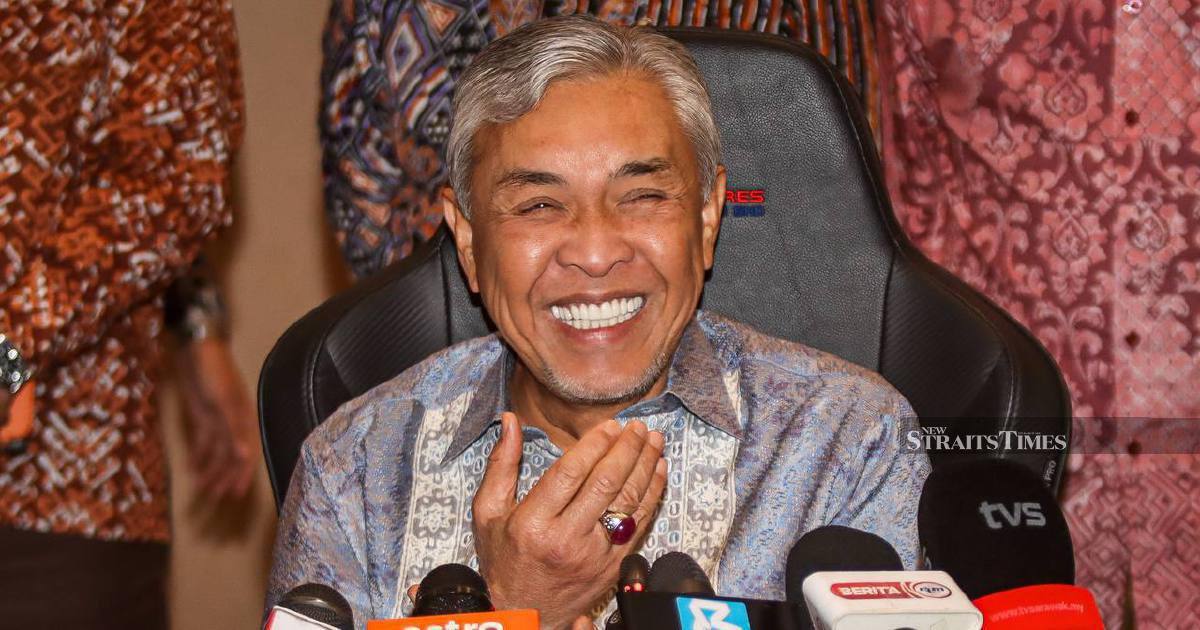
Deputy Prime Minister Datuk Seri Dr Ahmad Zahid Hamidi has offered his own contribution to the ongoing symbolic conversation with Prime Minister Datuk Seri Anwar Ibrahim, crafting a traditional four-line Malay pantun in response to the Prime Minister's earlier unity-themed verse. The exchange, which unfolded in George Town, reflects a distinctly Malaysian approach to high-level political communication—one that draws on classical Malay literary traditions to convey messages of substance beneath layers of poetic metaphor.
The pantun, a centuries-old form of Malay poetry deeply embedded in the nation's cultural fabric, has become an unexpected vehicle for dialogue between the two most senior figures in Malaysia's government. Rather than resort to the customary press statements and formal pronouncements, both leaders have chosen to engage through verse, suggesting an effort to infuse their political relationship with cultural resonance and perhaps a lighter touch of humour. This approach carries symbolic weight in a nation where traditional forms of expression remain culturally significant, particularly within Malay-speaking communities.
The Prime Minister's initial pantun centred on themes of unity and cohesion, using the imagery of roof and storm as metaphors for leadership during turbulent times. Such imagery speaks to Malaysia's political climate, where building consensus across diverse constituencies and managing competing interests remain perpetual challenges. By initiating the exchange through pantun, Anwar Ibrahim signalled a willingness to engage his deputy on softer ground, moving away from the sometimes adversarial tone that has occasionally characterised their public interactions.
Zahid's response carries its own layers of meaning. As Deputy Prime Minister and head of the United Malays National Organisation (UMNO), he occupies a position both complementary to and potentially competitive with the Prime Minister's role. His decision to respond in kind—employing the same classical form rather than dismissing it or retorting through conventional channels—suggests an acceptance of the collaborative tone being set. The four-line structure of a pantun allows for nuance and duality; the first two lines typically carry surface meaning while the concluding couplet conveys the deeper message intended by the poet.
The symbolism of this poetic exchange extends beyond mere pleasantries. Malaysia's coalition government brings together parties and leaders with different historical trajectories and political bases. UMNO, which governed Malaysia for decades before the watershed 2018 election, now shares executive space with Anwar Ibrahim's multiethnic People's Justice Party (PKR) and other coalition partners. Such power-sharing arrangements create natural friction points; when those fault lines are managed through cultural and symbolic channels rather than public acrimony, it suggests a maturity in political discourse.
For Malaysian readers and observers, this pantun exchange carries implications for how the current administration intends to navigate the coming months. Political unity in Malaysia is never monolithic; it is a carefully balanced ecosystem where different parties, despite sitting in cabinet together, must periodically reassert their distinct identities and constituencies. The use of pantun allows leaders to acknowledge this complexity while affirming commitment to the broader coalition project. It is a form of political communication that refuses simple binary readings.
The historical context matters as well. UMNO and its leaders have faced legal and political turbulence in recent years. Zahid himself has navigated significant personal and political challenges, making this moment of poetic dialogue with the Prime Minister noteworthy. It suggests that whatever tensions may exist within the coalition, there remains capacity for interaction framed in cultural terms—a reminder that Malaysian political life encompasses more than transactional manoeuvring and policy disputes.
Such exchanges also resonate with Malaysia's broader cultural identity. In an era where political communication increasingly happens through social media, sound bites, and adversarial framing, the deliberate choice to deploy pantun—a form requiring thought, craft, and cultural literacy—stands as a quiet assertion of Malaysian values. It harks back to a tradition where leaders were expected to be conversant in classical forms and where wit and linguistic skill carried political weight.
The immediate audience for this pantun exchange includes not only the Malaysian public but also members of the coalition itself. Other party leaders and grassroots politicians will note how the two most senior figures interact and calibrate their own behaviour accordingly. A positive tone at the top can percolate downward, reducing unnecessary friction within coalition structures that already operate along multiple fault lines.
Looking forward, the question becomes whether this poetic dialogue will translate into substantive cooperation on key legislative and policy agendas. Pantun can convey messages about intention and temperament, but governing requires concrete alignment on economic policy, security matters, and social issues. The symbolic warmth of the exchange must eventually meet the harder realities of coalition management and parliamentary mathematics.
Nevertheless, the pantun exchange serves an important function in Malaysia's political ecosystem. It demonstrates that even leaders from different parties and backgrounds can find common cultural ground. In a nation where unity remains aspirational rather than automatic, such moments—whether expressed through poetry or other means—matter more than they might appear on the surface. The roof and storm imagery invoked by the Prime Minister, now answered by the Deputy Prime Minister's verse, speaks to shared responsibility for keeping the nation's political house intact during times of stress.

