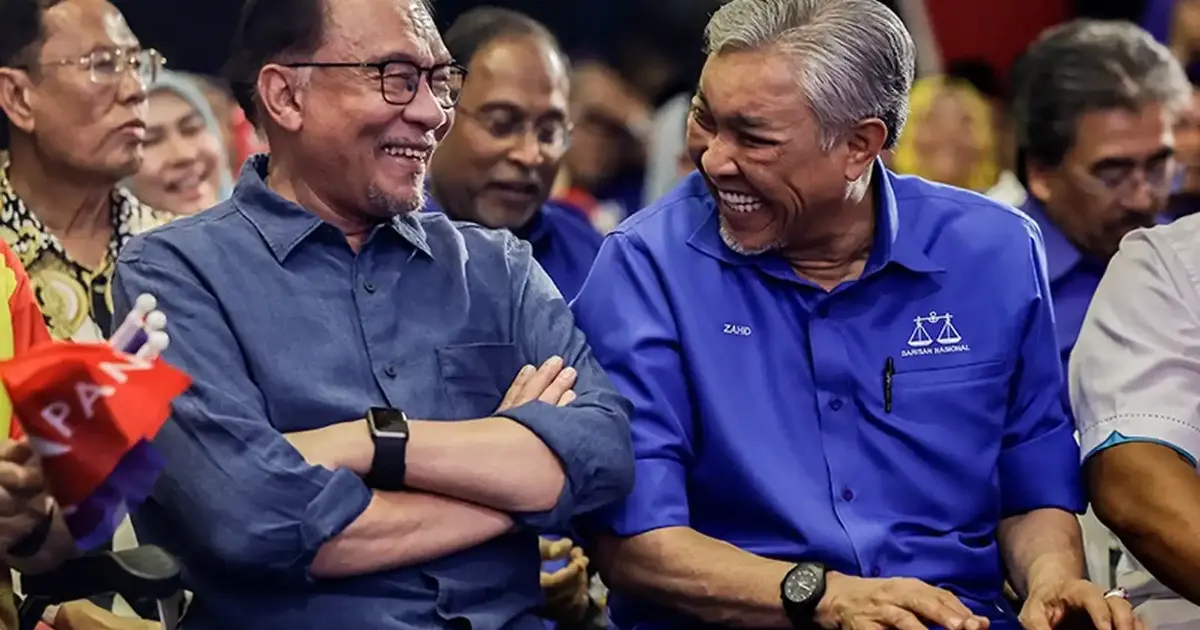
In a striking display of political theatre blending art with statecraft, Deputy Prime Minister Ahmad Zahid Hamidi has replied to Prime Minister Anwar Ibrahim's recent poem with verses of his own, signalling both camaraderie and careful positioning within Malaysia's delicate coalition framework. The exchange between the two senior figures underscores the symbolic dimensions of political messaging in Malaysia's complex power-sharing arrangement, where traditional forms of expression—including poetry—carry weight beyond their aesthetic value.
Zahid's poetic response arrives at a critical juncture for the unity government, which has transformed Malaysian politics by bringing together ideological adversaries under a shared governance structure. The gesture demonstrates how Malaysia's political leadership operates within multiple registers simultaneously, balancing public displays of unity with the underlying competitive dynamics that characterise any coalition. Poetry, with its capacity for simultaneous clarity and ambiguity, offers political figures a sophisticated vehicle for communication that transcends conventional press statements and public declarations.
Beyond the literary flourish, Zahid's remarks carry substantial political weight. As Barisan Nasional chairman, he used the occasion to reaffirm his bloc's steadfast commitment to sustaining the unity government throughout its mandated term. This assurance addresses persistent speculation within Malaysian political circles about the durability of arrangements that united Pakatan Harapan and Barisan Nasional despite their mutual antagonism during the 2022 general election campaign. Coalition mathematics in Malaysia remain perpetually precarious, with the government's survival contingent upon maintaining parliamentary numbers and managing intra-coalition tensions.
The poetry exchange, while seemingly lighthearted, reflects deeper anxieties within Malaysia's political establishment about governance legitimacy and institutional stability. Since the unity government's formation, observers have continuously questioned whether pragmatic accommodation could transform into genuine collaborative governance. The leaders' turn to poetic expression suggests an effort to humanise political relationships and project an image of partnership transcending bare electoral calculations. Such symbolic gestures matter substantially in Malaysian politics, where public perception influences both international confidence in governance and domestic political sustainability.
Barisan Nasional's explicit restatement of commitment to the coalition acquires significance given the bloc's historical role as Malaysia's hegemonic political force. For decades, BN governed Malaysia with commanding parliamentary majorities, and its integration into a unity framework represents an extraordinary shift in the nation's political architecture. Zahid's reaffirmation addresses potential sceptics within Barisan Nasional itself, particularly those who harbour reservations about the arrangement or harbour hopes for alternative alignments. The chairman's public endorsement establishes clear expectations for party discipline and coalition loyalty.
The unity government emerged from genuine political necessity following the 2022 election, which fragmented parliamentary representation across multiple coalitions and made traditional single-bloc governance impossible. Neither Pakatan Harapan nor any alternative configuration commanded sufficient parliamentary strength to govern independently, necessitating unprecedented cross-coalition cooperation. Malaysia's experience with the arrangement has produced mixed results, with some policies advancing smoothly while others encountering resistance born of ideological incompatibilities and competing institutional interests.
Maintaining coalition discipline presents ongoing challenges. Barisan Nasional comprises multiple component parties, each with distinct constituencies and political interests, while Pakatan Harapan encompasses groupings with fundamentally different organisational cultures and policy preferences. Zahid's emphasis on BN's commitment implicitly pledges to manage internal dissent and prevent defections that could destabilise parliamentary numbers. The statement functions as both internal party discipline and external reassurance to coalition partners that Barisan Nasional leadership controls its ranks.
The Malaysian public remains ambivalent about the unity government arrangement. While stability through broad-based coalition has prevented the fractious politics that might emerge from narrow majorities or perpetual governmental crises, many voters question whether genuine policy coherence can emerge from fundamentally opposed political movements. The poetry exchange and leadership reassurances represent attempts to foster public confidence in institutional arrangements that remain historically unprecedented within Malaysian politics.
For regional observers, Malaysia's experiment in cross-ideological coalition governance carries implications extending beyond the nation's borders. Southeast Asia has witnessed increasing democratic fragmentation and polarisation in recent years, and successful multiparty coalition management could offer instructive lessons. However, sustaining such arrangements demands continuous attention to building trust, managing expectations, and preventing the accumulation of grievances that could rupture cooperation. Zahid's poetic response and policy commitment reflect deliberate efforts to maintain momentum toward genuine partnership.
Looking forward, the unity government's trajectory will substantially depend upon whether rhetorical commitments translate into substantive collaborative governance. The coalition faces challenging legislative agendas requiring coordination across ideologically distinct partners, from economic policy through social programming to institutional reform. Success requires not merely poetic solidarity but sustained institutional engagement, compromise on competing priorities, and demonstrated willingness to transcend historical rivalries for collective national interest. The leaders' symbolic exchanges provide encouraging signals, though their ultimate significance will be measured by concrete governance outcomes rather than artistic expression.

