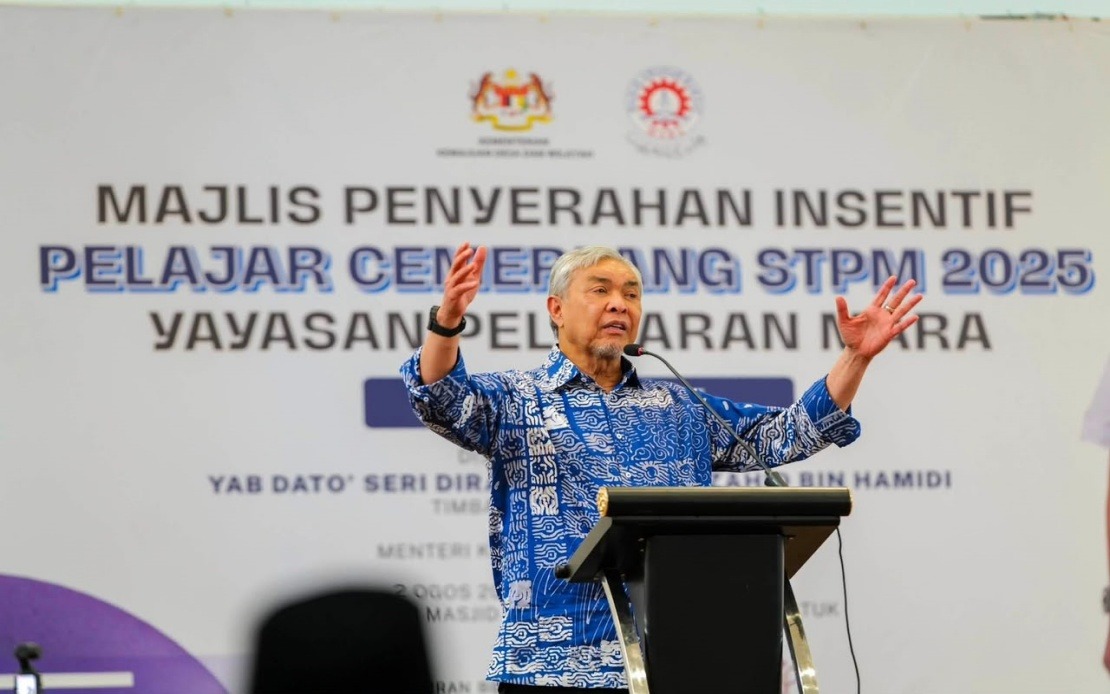
Thirty-eight students from two secondary institutions in Bagan Datuk have been rewarded by Yayasan Pelajaran MARA (YPM) for their exceptional achievements in the 2025 Sijil Tinggi Pelajaran Malaysia examination, an accomplishment that has drawn praise from senior government figures invested in the district's educational progress.
The recipients hail from Sekolah Menengah Kebangsaan Khir Johari and Sekolah Menengah Kebangsaan Tun Abdul Razak, two established institutions serving the Bagan Datuk area. Deputy Prime Minister Datuk Seri Dr Ahmad Zahid Hamidi, who represents the constituency in Parliament, announced the honour through his official social media channels, emphasising the calibre of young talent emerging from local schools. The recognition comes as part of YPM's broader commitment to identifying and supporting high-achieving Malaysian students across the nation.
Beyond the STPM excellence incentive awards, the announcement reveals a constellation of educational achievements that underscore the broader educational trajectory within Bagan Datuk. Three students from the district have secured competitive placements at Al-Azhar University in Egypt, where they will pursue advanced studies in Islamic Syariah and Usuluddin disciplines. Meanwhile, a further 23 students have been selected to receive the YPM Education Compassionate Fund, a mechanism designed to provide financial assistance to deserving candidates whose family circumstances might otherwise impede their academic progression.
The cumulative effect of these recognition schemes demonstrates how Malaysia's scholarship and incentive frameworks operate in tandem to support student advancement across different socioeconomic strata. YPM, as a federal institution, plays a pivotal role in channelling resources toward merit-based achievement while simultaneously offering compassion-based support to those facing economic hardship. For Bagan Datuk specifically, this represents a meaningful injection of educational opportunity that extends from secondary school achievement through to tertiary qualification and international study.
Datuk Seri Dr Ahmad Zahid Hamidi's commentary on these outcomes reflects a political and philosophical perspective on education's transformative capacity. He stressed that the success of these students validates a conviction that potential exists uniformly across communities, but requires deliberate investment through quality instruction, mentorship, and institutional backing. The implicit message directed at parents and guardians emphasises their irreplaceable role as motivational anchors within the educational journey, a sentiment particularly resonant in Malaysian culture where family support structures fundamentally shape student outcomes.
The international dimension of these achievements carries particular significance for regional academic networks. The placement of Bagan Datuk students at Al-Azhar University, one of the Islamic world's most prestigious institutions, reflects both the calibre of students emerging from Malaysian secondary education and the enduring appeal of this university among Malaysian scholars pursuing Islamic disciplines. Such placements strengthen Malaysia's historical and contemporary ties to Middle Eastern intellectual centres while providing Malaysian students with exposure to international academic standards and cross-cultural learning environments.
From a policy perspective, these recognition programmes exemplify how federal scholarship bodies like YPM translate educational merit into concrete opportunity. The tiering of support—from excellence incentives to compassionate funding—acknowledges that talent distribution does not correlate with income distribution, and that institutional scaffolding must account for socioeconomic variation while maintaining rigorous academic standards. For policymakers monitoring educational equity, such schemes provide evidence of mechanism effectiveness in identifying and nurturing talent across diverse circumstances.
The Bagan Datuk context itself warrants consideration. As a parliamentary constituency with its own demographic and socioeconomic profile, the district's educational achievements become politically legible as indicators of government service delivery and local institutional efficacy. When a Deputy Prime Minister publicly celebrates district-level educational outcomes, the gesture simultaneously recognises individual student accomplishment and implicitly markets government programmes as responsive to constituent needs. This intersection of personal achievement and political narrative shapes how educational success becomes incorporated into broader governance discourse.
Looking forward, Datuk Seri Dr Ahmad Zahid Hamidi articulated an aspiration for sustained and expanded educational achievement among Bagan Datuk youth, explicitly hoping that more students would access tertiary education both within Malaysia and internationally, subsequently returning to contribute their expertise to district development. This vision, while commonplace in political rhetoric, nevertheless identifies education as a mechanism for generating human capital that ultimately redounds to regional benefit—a framing that positions educational investment not as individual windfall but as collective resource generation.
The broader implications for Southeast Asia merit attention. Malaysian scholarship programmes like those administered by YPM represent a regional model of state-supported educational mobility, establishing pathways through which students from middle-income countries can access international qualifications and networks. These 38 Bagan Datuk students, along with their three peers entering Al-Azhar, contribute to a diaspora of Malaysian-qualified professionals whose experience abroad potentially generates knowledge transfer and international professional networks beneficial to domestic economic development.
For Malaysian readers, particularly parents and students navigating educational transitions, these recognitions underscore the availability of formal institutional support mechanisms operating alongside traditional school performance metrics. The existence of YPM excellence incentives and compassionate funding schemes, publicised through such district-level announcements, makes tangible the abstract promise of meritocratic opportunity within the Malaysian educational system. Equally, the international placements suggest that exceptional secondary school performance can generate pathways to globally recognised institutions, an outcome that resonates across aspirational middle-class households throughout Malaysia.

