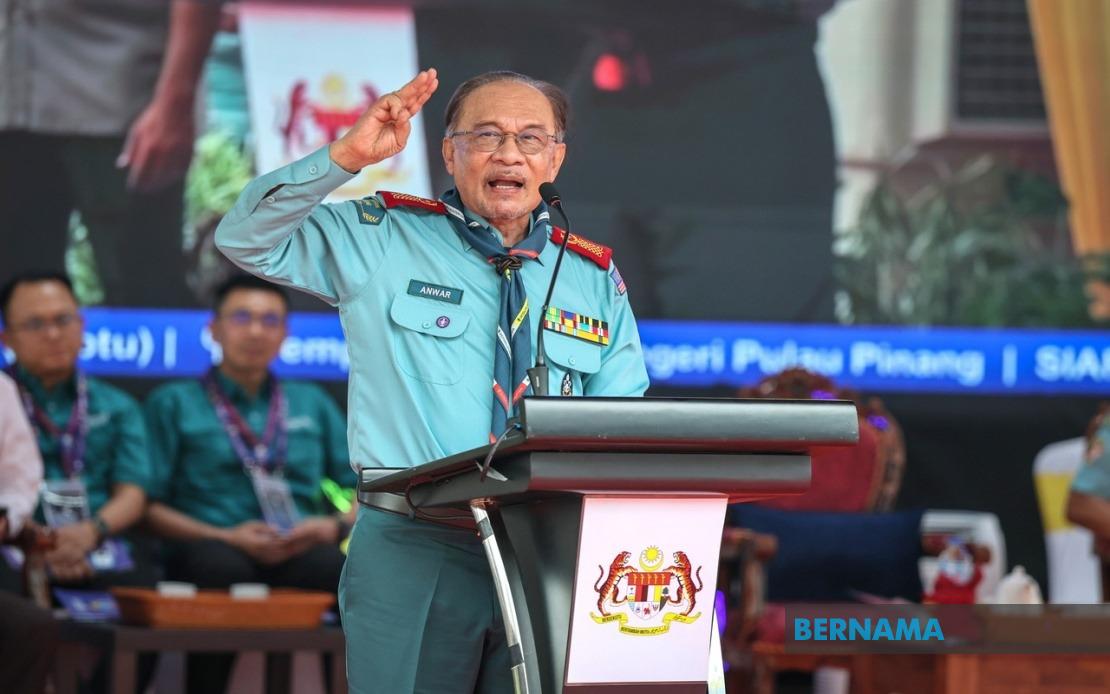
Prime Minister Datuk Seri Anwar Ibrahim has drawn a distinction between material advancement and genuine national development, arguing that Malaysia's future depends on nurturing a generation equipped with both intellectual rigour and strong moral foundations. Speaking at the opening of the 15th Malaysian Scouts Jamboree (MYJAM15) at the Penang State Stadium in Batu Kawan, Anwar contended that economic growth and technological prowess alone do not constitute true progress if the nation's young people lack discipline, values and a commitment to serving their communities. His remarks underscore a recurrent concern among Malaysian policymakers: the risk that rapid modernization may erode the ethical and cultural moorings that bind society together.
Anwar's vision centres on reimagining education as a comprehensive undertaking that transcends the transmission of facts and technical skills. He argued that schools, universities and training institutions should explicitly cultivate moral character alongside academic achievement, ensuring students internalize a sense of responsibility toward their families, neighbourhoods and the broader nation. This perspective reflects a traditional understanding of education as the formation of citizens rather than merely the production of workers. By framing knowledge acquisition as intrinsically linked to service and integrity, the Prime Minister positioned education as a vehicle for social cohesion rather than individual advancement alone, a framing likely to resonate with parents and educators concerned about rising individualism among youth.
The timing and venue of these remarks carry symbolic weight. The 15th Malaysian Scouts Jamboree, running through September 4, assembles more than 5,450 scouts—both local and international—from eleven countries spanning South Korea, Indonesia, Singapore and Sri Lanka. The jamboree's return to Penang marks a significant milestone, being the first time in six decades the event has taken place in the state since its inaugural hosting in Teluk Bahang during 1966. This historical context amplifies Anwar's message about continuity and heritage; the Scouts movement itself represents an established institution dedicated to character formation and civic engagement, making it an apt platform for articulating concerns about generational values.
Anwar specifically highlighted the tension between technological modernization and cultural preservation, a challenge particularly acute across Southeast Asia as nations grapple with rapid digital transformation. He warned that even as young Malaysians navigate the complexities of artificial intelligence and evolving information systems, they must remain anchored to their cultural roots and inherited values. This balancing act is not merely philosophical; it has practical implications for how educational curricula are designed, how social media is regulated, and how institutions resist the homogenizing pull of global digital platforms. The Prime Minister's emphasis suggests that Malaysia should not passively absorb technological change but should actively filter it through a distinctly Malaysian and Southeast Asian cultural lens.
The imperative to foster unity in diversity formed another pillar of Anwar's address, reflecting Malaysia's multi-ethnic and multi-religious composition. By highlighting that today's youth will become tomorrow's leaders, he implicitly warned that social fragmentation among the young could threaten national cohesion in subsequent decades. This concern is especially relevant given periodic communal tensions and the divisive potential of online discourse. Cultivating a generation conscious of their shared identity as Malaysians, despite their different backgrounds, represents both a moral imperative and a strategic necessity for political and economic stability across the region.
Anwar also invoked patriotism in the context of upcoming National Day celebrations in 2026, urging young people to sustain their spirit of national commitment and readiness to confront future trials. This framing casts patriotism not as nostalgic sentiment but as active preparation for obstacles yet to emerge—climate change, economic disruption, geopolitical shifts, and technological disruption among them. By connecting patriotism to resilience, he reframed it as a practical asset rather than an ornamental virtue, one that equips citizens to weather adversity collectively.
The presence of Penang Chief Minister Chow Kon Yeow and Chief Scout Datuk Prof Dr Mohd Zin Bidin underscored the multi-level political and institutional commitment to youth development. The Scouts movement, spanning local and international contingents, provided a living example of the kind of disciplined, values-driven young people Anwar championed—individuals engaged in structured learning, community service and intercultural exchange. The international dimension is particularly noteworthy; by welcoming scouts from across Asia, Malaysia demonstrates its openness to learning from peers while maintaining its own identity.
For Malaysian readers and policymakers, Anwar's remarks carry several implications. First, they signal that the government intends to elevate character education and values formation to parity with conventional academic metrics in assessing school and university performance. Second, they suggest heightened scrutiny of how technology is introduced in educational settings and how its cultural impacts are managed. Third, they invite a broader national conversation about what constitutes success in the twenty-first century, moving beyond GDP growth to encompass social stability, intergenerational equity and cultural continuity. These themes are especially resonant in a region where rapid development has sometimes outpaced social cohesion.
The challenge Anwar articulated is also one faced across Southeast Asia more broadly. Countries including Indonesia, Thailand and Vietnam likewise struggle to ensure that young people benefit from economic opportunity and technological access without losing grounding in their cultural identities. Malaysia's emphasis on scout-based character development offers a model that other nations may learn from, particularly in an era when institutional mechanisms for youth formation—extended families, religious organizations, community associations—have weakened in many societies. By championing the Scouts movement and similar institutions, Malaysia positions itself as a nation conscious of both progress and preservation, a stance likely to appeal to a population anxious about rapid change.
Ultimately, Anwar's message reflects a mature understanding of development that moves beyond the narrow metrics often employed by economists and technologists. A nation's true wealth, in this conception, lies not simply in the accumulation of capital or mastery of algorithms, but in the character and commitment of its people. By placing education, discipline and moral formation at the heart of national strategy, the Prime Minister has articulated a vision of progress that younger Malaysians may find both demanding and meaningful—one that asks them not merely to succeed individually, but to build a society worthy of the freedoms and opportunities they inherit.

