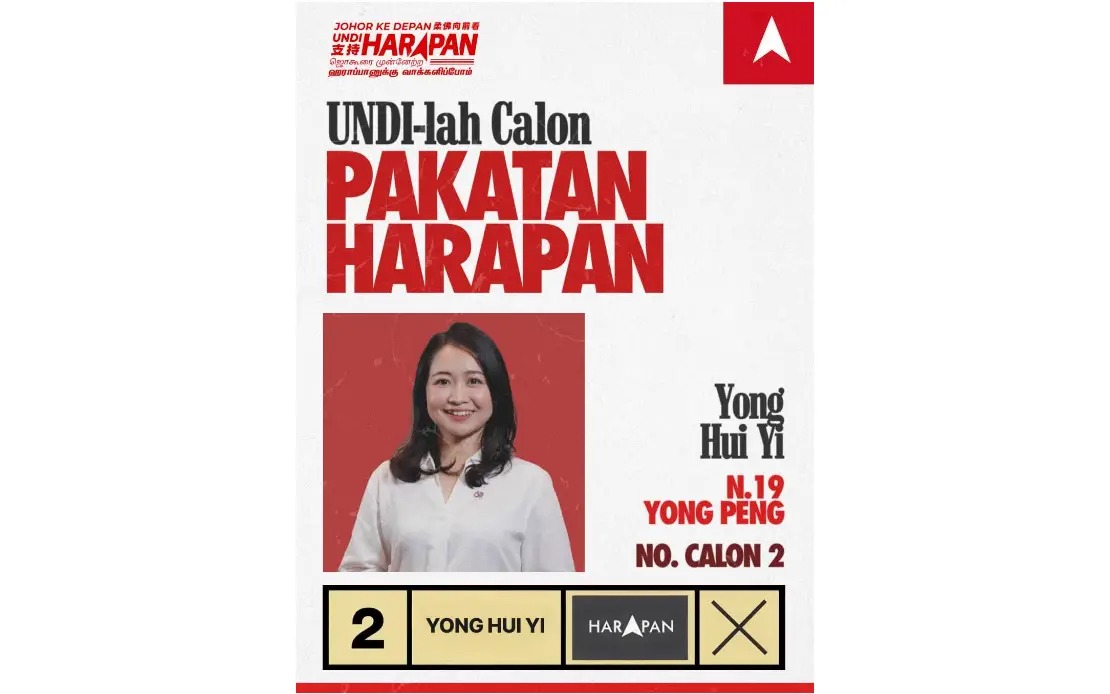
The 16th Johor state election race in Yong Peng is taking on an interesting dimension with Pakatan Harapan candidate Yong Hui Yi proposing an ambitious economic reimagining of the constituency. Rather than accepting the town's long-standing identity as merely a transit waypoint along the North-South Expressway, the 31-year-old is pushing for strategic repositioning that would unlock commercial potential and create sustainable livelihoods for residents. Her vision reflects broader conversations across Malaysian semi-urban constituencies about how secondary towns can participate meaningfully in national economic growth rather than remain peripheral to development narratives.
Yong's core argument centres on recognising an underexploited geographic asset. Thousands of vehicles traverse Yong Peng daily, yet the town captures minimal economic benefit from this traffic flow. By channelling these movement patterns into structured economic activity, she argues, the locality could generate employment and entrepreneurial opportunities that currently bypass local communities. This framing shifts the conversation from passive acceptance of Yong Peng's role as a stopover to active agency in determining its economic future. The proposal reflects contemporary thinking about value extraction from infrastructure assets that many Malaysian towns possess but struggle to monetise effectively.
Central to Yong's strategy is developing Yong Peng as a logistics and transport hub. Rather than a purely aspirational concept, she has articulated specific infrastructure components needed to realise this vision. The "driver's house" concept she promotes would establish structured rest facilities for long-distance and commercial vehicle operators, incorporating food establishments, repair workshops, retail outlets, vehicle maintenance services, and accommodation options. Such facilities would simultaneously serve highway users seeking amenities while catalysing local economic activity through employment creation and business opportunities for small traders and entrepreneurs already situated in the area.
However, Yong's pitch extends beyond logistics alone, a crucial distinction that broadens her appeal to diverse constituencies. She emphasises modern agriculture, small and medium enterprises, and supply chain operations as complementary economic pillars that Yong Peng could develop. This diversified approach acknowledges that single-sector reliance carries inherent risks and that sustainable development requires multiple revenue streams. The integration of agricultural modernisation is particularly relevant for a central Johor location where rural hinterland and urban connectivity intersect, creating natural advantages for value-added agricultural enterprises.
A particularly shrewd element of Yong's platform involves leveraging major regional development initiatives that extend beyond Yong Peng's immediate boundaries. She positions the constituency to benefit from spillover effects of the Johor-Singapore Special Economic Zone and infrastructure like the Johor Bahru-Singapore Rapid Transit System. As these megaprojects develop, demand for logistics services, food supply chains, modern agricultural inputs, and supporting industries will inevitably increase. Yong argues that Yong Peng's centrality and existing infrastructure position it ideally to become a support hub capturing some of this demand, rather than remaining peripheral to development benefits accruing primarily to larger urban centres.
Yong's platform includes deliberate attention to human capital development, recognising that infrastructure and investment alone prove insufficient without workforce readiness. She emphasises expanded skills training programmes, coordination with government agencies, and strategic partnerships with companies and investors to ensure young people acquire competencies aligned with emerging opportunities. This acknowledges a persistent challenge across Malaysian semi-urban areas: the outmigration of youth to larger cities seeking better employment prospects. Rather than attempting to prevent such migration, Yong's approach is to ensure Yong Peng becomes genuinely competitive as a destination offering sustainable futures for younger residents.
Campaign interactions have surfaced concrete resident concerns that extend beyond abstract economic development discourse. Yong reports that constituent feedback consistently highlights employment insecurity, cost of living pressures, public amenity deficiencies, and sanitation issues including pest problems and odour complaints. These grievances reflect daily lived experience in the constituency and cannot be addressed solely through structural economic initiatives. The acknowledgment that immediate concerns require parallel attention to longer-term development strategy demonstrates her understanding that electoral mandates depend on addressing both future potential and present discomfort.
Should she secure electoral victory, Yong has articulated three immediate priorities: strengthening public service delivery mechanisms, comprehensively mapping resident needs, and advancing economic development specifically centred on positioning Yong Peng within state-level planning for logistics, modern agriculture, and supply chains. This sequencing suggests practical recognition that effective development requires foundational administrative competence before ambitious economic projects can be implemented. The emphasis on needs mapping also indicates her campaign is not imposing predetermined solutions but rather committing to evidence-based constituency planning.
Yong's background includes meaningful exposure to government operations through working with Kulai MP and Deputy Communications Minister Teo Nie Ching and Kluang MP Wong Shu Qi. This experience, she suggests, has provided insight into how public issues are escalated through administrative channels to relevant agencies. For a relatively young candidate, this professional positioning addresses potential voter scepticism about inexperience by referencing practical knowledge of government processes and institutional connections. Such credentials matter particularly in Malaysian electoral contexts where constituent service capabilities and political networks significantly influence voting decisions.
The contest itself presents a straight fight between Yong Hui Yi and incumbent Ling Tian Soon of Barisan Nasional, eliminating three-cornered dynamics that often characterise Malaysian state elections. This binary choice sharpens the electoral narrative around competing visions for Yong Peng's future. The July 11 polling date, with early voting scheduled for July 7, concludes a campaign period during which Yong has consistently articulated economic transformation as central to her candidacy. For Malaysian observers, the Yong Peng race offers a microcosm of broader patterns emerging across semi-urban constituencies: younger, more economically imaginative candidates proposing development models that maximise local assets rather than simply hoping for government investment, while emphasising economic diversification and human capital development as essential accompaniments to infrastructure initiatives.

