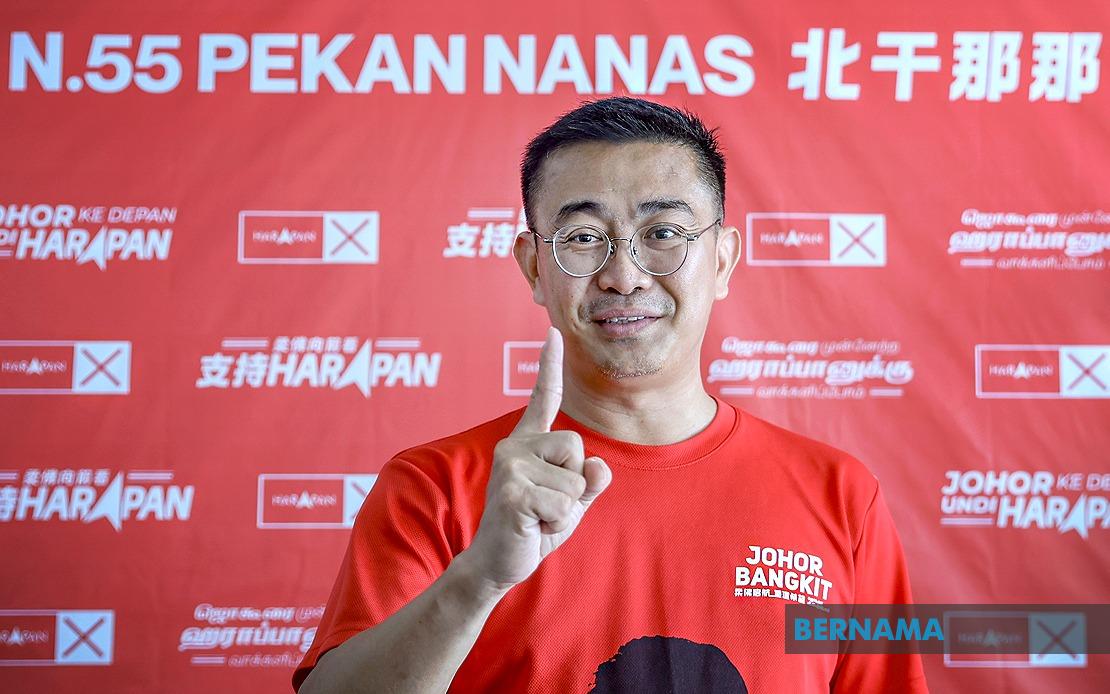
In the contest for Pekan Nanas in the 16th Johor state election, Pakatan Harapan's Yeo Tung Siong is mounting a comeback bid anchored on his performance during two previous terms representing the constituency between 2013 and 2022. Speaking during the campaign trail in Pontian, the former assemblyman expressed optimism that voters would reward his previous service and reinstate him as their representative, signalling confidence in an otherwise tight two-candidate race against incumbent Barisan Nasional candidate Tan Eng Meng.
Yeo's campaign strategy hinges considerably on direct voter engagement, a hallmark of his previous tenure. Through months of canvassing that included walkabout programmes, public talks, community meetings, and visits to markets and eateries, the PH contender estimates he has connected with roughly 60 per cent of the electorate. This methodical ground approach reflects a philosophy of accessibility he emphasised repeatedly—presenting himself as a representative who prioritises constituent responsiveness over formality. The positive feedback gathered during these encounters appears to have buoyed his confidence as polling day approaches.
Among Yeo's marquee achievements during his earlier terms was securing RM500,000 in government funding to rectify long-standing flooding issues plaguing the Pulai River, work that proceeded through straightening the river's course. Beyond this infrastructure intervention, he collaborated with the private sector to execute drainage works on the periphery of Kampung Melayu Raya, demonstrating his willingness to leverage non-governmental resources for community benefit. For voters concerned with tangible development, these projects serve as evidence of his ability to translate political office into concrete improvements to their living conditions.
The concerns raised repeatedly during his campaign rounds reveal persistent local anxieties that may prove decisive in the election outcome. Traffic congestion—a symptom of rapid urbanisation straining Johor's road networks—and employment scarcity rank prominently among resident frustrations. These grievances are not unique to Pekan Nanas; similar complaints echo across numerous Malaysian constituencies as infrastructure struggles to keep pace with economic growth and migration patterns. For a former representative seeking reinstatement, addressing these structural challenges becomes essential to his credibility.
Should he secure the mandate again, Yeo has outlined two priority infrastructure projects intended to alleviate vehicular congestion. A shortcut connecting Ulu Pulai to Pekan Nanas and another linking Pulai to the Sri Bunian junction would potentially reduce travel duration between Pontian and Johor Bahru, addressing a recurring complaint from residents who must navigate congested main roads. These proposals, if implemented, would yield tangible time savings for daily commuters and could unlock economic activity in peripheral areas currently hampered by accessibility challenges. Such infrastructure pledges resonate particularly with urban and semi-urban Malaysian constituencies experiencing transport bottlenecks.
Regarding employment opportunities, Yeo proposes reviving a career carnival initiative he previously organised in collaboration with major local employers. The mechanism aims to bridge the gap between job-seekers in Pekan Nanas and available positions, particularly within companies operating in the vicinity. While seemingly modest in scope, such initiatives address a structural problem affecting many Malaysian communities—information asymmetry and weak networking channels that prevent promising candidates from connecting with suitable employment. For constituencies where younger demographics face limited visibility into job markets, such programmes carry disproportionate importance.
Welfare assistance constitutes another plank of his platform. Yeo emphasises his intention to ensure vulnerable residents receive appropriate support through established government mechanisms including the Social Welfare Department (JKM) and the Social Security Organisation (SOCSO). This focus on social safety nets reflects broader conversations within Malaysian politics around the cost of living and household financial pressures. As inflation and economic uncertainty weigh on middle and lower-income households, accessibility to welfare services gains electoral salience, particularly in constituencies with significant numbers of retirees and informal-sector workers.
The race itself represents a straight contest between Yeo and the incumbent Tan Eng Meng, a configuration that simplifies voter choice but also intensifies the pressure on both candidates to mobilise their respective support bases. In such bipolar contests, turnout and swing voters often determine outcomes. Yeo's extensive campaigning suggests recognition that securing victory requires not simply retaining previous supporters but also converting independents and persuading those who may have voted for other parties in recent elections.
Yeo's previous experience as vice-principal and discipline teacher suggests pedagogical inclination toward instruction and behavioural guidance, qualities that may have shaped his approach to constituent relations. The transition from education to elected politics is relatively common in Malaysian politics, with former educators often bringing structured thinking and communication skills to governance roles. For voters in Pekan Nanas accustomed to Yeo's previous conduct, this background information reinforces narratives about his character and suitability for public office.
The broader context of the Johor election reflects reconfigured political alignments in Malaysia following the 2022 general election. Pekan Nanas's swing from PH to BN in recent electoral cycles illustrates the fluidity of voter preferences in the state, where neither coalition has established hegemonic control. For Yeo to recapture the seat, he must reverse a prior electoral loss, a task requiring not merely highlighting his past achievements but also convincing voters that subsequent changes in circumstance justify returning him to office. The months of campaigning he describes represent an attempt to rebuild the personal vote and communal relationships upon which such comebacks typically depend.

