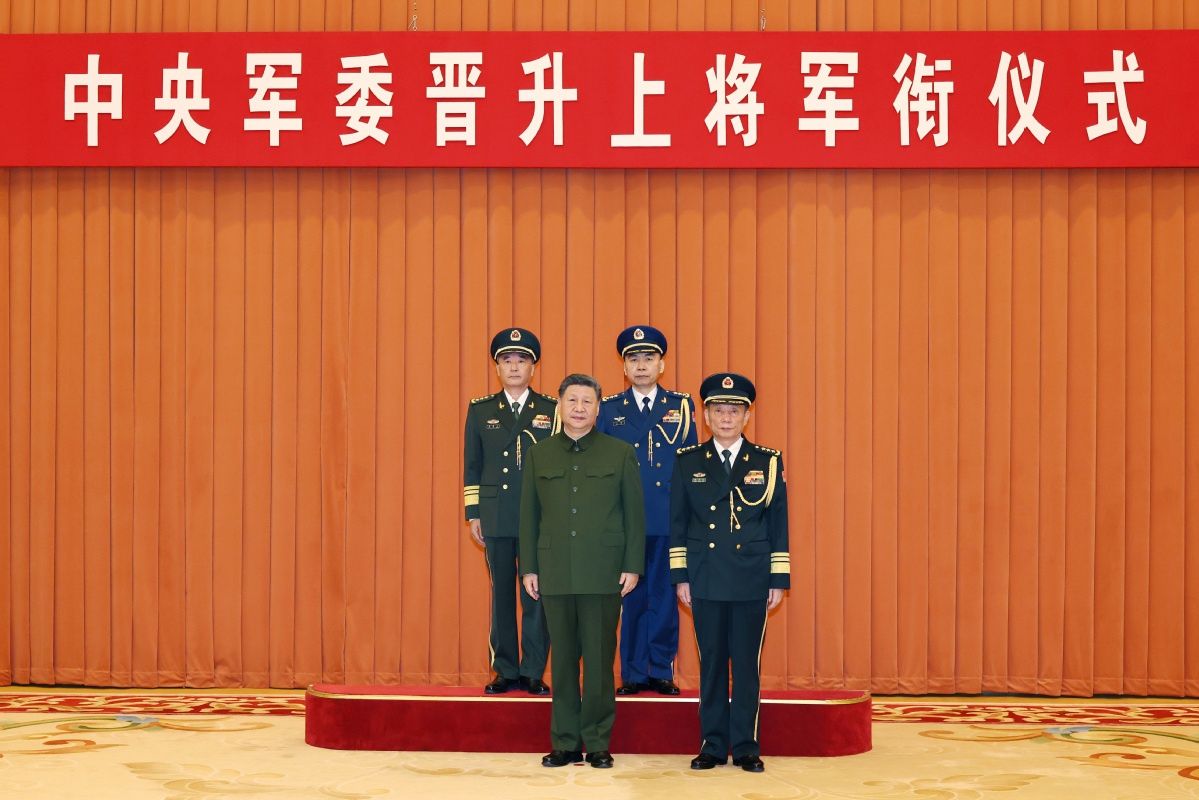
Chinese President Xi Jinping has reshuffled the leadership of the military's anti-corruption apparatus, appointing Zhang Shuguang to head the Central Military Commission's discipline inspection commission. The appointment, announced at a ceremony in Beijing on Friday (July 3) by state media Xinhua News Agency, marks another significant personnel change in Xi's ongoing overhaul of the armed forces. Both Zhang Shuguang and Wang Gang, the newly appointed People's Liberation Army Air Force commander, were simultaneously promoted to the rank of general, the highest active-service rank in China's military hierarchy.
The reshuffling extends beyond the anti-corruption function. Zhang Shengmin, who previously held the position of military's chief anti-graft official, has been elevated to vice chairman of the Central Military Commission, a role that typically carries significant strategic influence. The transition signals both continuity and transformation in how Beijing approaches corruption control within its massive defence establishment. Meanwhile, the next assignment for former Air Force Commander Chang Dingqiu remains publicly undisclosed, though such reassignments typically precede either lateral moves into advisory roles or further investigations.
Xi's cleansing of the military establishment represents the most ambitious purge of the armed forces in approximately fifty years, driven by concerns about institutional rot and factional loyalty that could undermine civilian control. The campaign commenced in mid-2023, shortly after Xi secured an unprecedented third consecutive term as Communist Party general secretary, a political victory that removed term limits and consolidated his authority. This timing was not coincidental; with enhanced political capital, Xi moved decisively to reshape military leadership and eliminate potential sources of institutional resistance to his policies.
The scale of the purge has proven extraordinary by contemporary Chinese standards. To date, Xi's campaign has resulted in the removal of two vice chairmen from the Central Military Commission, three additional CMC members, a sitting defence minister, and no fewer than twelve senior generals commanding major military regions and forces. This represents a wholesale replacement of significant portions of the senior command structure, suggesting either widespread corruption that had gone unchecked or a deliberate consolidation of power through personnel changes framed within an anti-corruption narrative.
The investigation into Zhang Youxia, arguably Xi's most shocking move, demonstrated that even the highest military echelons remain vulnerable to scrutiny. Zhang Youxia, formerly Xi's trusted general and current vice chairman of the Central Military Commission, faced investigation for unspecified misconduct earlier this year. His investigation rattled observers across Asia and beyond, as it illustrated that proximity to China's paramount leader provides insufficient protection from the anti-corruption machinery. This suggested that Xi's campaign transcends conventional factional warfare and reflects genuine efforts to assert civilian control and eliminate entrenched networks of patronage within the military.
Last week's stripping of parliamentary seats from six military-affiliated lawmakers added another dimension to the purge, indicating that the campaign extends beyond the uniformed services into the political structures through which military interests are represented. These individuals, previously elected or appointed to China's National People's Congress, represent a different category of influence—one that connects military interests to legislative processes. Their removal from parliament suggests an effort to sever or subordinate military representation in formal governance structures, ensuring that defence interests align with Xi's broader policy agenda.
For regional observers, particularly in Southeast Asia, these developments carry significant implications. A military establishment undergoing wholesale leadership change may experience transitional periods where institutional knowledge becomes fragmented and decision-making processes face disruption. China's military modernisation efforts, its posture in regional disputes including the South China Sea, and its strategic partnerships across Asia could all be affected during such transitions. The appointment of new leadership, however, also provides opportunities for neighbouring nations to engage with officers who may lack entrenched positions and preconceived commitments to hardline policies.
The anti-corruption framing of these changes carries domestic political significance within China. By presenting the purge as a campaign against institutional decay rather than factional consolidation, Xi frames his actions as serving the national interest and modernisation of the armed forces. The elevation of Zhang Shengmin to CMC vice chairman suggests that the leadership values institutional knowledge about corruption networks, positioning him to advise on further reforms. This approach combines punishment of alleged wrongdoers with rewards for those perceived as loyal reformers.
The broader pattern suggests that Xi views military corruption as inseparable from broader questions of institutional control and strategic alignment. The simultaneous promotion of multiple officers to general rank, including those assuming anti-corruption responsibilities, reinforces the message that Xi's administration prioritises both cleansing and loyalty. As the purge continues to unfold, the military establishment is being reorganised around individuals whose primary qualification appears to be alignment with Xi's vision for a disciplined, controllable, and modernised defence force.

