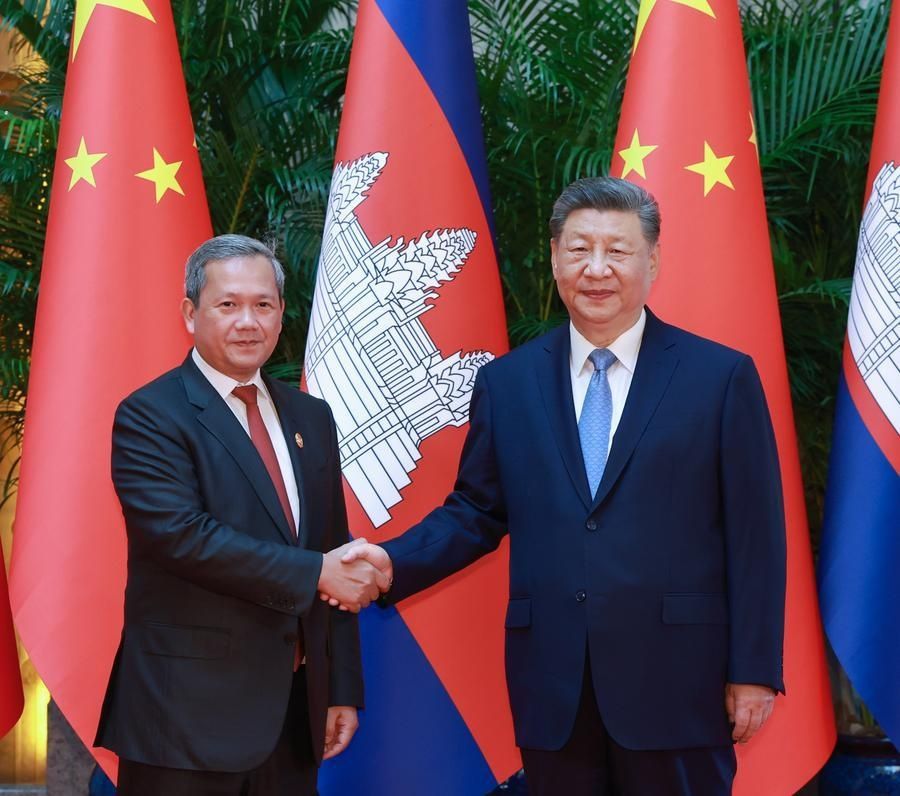
Chinese President Xi Jinping and Cambodian Prime Minister Hun Manet held talks in Shanghai on Friday that underscored the strategic depth of Beijing's relationship with one of its most consistent regional allies. The meeting, which took place during Hun Manet's attendance at the 2026 World Artificial Intelligence Conference and High-Level Meeting on Global AI Governance, highlighted China's determination to maintain Cambodia as a cornerstone of its Southeast Asian engagement strategy amid shifting geopolitical currents.
Xi framed the bilateral relationship in terms of historical continuity, emphasizing that the "ironclad friendship" established by earlier generations of leaders must be preserved and strengthened. This language carries particular weight given regional concerns about great-power competition and shifting alignments in Southeast Asia. By invoking historical bonds, Xi sought to position the China-Cambodia partnership as something transcending transactional interests—a positioning that serves Beijing's broader narrative of long-term commitment to the region.
The two leaders agreed to deepen cooperation through the so-called "Diamond Hexagon" framework, a multilayered mechanism designed to integrate economic, political, and security dimensions of their relationship. This architecture reflects China's sophisticated approach to bilateral partnerships, moving beyond simple trade agreements to encompass comprehensive strategic coordination across multiple sectors. The framework demonstrates Beijing's ambition to embed Cambodia more deeply into its economic and geopolitical sphere.
Economic integration featured prominently in discussions, with both sides committing to accelerate development of the Industrial Development Corridor and the Fish and Rice Corridor—initiatives designed to boost cross-border commerce and agricultural trade. These corridors represent practical mechanisms for deepening economic interdependence, particularly benefiting Cambodia's agricultural sector while creating new markets for Chinese industrial goods and services. For Malaysia and other ASEAN nations watching these developments, such deepening ties between Beijing and Phnom Penh carry implications for regional supply chains and economic architecture.
More significantly, Xi and Hun Manet identified emerging technologies as a priority area, with artificial intelligence and the digital economy explicitly mentioned as sectors requiring enhanced collaboration. This focus on future-oriented industries suggests China views Cambodia not merely as a recipient of infrastructure investment but increasingly as a partner in the technological domains that will define regional competitiveness over the coming decades. Cambodia's participation in China's AI ecosystem could reshape Southeast Asian technology markets.
Security cooperation formed another crucial pillar of their discussions. Xi called for accelerated action against transnational criminal activities, specifically naming counterfeiting, smuggling, online gambling, and telecom fraud. This agenda reflects genuine shared interests; Cambodia has become a significant source and transit point for telecommunications fraud operations targeting markets across East and Southeast Asia. Beijing's emphasis on this issue demonstrates how security cooperation now extends beyond traditional military domains to encompass the hybrid threats of the digital age.
The Cambodia-Thailand border issue received careful attention during the talks. Xi stated that China supports a negotiated resolution through dialogue and consultation, positioning Beijing as a responsible stakeholder invested in regional stability. However, this diplomatic formulation masks deeper strategic considerations; Cambodia's territorial disputes with Thailand create dependencies that reinforce Cambodia's reliance on Chinese patronage and goodwill. China's willingness to "play a constructive role" in these negotiations reflects both humanitarian concern and strategic interest in maintaining Cambodia's orientation toward Beijing.
Hun Manet's responses reaffirmed Cambodia's unwavering commitment to deepening ties with China, with explicit assurances that shifts in the international situation would not alter Cambodia's strategic direction. These assurances matter because they signal to Beijing that Cambodia's alignment remains stable regardless of external pressures or incentives from other powers. Hun Manet's restatement of Cambodia's adherence to the one-China policy, meanwhile, addresses Beijing's perennial concern about diplomatic recognition in an era when Taiwan has sought to expand its international footprint.
The Cambodian Prime Minister specifically highlighted Beijing's role in promoting peace between Cambodia and Thailand, framing China as a guarantor of regional stability rather than a power pursuing narrow strategic interests. This rhetorical move serves Cambodia's own diplomatic interests by suggesting that deeper Chinese involvement ultimately benefits regional peace. However, from a broader Southeast Asian perspective, the reliance on Chinese mediation in intra-ASEAN disputes raises questions about the organization's ability to manage its own internal conflicts without external great-power involvement.
One notable dimension of the talks involved Cambodia's gratitude for Chinese assistance in combating telecommunications fraud. This acknowledgment reflects the significant problem that organized crime networks operating from Cambodian territory pose to phone users, businesses, and financial systems across the region. By positioning anti-fraud cooperation as central to the bilateral relationship, both sides signal to affected populations that they are addressing genuine security threats, though critics argue that Cambodia has sometimes been reluctant to fully crack down on these operations due to corruption and their economic significance.
The bilateral engagement also carries implications for ASEAN cohesion. As one of the most China-aligned members of the association, Cambodia's deepening partnership with Beijing could influence broader ASEAN positions on South China Sea disputes, technology standards, and great-power competition. The emphasis on economic corridors and digital cooperation suggests China is pursuing a strategy of binding Southeast Asian economies more tightly into its sphere through development projects and technology partnerships rather than relying solely on traditional power projection.
For Malaysian stakeholders and policymakers, the Shanghai talks underscore the need for careful calibration of regional relationships. Cambodia's demonstrated stability in its alignment with China contrasts with more fluctuating partnerships elsewhere in Southeast Asia, suggesting that Beijing has succeeded in creating a relationship characterized by strategic predictability. Understanding how Cambodia maintains this equilibrium while managing relationships with other powers offers lessons for managing great-power competition in the region.

