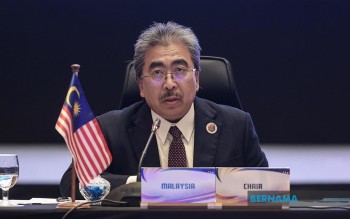
Malaysia's Investment, Trade and Industry Minister Datuk Seri Johari Abdul Ghani has sounded a clarion call for the World Trade Organization to undergo substantial reform, warning that the 30-year-old institution risks irrelevance unless it embraces the realities shaping twenty-first century global commerce. Speaking at the 39th Asia-Pacific Roundtable in Kuala Lumpur on June 30, Johari articulated a vision of an organization that moves beyond its post-Cold War mandate of tariff reduction and market liberalization to address the security-conscious, technologically competitive environment in which nations now operate.
The WTO was established during an era when policymakers viewed unrestricted trade flows as inherently stabilizing and economically beneficial across all member states. That consensus has fractured. Today's governments navigate an international landscape where considerations of economic resilience, technological leadership, strategic autonomy and supply chain robustness shape policy decisions in ways the original WTO framework never anticipated. Johari's remarks reflect a growing frustration among developing nations and middle powers that the multilateral trading system, while theoretically neutral, has struggled to accommodate legitimate national security concerns or address asymmetries in technological capacity and market power.
The minister crystallized this shift succinctly: the debate has migrated from the question of how to lower barriers to how governments should protect strategic capabilities. This transformation is not merely semantic. It represents a fundamental reorientation of how nations view international economic engagement. Countries now prioritize domestic production capacity in semiconductors, pharmaceuticals, rare earth minerals and other critical sectors. They screen foreign investment in strategic industries. They build redundancy into supply chains. These measures sit uncomfortably within the WTO's liberalization framework, yet they reflect genuine anxieties about technological dependence and geopolitical vulnerability that cannot be dismissed as mere protectionism.
For Malaysia and other Southeast Asian economies, this challenge carries particular weight. The region has integrated deeply into global manufacturing networks, making it simultaneously vulnerable to supply chain disruptions and dependent on open market access. Yet ASEAN nations also recognize the imperative to develop indigenous technological capacity and reduce reliance on external sources for critical goods. The WTO's evolution directly impacts ASEAN's ability to pursue these dual objectives without triggering disputes or facing accusations of violating multilateral commitments.
Johari emphasized that multilateral rules remain essential, perhaps more than ever, as strategic competition between major powers intensifies. A weakened or irrelevant WTO cannot perform its core function: providing a neutral mechanism for dispute resolution and establishing predictable, transparent standards for international commerce. Without credible multilateral institutions, economic disputes escalate more readily into broader geopolitical conflicts. The fragmentation of global trade into competing blocs—whether through regional agreements, technological standards wars, or supply chain reshoring—threatens the prosperity of smaller economies that depend on stable, rules-based access to global markets.
The challenge facing the WTO involves reconciling legitimate national security concerns with the principle that trade should not be weaponized for geopolitical advantage. This requires nuanced institutional evolution. The organization must develop clearer criteria for what constitutes a valid security exception, establish mechanisms for reviewing national industrial policies, and create frameworks for discussing supply chain vulnerabilities without automatically labeling such discussions as protectionist. Such reforms would represent a departure from the WTO's founding assumptions, but they reflect contemporary economic reality.
Malaysia's position as articulated by Johari reflects broader sentiment across the developing world. While ASEAN nations reaffirm commitment to multilateralism and open markets, they insist that the system serving them must acknowledge contemporary challenges. The WTO cannot pretend that semiconductor fabrication capacity, 5G infrastructure, or vaccine production exist in a purely commercial realm divorced from strategic considerations. Pretending otherwise only drives nations toward bilateral deals, regional arrangements, and ad-hoc coalitions that fragment the system further.
The 39th Asia-Pacific Roundtable, organized by the Institute of Strategic and International Studies Malaysia on behalf of the ASEAN Institutes of Strategic and International Studies network, provided an appropriate venue for this intervention. Themed "Accelerating Agency and Action," the June 30-July 2, 2026 conference convenes the region's leading policymakers, diplomats, military officials, academics and business strategists to wrestle with geopolitical, economic and security issues. These forums serve critical functions in building regional consensus and articulating developing-world perspectives that might otherwise be drowned out by dominant powers in global forums.
Johari's call for WTO adaptation should be understood within this broader context of Malaysia and the wider region seeking greater influence over the rules governing international commerce. The minister did not advocate abandonment of multilateralism. Rather, he argued for an institution that remains true to its core mission—reducing uncertainty, enabling dispute resolution, preventing economic conflicts—while accommodating the strategic realities of contemporary geopolitics. This represents a mature position: neither naïve adherence to a defunct orthodoxy nor cynical rejection of multilateral cooperation.
The path forward requires both WTO member states and the organization's leadership to acknowledge that the 1995 framework no longer maps neatly onto contemporary reality. Discussions about industrial policy, national champions, technological standards, and supply chain resilience can no longer be excluded from the multilateral trading system. They must be incorporated in ways that preserve the benefits of open commerce while respecting legitimate concerns about strategic vulnerability and technological independence. Without such evolution, the WTO will indeed fade in relevance as nations pursue their interests through alternative mechanisms, ultimately diminishing the stability and predictability that smaller, trade-dependent economies require.

