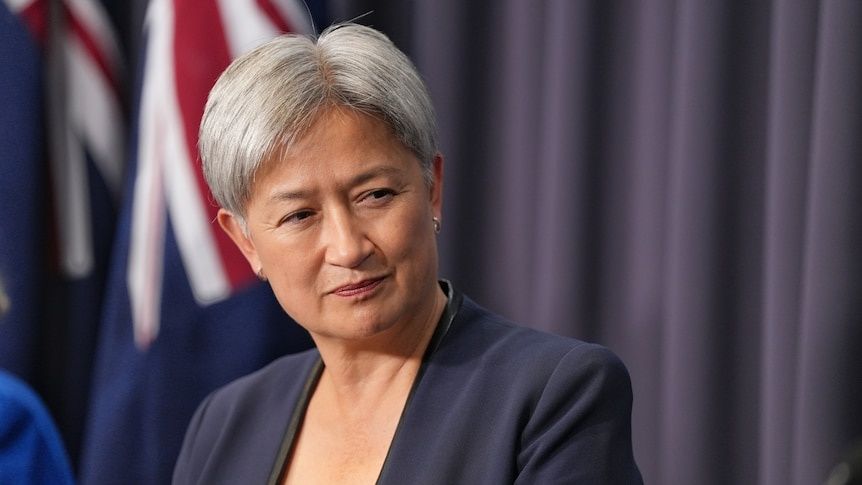
Australia's Foreign Minister Penny Wong has launched a forceful defence of multiculturalism, characterizing it as intrinsic to the nation's identity and security interests. Speaking at the Lowy Institute in Sydney on Friday, Wong positioned the country's diverse demographic makeup not merely as a social fact but as a strategic asset under threat from what she termed the "melancholic fantasy of a monoculture." The Malaysian-born minister, who holds the distinction of being Australia's first Asian-born federal minister, used her platform to directly challenge the rising political force of Pauline Hanson's One Nation party, which has ascended to become Australia's most popular political party according to recent polling data.
Wong's intervention carries particular weight given the demographic realities she cited. Census data reveals that approximately half of all Australians were either born abroad or have at least one parent born overseas, a statistic that underscores just how fundamental immigration and multiculturalism have been to Australia's post-war development. This demographic context provides empirical backing to Wong's central assertion: that the "only Australia that has ever existed" has been inherently multicultural. Her framing rejects the notion that multiculturalism represents a departure from some earlier, more homogeneous Australian identity, instead presenting it as the continuous thread running through modern Australian history.
The timing of Wong's remarks reflects genuine anxiety within Australia's centrist and centre-left political establishment about One Nation's trajectory. The party's surge in popularity, driven partly by community concerns about immigration, housing affordability, and economic pressures, has positioned it as a potential kingmaker in the 2028 federal election. One Nation's platform explicitly calls for a monoculture Australia and proposes a fundamental reassessment of the country's international obligations and development assistance commitments. Hanson herself, frequently compared to Donald Trump and France's Marine Le Pen for her nationalist political positioning, triggered widespread controversy this year by invoking Australia's historical "White Australia" policy, a restrictive immigration regime that operated until the 1970s.
Wong's strategic framing of multiculturalism as a security and economic necessity rather than merely a social value represents a deliberate rhetorical choice. She warned that internal and external forces seek to divide Australia, presenting the push toward monoculturalism as a weakening force that would undermine both domestic cohesion and Australia's position in an increasingly competitive global environment. By connecting immigration policy to national security architecture, Wong sought to elevate the debate beyond traditional culture war rhetoric into questions of Australia's strategic autonomy and international standing.
The Foreign Minister specifically highlighted how Australia's middle-power status depends on maintaining multiple strategic relationships and economic connections. In an era when military capability, economic coercion, and control of critical materials and technologies are increasingly wielded by major powers to constrain the choices available to smaller nations, Wong argued that Australia cannot afford to voluntarily limit its options through nationalist isolationism. The "call for a monoculture," she stated, amounts to "a call for Australia to curtain our choices and cut off our connections." This argument positions One Nation's nationalism as strategically self-defeating rather than merely culturally misguided.
Wong also underscored the economic contributions of immigrants and refugees to Australian society, citing their prominence in business and sport as visible demonstrations of multiculturalism's practical benefits. This empirical approach to defending diversity reflects an attempt to move the conversation away from abstract principles toward concrete outcomes and measurable value creation. The implicit argument is that multiculturalism is not a burden Australia must bear for moral reasons, but rather a source of competitive advantage in innovation, entrepreneurship, and soft power.
The Labor government's simultaneous acknowledgment of "legitimate concerns" about housing and economic pressures reveals the delicate political position Prime Minister Anthony Albanese's administration navigates. Rather than dismissing the anxieties fueling One Nation's rise, the government has indicated it plans to announce immigration policy adjustments. This approach attempts to address voter concerns about rapid demographic change without validating the monoculturalist ideology underlying One Nation's platform. Albanese himself referenced his Italian family name on Friday, subtly invoking his own connection to Australia's immigrant heritage while reaffirming that "modern Australia is multicultural."
Immigration levels have already begun declining from their recent peak, according to government statements, and further reductions are anticipated. However, the government has explicitly framed these adjustments as pragmatic economic management rather than capitulation to anti-immigration sentiment. Officials have emphasized that immigration reduction will occur "without vilifying people, without trying to divide the community," positioning policy recalibration as a unifying measure that serves the national interest rather than a response to xenophobic pressure.
The political dynamics at play extend beyond Australia's borders, carrying implications for regional stability and Southeast Asian nations with close ties to Australia. Malaysia, in particular, has substantial diaspora communities in Australia and maintains significant trade relationships. Wong's defence of multiculturalism and her warnings against nationalist isolationism represent Australia's commitment to the rules-based international order and open trade frameworks that have benefited Southeast Asia. A pivot toward One Nation's proposed foreign policy reorientation, including reduced development assistance and recalibrated international engagement, could reshape Australia's role as a stabilizing presence in the Indo-Pacific region.
The broader context involves how Australia's political establishment responds to the challenge posed by One Nation's populist messaging. Wong's speech represents an intellectual and strategic counter-argument rather than a dismissive rejection of voter concerns. By grounding multiculturalism in security and economic logic rather than relying solely on humanitarian or social justice arguments, the Labor government attempts to reclaim the terms of debate. Yet the persistence of One Nation's popularity, particularly among voters feeling economically anxious or culturally displaced, suggests that policy appeals to national interest may not fully address the psychological and social factors driving support for monoculturalist politics.
The trajectory of this political contest will significantly influence Australia's international relationships, domestic cohesion, and the regional security architecture of Southeast Asia. Wong's intervention signals that Australia's political centre intends to mount a vigorous defence of multiculturalism, not as a progressive ideal but as a practical necessity for national prosperity and strategic resilience. Whether this framing can effectively counter One Nation's narrative, particularly if economic conditions continue to worry voters, remains an open question with consequences extending far beyond Australia's shores.

