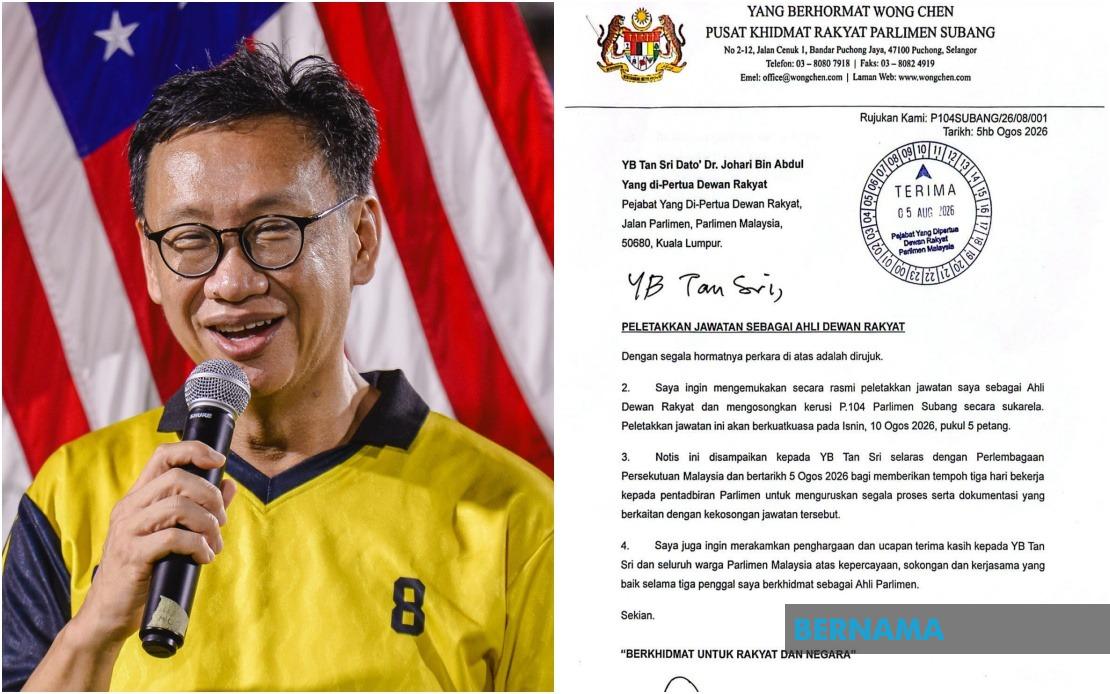
Wong Chen, who has represented the Subang constituency for three consecutive parliamentary terms, formally stepped down as a Member of the Dewan Rakyat today, with his departure taking effect at 5:00 pm. The veteran legislator submitted his official resignation letter to Dewan Rakyat Speaker Tan Sri Johari Abdul on August 5, well in advance of his final day, demonstrating a considered approach to the transition process.
The early submission of his resignation reflects Wong Chen's concern for institutional continuity and operational efficiency within Parliament. By providing advance notice, he gave the Dewan Rakyat administration adequate time to arrange the procedural and logistical requirements associated with the vacation of his parliamentary seat, ensuring a smooth handover to his successor. This administrative courtesy underscores the formalities that accompany the departure of a sitting legislator in Malaysia's Westminster-influenced system.
Wong Chen's three-term tenure places him among the more established voices in Malaysian politics, having navigated through multiple election cycles and parliamentary sessions. His decision to step down marks a significant turning point for the Subang seat, one of the country's urban constituencies. The timing and manner of his resignation suggest a deliberate decision rather than an abrupt exit, allowing him to manage the transition on his own terms and in coordination with parliamentary authorities.
In his formal correspondence dated August 5, 2026, Wong Chen cited the voluntary nature of his resignation, made in full accordance with the Federal Constitution. His language emphasised respect for constitutional procedures and institutional protocols, reflecting a commitment to lawful governance structures. The letter also expressed his gratitude to Tan Sri Johari and the parliamentary staff, acknowledging the cooperation and support he received throughout his tenure as a representative.
The outgoing MP plans to hold a special press conference tomorrow at 11:00 am to provide further details regarding his resignation. This public forum will likely allow Wong Chen to explain his motivations, reflect on his parliamentary service, and possibly discuss his future political or professional endeavours. Such conferences typically provide journalists and the public with direct access to clarification on significant political transitions, enabling broader understanding of the circumstances surrounding a legislator's departure.
Wong Chen's administrative arrangements extend beyond the resignation itself. Beginning next month, his office will cease using the honorific title "Yang Berhormat" on all billboards, signboards, and official correspondence. This symbolic removal marks the formal end of his status as an elected representative and signals the completion of his institutional separation from Parliament. Such procedural details, though seemingly minor, represent important steps in the ceremonial aspects of political transitions.
The Subang constituency, located in the Klang Valley region and encompassing parts of Petaling Jaya, has been a closely watched seat in Malaysian politics. As an urban constituency with a diverse electorate, Subang has historically been competitive, attracting candidates from various political parties and reflecting broader national political trends. Wong Chen's departure will necessitate either a by-election or the seat remaining vacant until the next general election, depending on parliamentary convention and political circumstances.
For the ruling government and the opposition, Wong Chen's resignation represents a shift in parliamentary composition and may have implications for legislative dynamics. The balance of seats in the Dewan Rakyat influences the government's ability to pass legislation and maintain confidence votes. Depending on Wong Chen's party affiliation and the party of his likely successor, this change could subtly alter the parliamentary mathematics, though the extent of such impact depends on the broader political configuration.
Wong Chen's three-term service provides insight into the career trajectories of Malaysian parliamentarians in the modern era. Many legislators serve multiple terms, building expertise in particular policy areas and developing influence within their parties and parliamentary committees. The decision to retire after three terms, rather than seeking additional terms or higher office, suggests a deliberate choice about the duration and scope of public service.
The procedural and ceremonial aspects of Wong Chen's resignation illustrate the formality embedded in Malaysian parliamentary practice. From the submission of written notification to the Speaker, through to the removal of honorific titles and the holding of explanatory press conferences, each step reflects established conventions governing the relationship between individual legislators and the institution of Parliament itself. These practices, accumulated over Malaysia's post-independence democratic history, provide frameworks that lend stability and predictability to political transitions.
Looking forward, the Subang seat will likely become the focus of political manoeuvring among various parties seeking to retain or capture the constituency. Political analysts will scrutinise whether Wong Chen's departure signals broader shifts within his party or reflects personal circumstances unrelated to party politics. The subsequent electoral contest, whenever it occurs, will provide voters with an opportunity to reassess their representation and will test the appeal of competing candidates seeking to succeed Wong Chen's three-term tenure.

