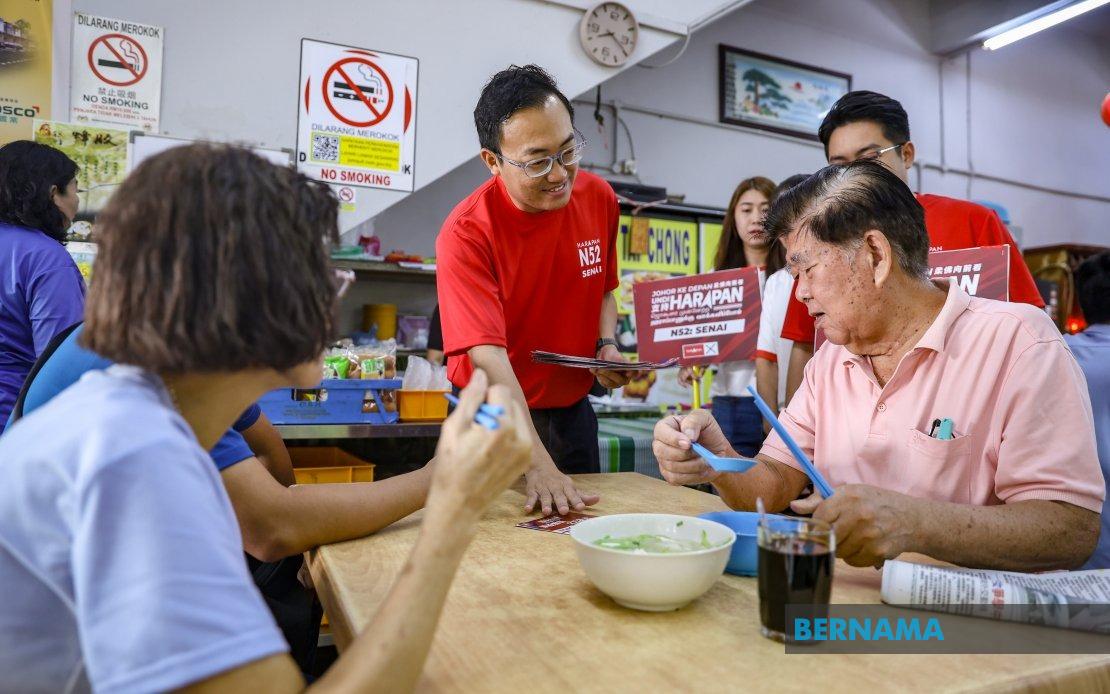
Wong Bor Yang, the sitting assemblyman for Senai, is casting his re-election bid as a validation of practical governance and sustained commitment to constituent welfare. The Pakatan Harapan candidate believes his decade-long engagement with the constituency gives him a decisive edge over opponents in the contest scheduled for July 11, positioning himself as the most seasoned choice in a three-way race for the seat representing over 66,600 voters.
Wong's campaign strategy pivots on accomplishments rather than rhetoric, grounded in tangible outcomes achieved during his current term. His emphasis on infrastructure delivery reflects a broader voter preference emerging across Malaysia for measurable results over political grandstanding. The Senai seat, with its mixed demographic profile spanning urban and semi-rural areas, represents precisely the type of constituency where bread-and-butter governance issues often outweigh ideological considerations. This strategic focus positions Wong to appeal across traditional voter segments that might otherwise remain divided along party lines.
Central to Wong's narrative is his role in tackling chronic flooding that has long plagued sections of Senai. During his tenure, he secured government approval for RM1 million in drainage improvements targeting Taman Aman and its connection to Sungai Skudai. Working in conjunction with neighbouring Kulai MP Teo Nie Ching, he additionally channelled RM3 million towards drainage upgrades in Peladang Kulai Besar and Saleng—two previously flood-prone zones that have since been delisted from the district's vulnerability register. These achievements carry particular resonance in Malaysia's context, where monsoon-induced flooding remains a persistent quality-of-life challenge affecting property values, public health, and business operations across multiple states.
Wong's professional journey reflects the complex political trajectories common among second-generation opposition figures now integrated into government structures. His path began with a 2014 posting as a special officer within the Kulai MP's office, evolved through his 2018 appointment as a local councillor during the initial Pakatan Harapan administration, and culminated in his election as state assemblyman—a progression that spans the opposition, the first PH government, and the subsequent political realignment. This experience sequence, spanning Malaysia's tumultuous political transition following the 2018 general election and its aftermath, provides Wong with institutional knowledge that newly minted candidates typically lack. A journalism graduate from Shih Hsin University in Taiwan, Wong brings a communication background that may explain his methodical public engagement approach.
Beyond infrastructure, Wong has invested political capital in cultural preservation and heritage promotion. His initiative to repurpose a derelict cinema into a community operations centre and renovation of a deteriorating badminton facility into Tiny Lake—a family recreational space under the government's Sejati MADANI programme—demonstrate attention to quality-of-life amenities beyond essential services. These projects reflect a recognition that constituencies increasingly evaluate representatives on their capacity to enhance livability across multiple dimensions. In Senai's context, such initiatives may resonate particularly with younger families and retirees seeking vibrant community spaces.
Healthcare represents Wong's articulated second-term priority, addressing what he frames as an increasingly critical deficiency. Kulai Hospital's current capacity of 93 beds stands sharply misaligned with the district's projected 500,000-person population by 2030—a demographic trajectory that mirrors growth patterns across the Johor corridor as industrial expansion and urbanisation accelerate. Wong has pledged sustained pressure on state authorities to resolve bureaucratic impediments delaying construction of a new health clinic in Taman Mewah, Senai. This healthcare focus carries significance beyond local politics, reflecting broader Southeast Asian healthcare infrastructure challenges as ageing populations and urban density place mounting strain on existing facilities.
Wong's competitive environment has shifted substantially since his previous election. He faces a three-cornered contest against Barisan Nasional candidate Tai Chee Chee and Bersama candidate Tew Chien How—configuration that fundamentally alters vote distribution mathematics. The Bersama presence, representing a splinter faction, may fractionalise votes across the political spectrum in unpredictable ways. Wong's confidence in voter maturity suggests belief that Senai's electorate will prioritise demonstrated competence over new candidacies, a gamble that depends partly on whether opposition consolidation or fragmentation ultimately prevails.
Wong's extended service narrative—spanning twelve years across multiple institutional contexts—constructs an image of incremental relationship-building and problem-solving persistence rather than revolutionary change. This positioning appeals to constituencies increasingly weary of political upheaval but simultaneously hungry for tangible improvements. His emphasis on pragmatism over partisanship reflects recognition that voters facing flooding, inadequate healthcare, and service delivery gaps care primarily about solutions, not party loyalty. The question remains whether this competence-based positioning will prove sufficient against opponents likely emphasizing fresh perspectives or stronger party machinery.
The July 11 polling date comes amid continued recalibration of Johor's political landscape following the 2022 state election. Wong's campaign unfolds within this broader context of shifting allegiances and voter preferences across the peninsula's largest state. Senai's outcome will contribute to broader patterns revealing whether constituencies reward incumbency and track record or respond to appeals for change. Early voting on July 7 precedes the main poll, allowing preliminary assessment of campaign momentum. Wong's explicit confidence—grounded in specific deliverables rather than abstract promises—reflects a calculated strategic choice to fight the contest on terrain where his accumulated experience provides measurable advantages over less-established opponents.

