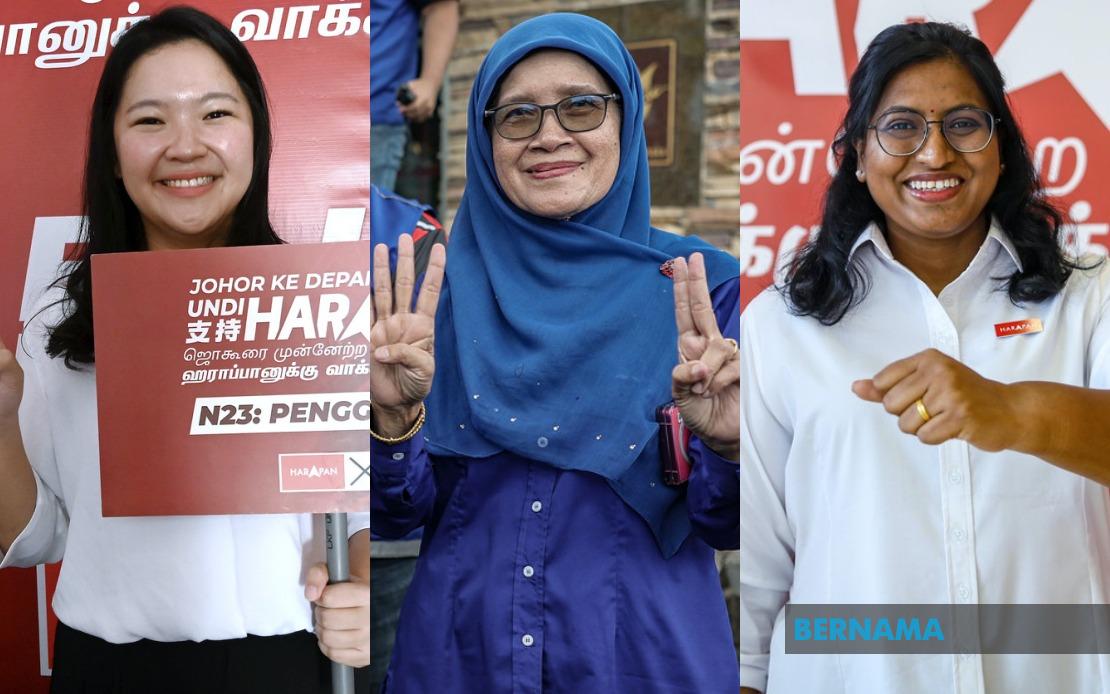
The 16th Johor State Election delivered a qualified victory for women in politics, with ten female candidates winning assembly seats despite representing a relatively small proportion of the overall candidate pool. The outcome underscores both progress and persistent challenges in female political representation across Malaysia's southern state, where women accounted for just under 20 per cent of the 172 candidates who contested the 56 available positions in the state legislature.
Barisan Nasional's dominance in the election extended to its female representatives, who claimed seven of the ten winning seats. The coalition's successful women candidates demonstrated strong performance across diverse constituencies, securing victories through both incumbent advantage and competitive multi-candidate contests. This result reflects BN's commanding overall performance, in which the coalition captured 48 of 56 seats, consolidating its control over the state assembly.
Nadhirah Afiqah Abdull Rahim, Ledang Puteri UMNO chief contesting her first election, won the Serom seat by an impressive margin of 9,406 votes against opposition from both Perikatan Nasional and Pakatan Harapan challengers. Her debut victory signals the party's confidence in cultivating younger female political talent and reflects voter acceptance of new female faces in Johor politics. The scale of her victory margin demonstrates that gender presented no barrier to voter support in this constituency.
Other BN women achieved noteworthy results that highlighted shifting voter sentiment. Nor Rashidah Ramli's victory in Parit Raja proved particularly significant, as her 13,576-vote majority represented a substantial increase from the 4,219-vote margin achieved in the previous 2022 state election. This surge in support suggests that her incumbent status and performance in the previous term resonated strongly with constituents, improving BN's position in a competitive three-way race. Similarly, Norlizah Noh secured an emphatic win in Johor Lama with a 16,344-vote majority, defeating both a PN candidate and the election's youngest contender, Danish Hossman Abd Rahman of PH.
Chan San San's capture of the Johor Jaya seat represented a striking upset, as the constituency had been regarded as a stronghold of the Democratic Action Party and Pakatan Harapan. Her win, achieved with 35,971 votes across a four-candidate field, suggests potential shifts in voter preferences in what had been considered an opposition-friendly area. This victory carries broader implications for BN's electoral prospects in traditionally challenging constituencies throughout the state. Alwiyah Talib's third consecutive victory in Endau demonstrated the durability of entrenched female incumbents, particularly when they command genuine constituent support.
Fauziah Misri and Hasrunizah Hassan rounded out BN's female representatives with commanding performances. Fauziah's 15,776-vote majority in Penawar reflected decisive voter confidence, while Hasrunizah successfully retained Pulai Sebatang with a 13,590-vote margin—a notable improvement of 6,325 votes compared with her 2022 result. These victories underscore that experienced female politicians, when properly supported by party machinery and enjoying incumbent advantages, can mobilise substantial electoral backing.
Pakatan Harapan's three female representatives emerged from diverse backgrounds, reflecting the coalition's broader appeal across different demographics and geographic areas. Felicia Poh Rui Ling successfully defended the Penggaram seat at just 28 years old, defeating a BN candidate by 4,137 votes in a direct contest. Her youth suggests that PH's female candidates benefit from an electorate willing to support younger women in politics, potentially reflecting the coalition's positioning as an alternative political force. Chu Poh Yee retained Mengkibol with a 4,213-vote majority, demonstrating the persistence of PH support in specific constituencies despite the coalition's overall weakness in Johor.
Kartiyaini Jeyapalan, a lawyer from Skudai, retained the traditional PH stronghold of Skudai with an impressive 15,280-vote majority in a four-candidate race. Her professional background and substantial margin of victory illustrate that female candidates with clear professional credentials can command robust support even within increasingly competitive electoral environments. Her win demonstrated that PH maintains genuine support in certain localities despite BN's domination of the state assembly.
The election highlighted persistent gender imbalances within Malaysian political representation. Women constituting only 20 per cent of candidates across all parties reflects continued structural and cultural barriers to female political advancement. However, the relatively respectable performance of female candidates when fielded—with ten of 34 winning in a state where BN captured 86 per cent of seats—suggests that voter resistance to female candidates may be less significant than party-level recruitment and candidate selection processes. The victory rate for women candidates approximated their overall proportion in the legislature, indicating that electoral outcomes reflected broader coalition performance rather than gender-based voting patterns.
The results carry implications for future political recruitment strategies. The demonstrated capacity of women candidates to win significant majorities in competitive contests challenges assumptions that female representation requires protected seats or preferential treatment. Simultaneously, the relatively limited number of women candidates fielded by all major parties indicates ongoing hesitation about prioritising female political recruitment and advancement. For Johor specifically, the election demonstrated that women politicians can succeed across diverse constituency types—from urban areas like Johor Jaya to rural constituencies like Serom and Endau.
Looking forward, the Johor election results provide a baseline for assessing progress in female political representation within Malaysia. While ten successful female candidates represents genuine achievement, the broader context of women constituting only 20 per cent of candidates suggests considerable room for expansion. The strong performances by several female representatives, particularly in competitive multi-candidate contests and in constituencies won by landslide majorities, indicate that supply-side limitations rather than demand-side resistance may represent the primary constraint on women's political advancement in Johor and similar Malaysian states.

