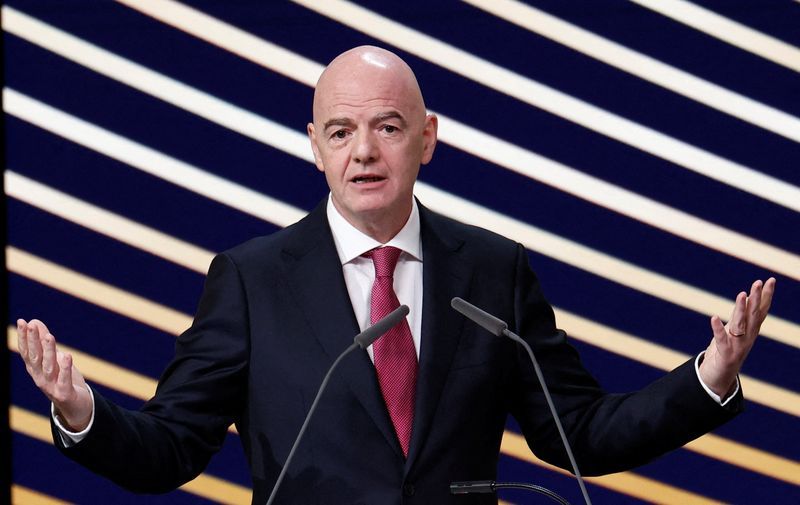
The gravest political crisis facing FIFA President Gianni Infantino in his ten-year tenure has, unexpectedly, found its most articulate opposition from two women serving on UEFA's executive committee. Laura McAllister of Wales and Norway's Lise Klaveness have become the public face of resistance to Infantino's attempted overhaul of the sport's financial structures, a situation that has prompted wider reflection on whether international football governance remains fundamentally inhospitable to female leadership. The collision between these two forces—organisational crisis and calls for systemic change—offers Malaysian and Southeast Asian football observers a window into how power struggles within global sporting bodies intersect with deeper questions about institutional renewal and inclusivity.
The immediate trigger for this governance upheaval stems from Infantino's push to establish FIFA Football Enterprises, a private equity-backed commercial venture designed to generate new revenue streams. The proposal encountered fierce resistance from UEFA and other regional confederations, ultimately unravelling in the face of coordinated opposition. Wales became the first national association to withdraw support for Infantino's re-election bid, and dissent quickly metastasised through FIFA's own bureaucracy. McAllister's proposal for a UEFA-wide boycott of FIFA events received unanimous backing at an emergency meeting, signalling a rare moment of institutional unity against centralised authority. An emergency gathering in Morocco was subsequently called to address the deepening schism, yet the structural damage to Infantino's position appeared already substantial.
McAllister, who holds the position of UEFA vice-president, articulated a sophisticated analysis of why women's voices have become so significant in this moment. She and Klaveness bring backgrounds shaped by direct participation in women's international football before transitioning into governance roles—McAllister holds a doctorate in political science whilst Klaveness trained as a lawyer. This combination of practical sporting experience with academic discipline appears to have furnished both leaders with frameworks for evaluating FIFA's institutional health that diverge from conventional football administration thinking. McAllister suggested that female administrators, less invested in the commercial mechanics that dominate male-dominated sporting hierarchies, retain sharper focus on football's fundamental purpose as a universally accessible game rather than as a profit-maximisation vehicle.
The governance failures that precipitated this crisis extend well beyond the FFE debacle. McAllister itemised a catalogue of decisions that have systematically eroded institutional legitimacy: FIFA's entanglement with the European Super League project, the sport's compromised relationship with World Cup host nation controversies, and a particularly revealing episode wherein Infantino was pressured by former United States President Donald Trump to rescind a red card decision affecting American striker Folarin Balogun. Each incident, McAllister argued, represented not isolated mistakes but symptomatic expressions of deeper institutional decay. The pattern suggests an organisation vulnerable to political pressure from powerful states and willing to subordinate sporting integrity to commercial or diplomatic considerations. For governance watchdogs in Southeast Asia, where football administration often mirrors international power structures, these dysfunctions offer cautionary lessons about what happens when technical sporting bodies become extensions of geopolitical competition.
The broader question of female FIFA leadership has acquired new resonance precisely because the present crisis has exposed male-dominated structures' vulnerability to capture by narrow commercial interests. McAllister expressed measured optimism tempered by realistic assessment of existing obstacles. She acknowledged that theoretical merit alone cannot overcome ingrained institutional cultures—football's administrative apparatus, she suggested, has substantially lagged other sectors in embracing women in senior roles. The IOC, by contrast, has pioneered gender equity initiatives for two decades and now achieves approximate parity in athlete representation across Olympic competitions. FIFA's World Cup, despite its global reach, maintains stark gender disparities in both participation and investment, with men's and women's tournaments operating as fundamentally unequal enterprises. This structural inequality in resource allocation mirrors the demographic composition of FIFA's decision-making bodies, where only ten of 211 member associations have female presidents.
Klaveness' emergence as a leading voice carries particular symbolic weight given her position as one of the rare women occupying top-tier UEFA influence. Her nomination by former FIFA President Sepp Blatter as a potential future leader—an endorsement suggesting even among establishment figures there is recognition that institutional reform requires fresh perspectives—crystallised the question of whether this governance crisis might catalyse meaningful change. Yet McAllister counselled against precipitous action, advocating instead for methodical institutional building. She warned that attempting to force women into leadership positions without deeper cultural transformation within football governance structures risked tokenism and backlash. Genuine progress required patient engagement, momentum-building across continental confederations, and recognition that real change in global sporting bodies occurs through sustained coalition-building rather than dramatic institutional upheaval.
McAllister's framing of women's resistance to the FFE proposal as fundamentally rooted in footballing values rather than gender politics represents a sophisticated political strategy. By grounding their opposition in principles of universal access, grassroots development, and sport's cultural autonomy from market forces, McAllister and Klaveness have positioned themselves as defenders of football itself rather than advocates for particular group interests. This rhetorical move holds significance across Southeast Asia, where women in sports administration often navigate similar tensions between being perceived as gender advocates versus being recognised as legitimate institutional actors. Their argument that football serves constituencies from the poorest communities to elite professional structures, that it belongs equally to girls and boys, and that it should resist subordination to private capital or state interference, transcends gender-specific concerns and speaks to fundamental questions about football's role in democratic societies.
The political feasibility of female FIFA leadership remains constrained by structural realities McAllister frankly acknowledged. Any presidential challenge would require backing extending well beyond Europe—a requirement that amplifies the difficulty given that global football governance reflects unequal distributions of political and economic power. Developing associations, many of which control crucial votes in FIFA elections, may prioritise different priorities than the governance reform agenda championed by European confederations. McAllister's realism about these constraints, combined with her insistence on continued advocacy for change, suggests an understanding that institutional transformation in global sports follows glacial timelines. For Southeast Asian football administrators watching these developments, the implication is clear: advancing women's leadership requires simultaneously building cases for systemic governance reform and recognising that both processes operate within existing power structures that will not yield without sustained pressure.
The immediate resolution of FIFA's governance crisis remains uncertain, yet the visibility achieved by McAllister and Klaveness has already shifted the conversation in ways that transcend their original opposition to the FFE proposal. Their positioning as credible institutional actors capable of articulating complex governance problems has implicitly challenged football's presumption that administrative expertise and sporting legitimacy naturally gravitate toward male administrators. For Malaysian and Southeast Asian readers, the significance extends beyond abstract questions of representation. These dynamics directly affect regional confederations' autonomy within FIFA structures, the governance standards expected of national associations, and the pathways available for ambitious administrators regardless of gender. The women challenging FIFA's current hierarchy are ultimately fighting for an institution whose decisions shape football across the region—making their struggle consequential for far more than international sports politics.

