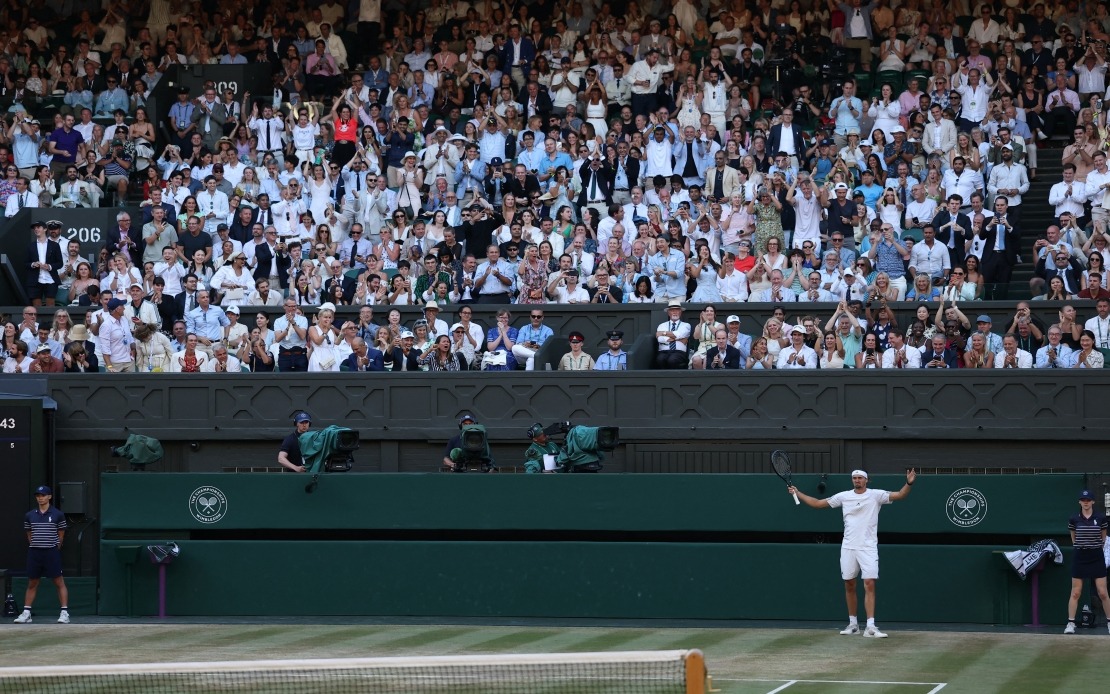
Wimbledon 2026 has concluded with a collection of matches that will be studied and celebrated for years to come, each representing a different thread in the rich tapestry of grass-court tennis. Jannik Sinner's four-set victory over Alexander Zverev in the men's singles final provided the narrative arc that such a tournament demands, though the fortnight's most compelling moments extended well beyond the championship showcase.
The women's final offered an emotional counterpoint to Sinner's clinical performance, as first-time grand slam finalist Noskova navigated a psychological minefield of her own creation. The young Czech squandered five separate championship points during a catastrophic second-set collapse, surrendering a commanding 5-2 lead as her opponent clawed back into contention. This unravelling inevitably evoked memories of Jana Novotna, the late Czech champion whose 1993 final loss to Steffi Graf—sealed after Novotna surrendered an apparently decisive advantage—produced one of tennis's most indelible images: tears on the shoulder of the Duchess of Kent. Novotna endured five years of heartache before capturing her own Wimbledon crown in 1998, a redemptive arc that seemed to hang over the championship stage. Yet Noskova, at just 21 years old, possessed neither the burden of such prolonged anguish nor the inclination to defer her vindication. Rather than collapse under the weight of nearly lost opportunity, she seized the decisive set and, walking past the trophies en route from the bathroom, made a declaration to herself: "I'm taking the big one!"
If Noskova's triumph represented emotional recovery, then British wild card Fery's run to the semi-finals embodied the underdog narrative that captures global sporting imagination. The 23-year-old from Wimbledon, ranked a modest 114th in the world, became the story of the Championships by engineering one of the tournament's most improbable deep runs. His quarter-final victory against Zizou Bergs, a player ranked 77 places higher, unfolded under the most arduous circumstances. Competing on Court 18 in baking heat, Fery found himself trailing 4-1 in both the fourth and fifth sets while enduring three separate nosebleeds that tested his physical and mental reserves. He recovered to force a tie-break in the fourth set, which he controlled with the composure of a player far more experienced, then demonstrated the same nerve in the subsequent 10-point decider even as his opponent—the higher-ranked favourite—visibly lost his poise. That victory transformed Fery into the darling of SW19, and more substantively, marked him as only the fifth British man in this century to advance into the tournament's second week, a statistic that underscores how rare such native success has become at the All England Club.
Djokovic's quarter-final against Felix Auger-Aliassime presented an entirely different character study: the 39-year-old Serbian monarch defying age through sheer championship experience, yet at a cost that would ultimately prove unsustainable. The match stretched to five hours and 15 minutes, establishing a new record as the longest quarter-final in Wimbledon history and concluding just eight minutes before the 11pm curfew. This extended struggle was precisely what Djokovic did not require as he pursued another grand slam crown. The contest saw him require treatment for a calf concern at the conclusion of the opening set, followed by a heated altercation with tournament referee Denise Parnell regarding the closing of the Centre Court roof ahead of the third set. Though Djokovic extracted victory from a 24th grand slam title holder's deep reserves, the toll was evident. The depleted energy that saw him fall to Jannik Sinner in the semi-final suggested that the marathon against Auger-Aliassime had extracted a price no amount of willpower could overcome.
The women's semi-final between Muchova and Coco Gauff condensed all the tension and reversal of fortune that Wimbledon can generate into a single dramatic tie-break. The final set's decisive tiebreak unfolded across 18 pulsating minutes during which both players held match points, creating a contest-within-the-contest that exemplified tennis at its most unforgiving. At 8-8 in the tiebreak, Muchova received a time violation and subsequently sent her shot long, gifting Gauff a match point opportunity. Yet the American inexplicably deposited what should have been a routine drop-shot winner into the net, a mistake that threatened to be fatal. Muchova seized the reprieve and moved forward with her own match point, but fate intervened through a slip that cost her the critical volley as Gauff's cross-court forehand whisked past. The Czech ninth seed would not be denied a second chance, however, and she converted decisively to secure her passage to the final.
Serena Williams's return to competitive tennis at 44 years old, nearly four years after "evolving away" from professional tennis, represented the tournament's most transcendent human element. Granted a wild card for the occasion, the American superstar commanded Centre Court during the opening week to an overwhelming standing ovation that reflected her historical significance to the sport. Facing Australian Ajla Tomljanovic—a player 24 years her junior—Williams seemed poised for a storybook finish, taking an early break in the deciding set and suggesting that her competitive edge remained intact. Yet the final straight revealed the accumulated weight of time. Williams, competing with a knee injury sustained late in the first set that ultimately prevented a planned doubles partnership with her sister Venus, gradually ceded momentum as her younger opponent demonstrated the capacity to manage both the formidable opponent and the magnitude of the occasion. The injury that limited her second-week participation provided a bittersweet punctuation to a remarkable if brief return, reminding observers that even the greatest athletes ultimately confront the constraints of human physiology.

