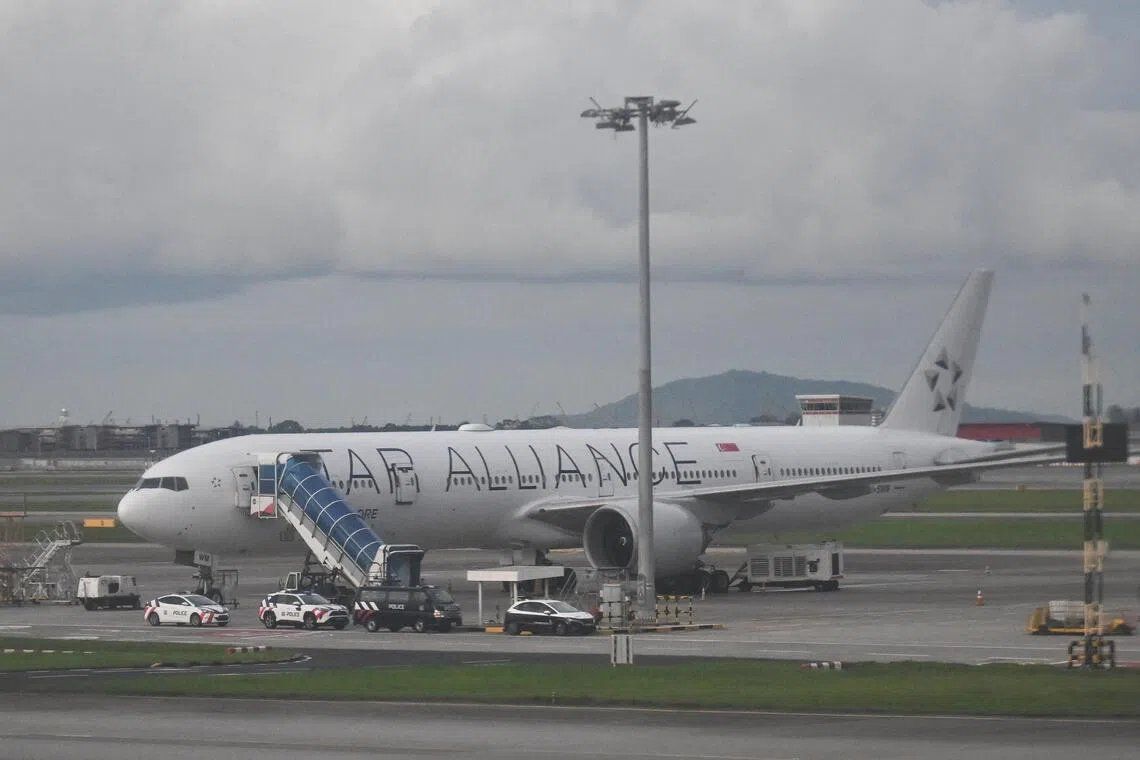
Linda Kitchen, a 74-year-old British woman, has commenced legal proceedings against Singapore Airlines at the High Court in London following the death of her husband during a catastrophic turbulence incident aboard Flight SQ321 in May 2024. The widow is pursuing damages to support her medical needs, specifically to fund specialist care for the severe spinal fractures she sustained when the aircraft encountered sudden extreme weather conditions while en route from London to Singapore.
The tragic incident unfolded on May 21, 2024, as the Boeing 777-300ER aircraft passed over Myanmar during a routine breakfast service. Without warning, Flight SQ321 experienced a dramatic vertical drop of over 54 metres within five seconds, creating chaos throughout the cabin as unsecured items and passengers were thrown violently about. The couple, Geoffrey and Linda Kitchen, had been married for 52 years and were embarking on a six-week holiday spanning Singapore, Indonesia, and Australia when the incident occurred. Geoffrey Kitchen, a respected theatre director, was thrown directly onto his wife during the plunge, crushing her against the seat armrest with enough force to break her back.
As fellow passengers intervened to move Geoffrey from Linda, a physician on board attempted emergency resuscitation measures. However, Geoffrey Kitchen suffered a fatal heart attack during the ordeal, and his death was only confirmed to Linda two days after the aircraft had been diverted to Suvarnabhumi Airport in Bangkok for an emergency landing. The impact on the widow proved both physical and psychological: she spent ten days in Thai hospitals before being airlifted to Bristol in the United Kingdom, where she remained hospitalised for approximately another week before being discharged with substantial ongoing care requirements.
The flight carried 211 passengers and 18 crew members, of whom 79 sustained injuries ranging from minor to severe. The scale of casualties underscores the extreme nature of the meteorological event that triggered the incident. Singapore Airlines subsequently extended compensation offers to affected passengers: those with minor injuries received US$10,000, whilst passengers requiring long-term medical treatment were offered advance payments of US$25,000. All passengers also received full refunds of their airfares, and the airline issued a formal apology acknowledging the trauma experienced by those aboard.
Anthe Korelidou, the specialist aviation lawyer representing Linda Kitchen and her family, has framed the High Court proceedings as a critical step toward obtaining thorough answers about the incident and determining whether preventative measures could have mitigated the severity of injuries sustained. The lawyer emphasised that the family's motivation extends beyond compensation to encompassing a comprehensive investigation into what occurred and whether additional safeguards might have reduced the harm to Geoffrey Kitchen and other passengers. This broader investigative objective reflects growing scrutiny over airline safety protocols and weather detection systems.
British court documents reveal that the Kitchen family has lodged two separate claims: one on behalf of Linda Kitchen for her personal injuries and a second in her name representing Geoffrey Kitchen's estate. Beyond the Kitchen family, six additional passengers—Bradley Richards, Jack Jenkins, Hannah Fullerton, Andrew Dawood, Bryan Matthews, and Pauline and Michael Rainey—have also initiated legal action against Singapore Airlines, indicating a broader pattern of litigation emerging from the incident. These multiple proceedings suggest that the compensation offers extended by SIA may prove insufficient for some claimants or that questions regarding liability and airline responsibility remain unresolved.
The Singapore Transport Safety Investigation Bureau released a technical report examining the circumstances surrounding the turbulence event. The investigation concluded that storm clouds responsible for the severe weather conditions were not detected by the aircraft's onboard weather radar system, thereby surprising the captain and preventing any opportunity for evasive manoeuvres or cabin preparation. Critically, whilst the TSIB identified the radar's failure to identify the storm system, the bureau determined that investigation findings remain inconclusive regarding whether the weather radar equipment itself experienced technical malfunctions or whether the storm conditions simply exceeded the system's detection capabilities.
This technical ambiguity carries significant implications for Singapore Airlines' legal defence and for the broader aviation industry's approach to adverse weather management. If the radar system functioned normally but failed to detect atmospheric conditions, the responsibility for the incident might rest with regulatory limitations in contemporary weather detection technology or with crew decision-making protocols. Conversely, should technical failures be substantiated, liability questions become more directly attributable to the airline's maintenance procedures and equipment standards. For Malaysian readers and Southeast Asian aviation stakeholders, this case represents a broader concern about whether current weather radar systems and meteorological protocols provide sufficient protection across the region's airspace, particularly during monsoon seasons when severe weather systems develop rapidly.
The incident occurred during Asia-Pacific's busy travel season and underscores the vulnerability of long-haul flights crossing equatorial regions prone to sudden atmospheric disturbances. Malaysia, as a Southeast Asian aviation hub with substantial traffic over similar weather-prone airspace, faces comparable risks. The SQ321 case may prompt regional aviation authorities to reassess weather radar standards and crew training protocols across commercial aircraft operating throughout Asia. Singapore Airlines, as one of the region's premier carriers, faces reputational implications as litigation proceeds, particularly given the carrier's historical emphasis on safety and service excellence.
Linda Kitchen's pursuit of damages represents not merely a claim for compensation but a demand for institutional accountability within aviation operations. Her statements to media outlets conveyed the profound personal devastation resulting from losing a long-term spouse whilst simultaneously enduring severe physical trauma and lengthy hospitalisation. The requirement for ongoing specialist care due to her spinal injuries has transformed what was intended as a celebratory retirement holiday into a medically intensive existence. Her determination to pursue thorough investigation reflects a common pattern among aviation accident victims' families: seeking systemic understanding and reform rather than accepting incidents as mere misfortune.
As the litigation progresses through British courts, Singapore Airlines has declined to comment on the case, citing the pending legal proceedings. This stance, whilst appropriate from a corporate liability perspective, may not fully address the broader aviation safety questions raised by the incident. The intersection between technical investigation findings, airline operational procedures, and passenger safety standards remains central to understanding whether the May 2024 turbulence event represents an isolated meteorological anomaly or reveals systemic gaps in aircraft safety systems and protocols. For regional carriers and aviation regulators, the outcome of Kitchen's High Court case and the associated litigation may establish important precedents regarding airline accountability for passenger injuries during severe weather encounters.

