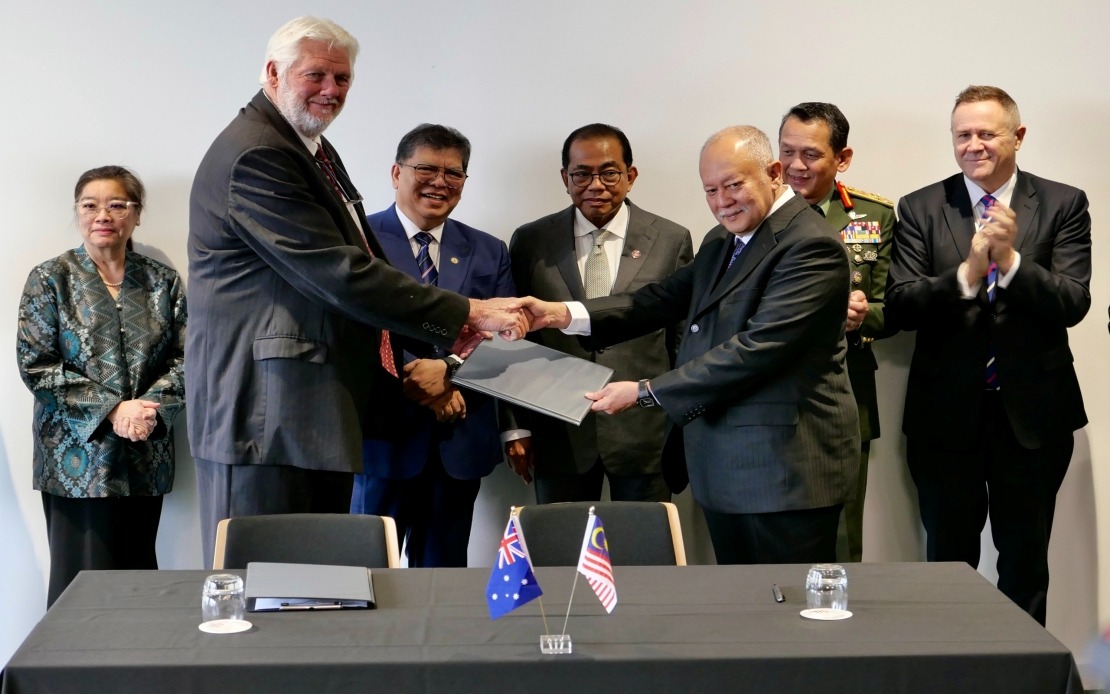
Malaysia is moving decisively to strengthen its domestic defence manufacturing ecosystem through a landmark collaboration between Weststar Defence Industries Sdn Bhd and Australian rocket technology company Rocket Technologies International Pty Ltd. Defence Minister Datuk Seri Mohamed Khaled Nordin has characterised the partnership as a transformative step that will position Malaysia to develop and produce advanced rocket and missile systems domestically, reducing reliance on foreign suppliers and building critical in-house expertise.
The agreement underscores Malaysia's commitment to the National Defence Industry Policy (DIPN), a strategic framework designed to cultivate homegrown capability across the defence technology spectrum. Rather than remaining dependent on imports, the country is investing in the knowledge transfer and infrastructure necessary to manufacture sophisticated defence systems. This localisaton of production carries profound implications for national security, economic diversification, and regional standing in Southeast Asia, where countries are increasingly scrutinising defence autonomy.
Under the accord, Weststar will construct and operate a manufacturing facility within Malaysia where rocket production will commence within twenty-four months. The timeline then extends into missile production, signalling a phased but determined expansion of the country's technological ambitions. This measured approach allows the company to build workforce competency and quality assurance protocols while scaling operations incrementally. The facility will function not merely as a manufacturing hub but as a knowledge centre where Malaysian engineers, technicians, and scientists acquire hands-on experience in rocketry and propulsion systems.
Equally important is Malaysia's prospective integration into RTI's international supply chain network. By entering this ecosystem, domestic suppliers and manufacturers gain pathways to participate in global defence procurement contracts. This exposure creates cascading economic opportunities throughout Malaysia's industrial base, as sub-contractors, materials suppliers, and service providers develop capabilities tailored to international defence standards. For a nation seeking to diversify its economy beyond traditional sectors, defence manufacturing represents a high-value avenue employing skilled labour and driving innovation.
The partnership was formalised during Defence Minister Mohamed Khaled's three-day working visit to Australia, where he and Weststar Group founder Tan Sri Dr Syed Azman Syed Ibrahim met with RTI founder Allan James Payne in Canberra. The ceremonial signing at the National Convention Centre provided a prominent platform, signalling both governments' endorsement of the initiative. Mohamed Khaled specifically thanked the Australian government for facilitating and approving the collaboration, reflecting the diplomatic clearance required when sensitive defence technologies and manufacturing relationships cross international boundaries.
During his Australian sojourn, the Defence Minister led a high-level delegation encompassing Royal Malaysian Air Force chief General Tan Sri Muhamad Norazlan Aris, Universiti Pertahanan Nasional Malaysia (UPNM) vice-chancellor Lt Gen Datuk Wira Arman Rumaizi Ahmad, and National Aerospace Industry Corporation Malaysia (NAICO Malaysia) chief executive officer Prof Shamsul Kamar Abu Samah. This composition reveals deliberate inclusion of military, academic, and industrial stakeholders, reflecting recognition that technological advancement demands synergy across these sectors. The group toured the Institute for Space, Defence and Advanced Technologies at the University of Southern Queensland, where they examined advanced composite manufacturing and hypersonics laboratories co-developed with defence industry partners including RTI.
The institutional exchanges underscore a critical insight: Malaysia recognises that academic partnerships amplify defence innovation. Universities increasingly function as incubators where theoretical research translates into commercial defence applications. By studying Australia's model of industry-academia collaboration, Malaysia's delegation gathered insights applicable to strengthening similar networks domestically, potentially through UPNM and other research institutions.
Beyond the Weststar-RTI arrangement, Mohamed Khaled utilised the visit to elevate Malaysia-Australia defence relations more broadly. He convened discussions with Australian Deputy Prime Minister and Defence Minister Richard Marles, exploring expanded areas of strategic cooperation. These conversations likely touched upon regional security challenges, maritime domain awareness in the Indo-Pacific, and counterterrorism coordination—domains where Malaysian and Australian interests converge. Mohamed Khaled expressed optimism that bilateral defence ties would deepen, contributing to what he termed shared interests and regional peace and stability, language reflecting the geopolitical significance both nations assign to their partnership.
Parallel parliamentary engagements reinforced the diplomatic momentum. Dewan Rakyat Speaker Tan Sri Johari Abdul and Malaysia's High Commissioner to Australia Datin Paduka Sharrina Abdullah participated in an official welcome at Australian Parliament House and met with Speaker of the House of Representatives Milton Dick and Australian parliamentarians. These cross-legislative exchanges institutionalise the relationship and cultivate long-term political support for defence cooperation, essential for projects requiring sustained investment and commitment.
For Malaysia, the strategic implications extend beyond immediate military capability. Developing sovereign rocket and missile production capacity addresses a longstanding vulnerability: the country's limited ability to design and manufacture advanced weaponry independently. While Malaysia will not become a comprehensive defence technology powerhouse overnight, establishing bridgeheads in critical domains like rocketry and missiles accelerates the trajectory toward greater self-sufficiency. This capacity also enhances Malaysia's credibility in regional security architecture, as nations increasingly respect peers capable of indigenous technological innovation.
The economic dimension deserves emphasis. Defence manufacturing generates well-remunerated employment for engineers, skilled technicians, and research personnel—precisely the talent Malaysia endeavours to retain domestically rather than losing to overseas opportunities. The sector catalyses supply chain development, training programmes, and specialised services. Over time, companies that mature within Malaysia's defence ecosystem may pivot toward dual-use civilian applications, multiplying returns on the initial investment.
Regionally, Malaysia's advancing defence capabilities ripple outward. As Southeast Asian nations modernise militaries and navigate competition for influence in the Indo-Pacific, Malaysia's indigenous rocket and missile capability elevates its strategic profile. It signals to ASEAN partners that Malaysia possesses technological sophistication and to major powers that Malaysia is serious about shaping its own security trajectory rather than remaining wholly dependent on external provision of advanced systems.
The Weststar-RTI partnership thus represents a convergence of strategic, economic, and diplomatic objectives. It operationalises the National Defence Industry Policy by anchoring concrete investment and capability development. It deepens Malaysia-Australia ties through tangible collaboration benefiting both nations. Most fundamentally, it inscribes into Malaysia's defence posture a commitment to sovereignty—the capacity to develop the instruments of national protection through homegrown expertise and manufacturing prowess.

