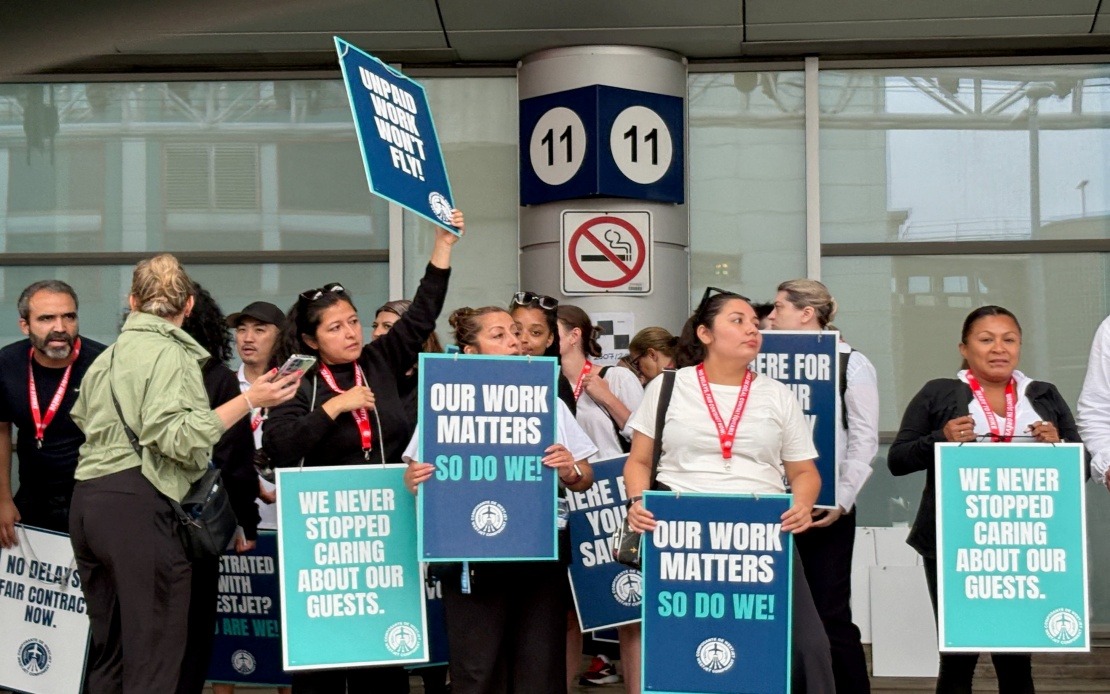
The labour dispute at WestJet Airlines intensified when over 4,000 flight attendants initiated a strike on Sunday, effectively halting approximately 600 daily flights and leaving an estimated 250,000 passengers scrambling to rearrange their travel plans. The timing proved particularly costly for the airline, as Monday marked a civic holiday in Canada, transforming the weekend into one of the busiest travel periods annually and amplifying the disruption's impact across the country's aviation network.
The core of the disagreement centres on compensation for ground duties that flight attendants perform before boarding and after passengers disembark. Currently, WestJet crew members receive between $28.88 and $53.61 per credit hour, a structure that union representatives argue fails to account for essential preparatory and concluding work that extends beyond flight time itself. This grievance has simmered for nearly eleven months through protracted bargaining sessions, suggesting both sides have held firm positions throughout the negotiation process.
The union representing the striking workers, the Canadian Union of Public Employees, positioned the airline as the obstacle to reaching an accord. Alia Hussain, speaking on behalf of the membership, declared that the strike would not have occurred had WestJet management demonstrated genuine responsiveness to worker concerns during the extended negotiation period. The accusation reflects deep frustration within the workforce over what they perceive as the carrier's intransigence in recognising the value of their labour beyond the formal flight duration.
WestJet's leadership acknowledged the disruption while maintaining the airline's position. Chief Executive Alexis von Hoensbroech expressed disappointment at the strike's commencement, emphasising the negative consequences for passengers, employees, and the communities the airline serves. The company committed to offering refunds to affected travellers, though such compensation does little to restore the plans of hundreds of thousands disrupted by the industrial action. Industry analysts project the strike will cost WestJet millions of dollars in lost revenue and operational expenses.
The dispute reflects a broader shift within North American aviation labour relations. Delta Air Lines pioneered ground work compensation in 2022, recognising that flight attendants invest considerable time in duties beyond flight operations. Air Canada subsequently adopted a similar framework in February following negotiations that produced a new collective agreement. Under the Air Canada arrangement, flight attendants now receive up to 70 per cent of their hourly rate for the hour immediately preceding takeoff, establishing a precedent that WestJet flight attendants argue their own employer should match.
For Malaysian and Southeast Asian readers, this labour confrontation illustrates the evolving dynamics of aviation workforce relations globally. As low-cost carriers continue expanding across the Asia-Pacific region, often emulating WestJet's business model emphasising operational efficiency, similar disputes over ground work compensation and fair wages appear likely to emerge. The precedent set by Delta and Air Canada suggests that workforce expectations regarding ground duty pay are hardening across the industry, potentially pressuring regional carriers to reconsider their own compensation structures.
Federal Jobs Minister Patty Hajdu intervened publicly, expressing disappointment that negotiations had failed to produce an agreement. Her statement underscores the government's concern about the strike's broader economic ramifications, particularly during a peak travel period when disruptions cascade throughout tourism, hospitality, and business sectors dependent on reliable air connectivity. Such intervention, while limited in direct leverage, reflects official recognition of the dispute's significance beyond the immediate airline-union relationship.
The strike's resolution remains uncertain as both parties maintain entrenched positions. WestJet management must balance union demands against competitive pressures and profit margins in an industry characterised by razor-thin margins and intense competition. Flight attendants, meanwhile, face the immediate consequences of lost wages during strike action whilst betting that sustained pressure will compel management to adopt ground work compensation comparable to competitors. The longer the action persists, the greater the mutual pain, potentially forcing compromise or escalating the confrontation.
The incident highlights how labour disputes in essential services like aviation create cascading disruptions affecting millions beyond the immediate workplace. The 250,000 passengers stranded by this strike represent not merely statistical inconvenience but genuine hardship—missed business meetings, delayed family reunions, cancelled vacations, and lost economic activity. For regional carriers considering expansion strategies, the WestJet situation demonstrates that workforce relations constitute critical operational risk factors requiring sophisticated management and fair-minded policy frameworks.
Moving forward, the resolution of this dispute may establish important precedent for the aviation sector across North America and potentially beyond. Should WestJet ultimately concede ground work compensation comparable to Air Canada's framework, pressure will mount on other carriers to adopt similar provisions. Conversely, if management successfully resists union demands, it may embolden other airlines to maintain traditional compensation structures despite competitor concessions. Either outcome will ripple through an industry where labour costs represent significant expense categories and where workforce satisfaction directly correlates with service quality and safety standards.

