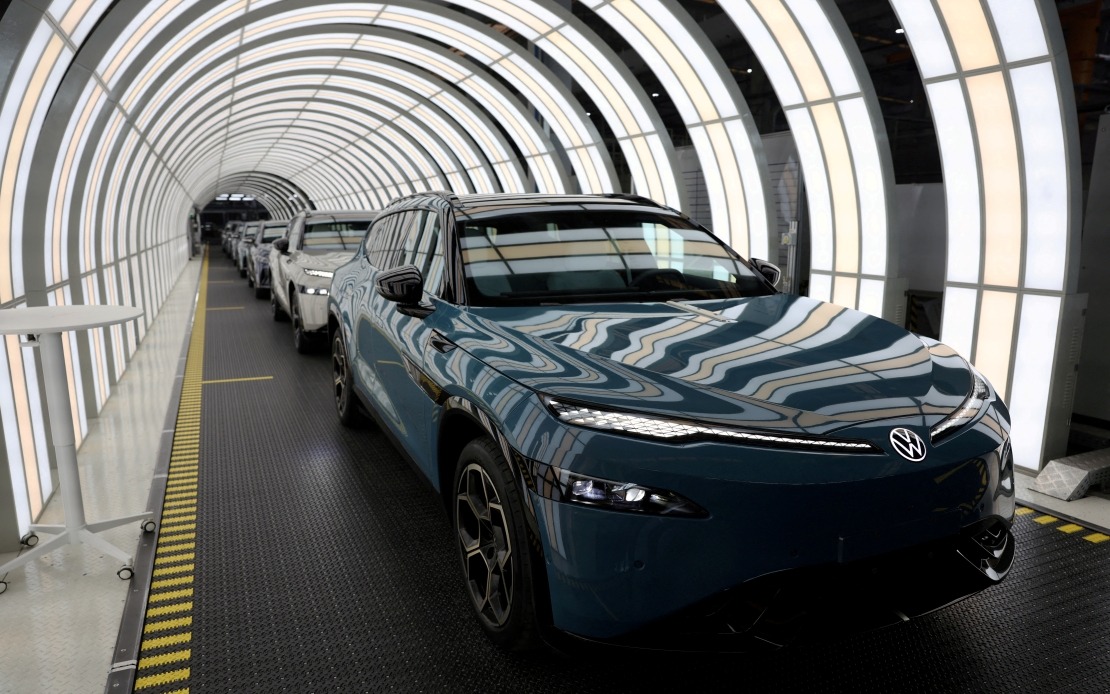
Western automakers have meaningfully reorganised their European electric vehicle supply chains in response to tariff pressures imposed by the European Union, according to fresh research released this month. A comprehensive study by transport advocacy group T&E reveals that major manufacturers including BMW, Dacia, Volvo, Smart and Tesla have dramatically cut their reliance on vehicles manufactured in China, reversing a trend that had accelerated in recent years. The shift represents a significant realignment of global automotive production strategies, with implications extending far beyond Europe's borders into supply chains that affect manufacturers and consumers throughout Southeast Asia.
The data demonstrates a sharp contraction in Chinese-sourced vehicle sales within the European market. During the first quarter of this year, Western automakers' share of China-manufactured battery electric vehicles sold across Europe dropped to just 23 per cent of their total EV sales, compared with 38 per cent recorded in 2024. This represents a reduction of 15 percentage points in merely six months, signalling a rapid and decisive reorientation of production and sourcing decisions by multinational manufacturers responding to trade policy changes. The findings, which relied on production and sales data compiled by GlobalData, paint a picture of considerable disruption within established supply networks.
Tesla's experience offers a particularly instructive case study. The American electric vehicle manufacturer's dependence on Chinese production for its European market has contracted from 23 per cent to 19 per cent during the same timeframe. While this reduction appears less dramatic than the overall Western brand average, it reflects Tesla's substantial existing European manufacturing footprint, particularly through its Berlin Gigafactory. Nevertheless, even Tesla's reorientation demonstrates the tangible commercial pressure exerted by EU tariff policy on traditionally China-dependent production models.
Contrasting fortunes among Chinese exporters illustrate how tariff structures shape competitive outcomes. Chinese automakers including BYD and Geely have maintained robust export growth to Europe despite the 2024 tariff implementation, primarily due to oversupply conditions within China's domestic manufacturing sector. These manufacturers possess sufficient production capacity that even reduced market access remains commercially attractive. However, SAIC confronts substantially different circumstances, having experienced pronounced sales declines throughout European markets since tariff introduction. The European Union determined that SAIC benefited disproportionately from state subsidies across its entire supply chain, justifying tariff rates approaching double those applied to competitors such as BYD and Geely. This differential treatment underscores how tariff policy mechanisms can fragment previously unified market segments.
The tariff regime has simultaneously catalysed a fundamental strategic reorientation among Chinese manufacturers themselves. Rather than accepting reduced export access, these companies have aggressively expanded their European production footprint. Since the EU commenced its subsidy investigation in 2023, Chinese automakers have announced plans for ten production facilities across the continent. This factory-building represents a long-term commitment to European market participation, suggesting Chinese manufacturers view the region as sufficiently valuable to justify substantial capital investment and operational complexity. For Malaysian automotive sector participants and policymakers, this expansion demonstrates how trade barriers can inadvertently accelerate the internationalisation of foreign competitors' production capabilities.
Chinese manufacturers have simultaneously pursued an alternative export strategy through plug-in hybrid vehicles, which occupy a distinct regulatory and market position within the EU framework. Their share of the European plug-in hybrid market has expanded dramatically, rising from merely 3 per cent in 2024 to 13 per cent in the current period. This tenfold proportional increase reflects deliberate market repositioning, with Chinese producers recognising that regulatory treatment and tariff applications differ between battery electric and hybrid categories. The strategy reveals sophisticated commercial decision-making, with manufacturers adapting their product mix to navigate complex and evolving European trade policy landscapes.
These developments carry significant implications for Malaysian stakeholders across multiple sectors. The automotive industry, already deeply integrated into regional and global supply chains, faces pressure to reassess sourcing relationships and production locations. Battery and component manufacturers serving the EV ecosystem must monitor tariff escalation risks, particularly as the European Union potentially extends or adjusts its trade enforcement mechanisms. The broader investment climate within Southeast Asia reflects growing protectionism, as major trading blocs employ tariff policy to reshape industrial organisation according to their strategic preferences.
The European Union's tariff strategy represents a deliberate attempt to rebuild domestic EV manufacturing capacity and reduce dependence on Chinese suppliers, reflecting concerns about supply chain vulnerabilities and technological sovereignty. The approach combines penalties for imports with incentive structures favouring local production, creating dual pressures that motivate multinational corporations to reconfigure their operations. Malaysia and other ASEAN nations must consider whether similar policies might emerge regionally, and how such developments could influence investment decisions by companies seeking alternative production locations.
Looking forward, the restructuring visible in European markets demonstrates how trade policy tools reshape global manufacturing networks with considerable speed. Western automakers have proven capable of adjusting sourcing within months rather than years, suggesting that supply chain inflexibility represents a diminishing constraint on policy implementation. Chinese manufacturers' simultaneous investment in European production indicates that even heavily penalised exporters maintain sufficient commercial incentives to expand operations substantially. The automotive sector's ongoing transformation reflects deeper shifts in international economic organisation, where regions increasingly pursue strategic industrial autonomy through trade mechanisms.

