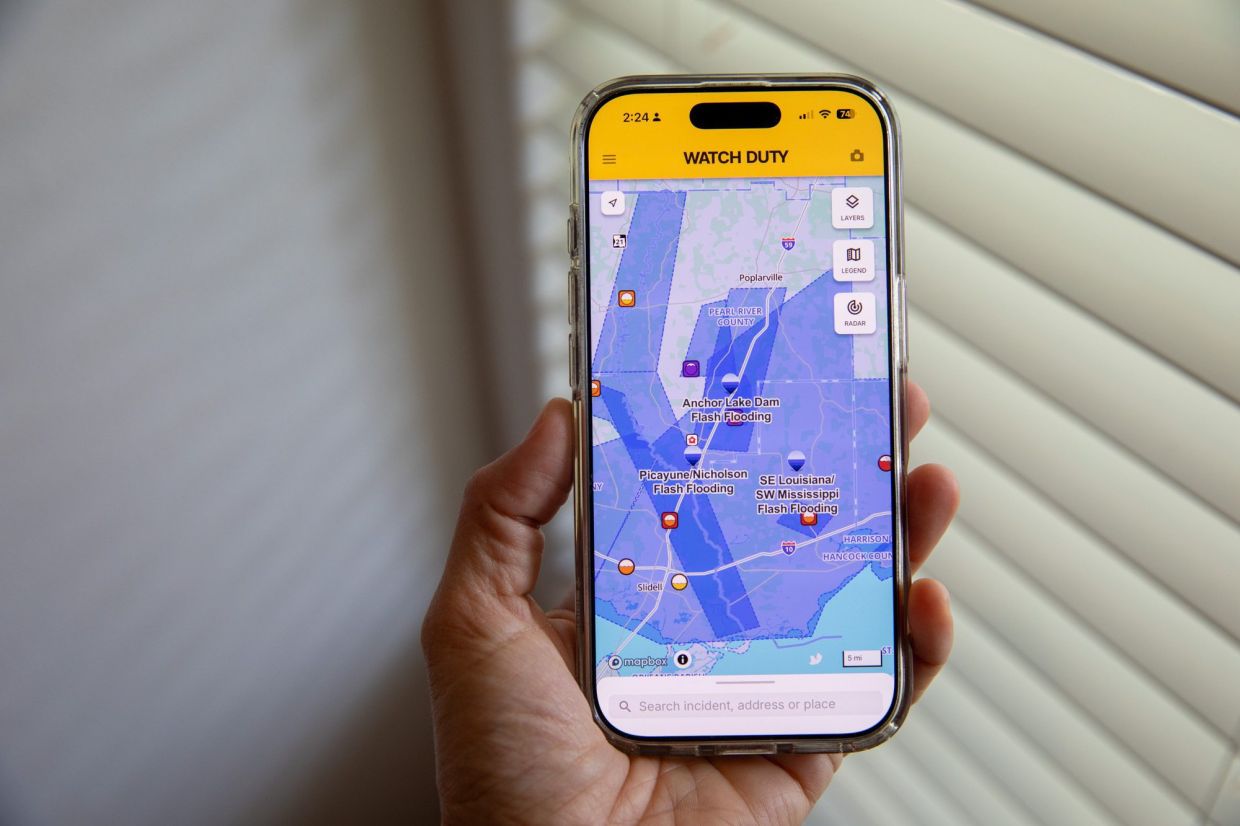
When fire swept across Los Angeles County in January 2025, millions of residents turned to an unexpected source for survival information: a free smartphone application called Watch Duty. Matt Blea, facing evacuation decisions with his family near Altadena, downloaded the app on a friend's recommendation and found detailed mapping of the fire's perimeter, evacuation orders, and emergency response updates. The information proved decisive—Blea evacuated that evening, escaping the Eaton Fire that would ultimately destroy his home. His experience was shared by more than 2.5 million other Californians who relied on Watch Duty during those catastrophic weeks, underscoring a troubling reality about disaster management in the modern era: grassroots technology has become essential precisely because official channels often fail to reach people in time.
The app's success during the Los Angeles fires revealed systemic vulnerabilities in how governments communicate with citizens facing imminent danger. Behind Watch Duty's real-time updates stood approximately two dozen paid staff members and over 100 volunteers who worked continuously to monitor emergency radio frequencies, aircraft transmissions, and local agency announcements. They collected raw information from dozens of sources, verified its accuracy, and pushed it through maps, text feeds, and push notifications designed to cut through digital noise. David Hertz, a Malibu fire brigade captain, described the service as "a democratisation of data that empowers people"—a characterisation that hints at uncomfortable truths about how emergency management has traditionally operated. In the Eaton and Palisades fires that killed 31 people, some neighbourhoods received minimal or delayed official warnings, forcing residents to seek information independently.
Watch Duty's expansion into flood monitoring, which began in June 2025, reflects the growing recognition that climate change is fundamentally altering disaster patterns across North America. The timing is significant: the service's flood-tracking launch coincides with the onset of peak flash flood season and arrives nearly a year after devastating Texas floods that claimed more than 130 lives and sparked intense criticism about why Hill Country residents and tourists received inadequate advance warning. John Mills, the nonprofit's CEO and co-founder, frames this expansion through the lens of urgency. "This is painful that this keeps happening," he stated, expressing frustration that critical information fails to reach people through sufficient channels quickly enough. The pattern he identifies extends far beyond Texas or California—it represents a continent grappling with weather hazards that increasingly exceed the capacity of traditional warning systems.
Mills created Watch Duty in 2021 after personally experiencing the gaps in official emergency communications. A fire burning near his Northern California home went largely unmarked in his awareness until he realised that nearby volunteer radio operators monitoring emergency scanners possessed far more current information than any government agency had disseminated. Rather than accepting this as inevitable, Mills recognised an opportunity: combine the real-time monitoring capabilities of dedicated volunteers with modern technology infrastructure to create a unified information platform. He recruited those volunteer scanner monitors and fellow software engineers to build the application, deliberately structuring it as a nonprofit organisation. This decision proved strategically important—nonprofits often inspire greater public trust than for-profit ventures, particularly in life-safety contexts. The model has succeeded spectacularly; Watch Duty now serves more than 20 million registered users and received nearly US$6 million in grants and donations during 2025 alone.
The operational model behind Watch Duty's effectiveness depends on a surprisingly lean structure scaled through distributed volunteerism. Approximately 300 volunteer "reporters" form the backbone of the system, drawing information from multiple streams: emergency radio scanners, satellite imagery, webcams, crowdsourced reports, and official announcements. These individuals possess a singular focus—monitoring and verification—which paradoxically makes them faster than official agencies burdened with incident command responsibilities, resource coordination, and bureaucratic protocols. Pete Curran, Watch Duty's meteorologist and a retired firefighter, emphasises this advantage: "Our only responsibility is to watch and listen. We're not in charge of the incident." The app presents all this collated information in five languages through formats optimised for emergency situations—maps showing precise hazard boundaries, plain-language text summaries, and aggressive push notifications that penetrate phone silencing settings. Users need not navigate multiple government websites, weather services, or county portals; everything consolidates into one purpose-built interface.
Watch Duty's flood-monitoring capability draws from authoritative scientific infrastructure while adding human interpretation and local context. The platform integrates weather modelling and data feeds from the National Weather Service, National Oceanic and Atmospheric Administration, and United States Geological Survey. Beyond simply republishing official flood warnings and watches, Watch Duty helps users understand their personal vulnerability. The interface displays which areas fall within FEMA-designated flood zones, explains what specific river gauge readings should trigger concern, and allows customisation so users receive notifications only when conditions affecting their location reach dangerous thresholds. This approach transforms abstract data into actionable personal intelligence—a person living near a river can see the current gauge height, understand what historical levels mean, and know precisely when to prepare or evacuate.
Dr Lori Moore-Merrell, who served as US Fire Administrator under President Joe Biden and now sits on Watch Duty's board, highlights why flooding demands this expanded attention. "We are seeing crazy rainfall in places that it's not normal for them," she observed, capturing how climate change has created hazard patterns exceeding historical experience. Communities that have never experienced significant flooding now face sudden torrential rains; traditional risk assessments become unreliable guides. Watch Duty's data-driven approach helps residents in these newly vulnerable zones understand emerging threats rather than defaulting to assumed safety based on past experience. The platform essentially extends institutional memory beyond what any single community has accumulated, allowing residents to learn from others' experiences and to understand warning signs that official systems might overlook or misinterpret.
Yet technological solutions, however sophisticated, cannot fully compensate for systemic weaknesses in emergency management infrastructure. Chad Berginnis, executive director of the Association of State Floodplain Managers, articulates a crucial limitation: "a warning is only as good as the knowledge to do something about it." A perfectly timed flood alert means little to someone who doesn't know which routes lead to higher ground, who lacks transportation, or who faces psychological paralysis when disaster strikes. The ASFPM recommends that households not merely develop emergency plans but rehearse them, converting abstract knowledge into muscle memory. Berginnis identifies a troubling pattern: "One of the massive failures is not knowing what to do." This reflects how disasters expose not merely communication gaps but deeper social fragmentation where many people lack concrete connections to their communities and thus lack information networks beyond official channels.
The broader policy context surrounding Watch Duty reveals precarious funding for the underlying infrastructure that makes emergency warning systems possible. Federal agencies and local emergency management bodies face ongoing budget constraints, with past cuts to the National Weather Service and threatened reductions to other agencies that provide the foundational data Watch Duty depends upon. Berginnis emphasises the harsh reality: "At the end of the day, if you want eyes and ears out there, you've got to pay for it." Watch Duty's nonprofit model, while admirably efficient, essentially represents a workaround for inadequate public investment in emergency infrastructure. The sustainability of relying on volunteer labour and philanthropic donations to supplement government services raises troubling questions about whether this patchwork can scale across all American communities facing intensifying climate hazards.
Mills himself insists Watch Duty is not intended as a replacement for government agencies but rather as a supplement filling immediate gaps. "We need National Weather Service, we need fire service, we need all this infrastructure to operate," he emphasised, stressing that users should still enrol in official local alert systems. This partnership model makes practical sense but also reveals uncomfortable truths: government agencies whose primary responsibility includes public safety are being outpaced by a nonprofit startup with a fraction of their resources. The dynamic raises questions about whether current government structures can adapt to climate-driven changes in disaster frequency and intensity, or whether future resilience will increasingly depend on improvised systems built outside formal institutions.
A final constraint on Watch Duty's effectiveness deserves acknowledgment: the app requires both smartphone ownership and cellular coverage. While smartphone penetration in developed countries approaches universal levels, coverage remains spotty in rural areas where flooding often causes the most damage. Similarly, populations without smartphone access—elderly residents, unhoused individuals, recent immigrants—cannot benefit from the service regardless of its quality. Berginnis advocates for redundancy in warning systems, noting that inexpensive NOAA weather radios provide backup when digital systems fail and require no subscription or technical sophistication. "Sometimes we get so focused on tech, we forget the easy stuff," he observed, capturing how innovation can obscure simpler, more universally accessible solutions. For Malaysian readers observing Watch Duty's expansion, the implications extend beyond mere curiosity about American emergency management—they highlight how rapidly climate change is outpacing institutional capacity, and how hybrid systems combining technology with human networks may become necessary across the region as rainfall patterns intensify and flooding becomes increasingly frequent in previously unaffected areas.

