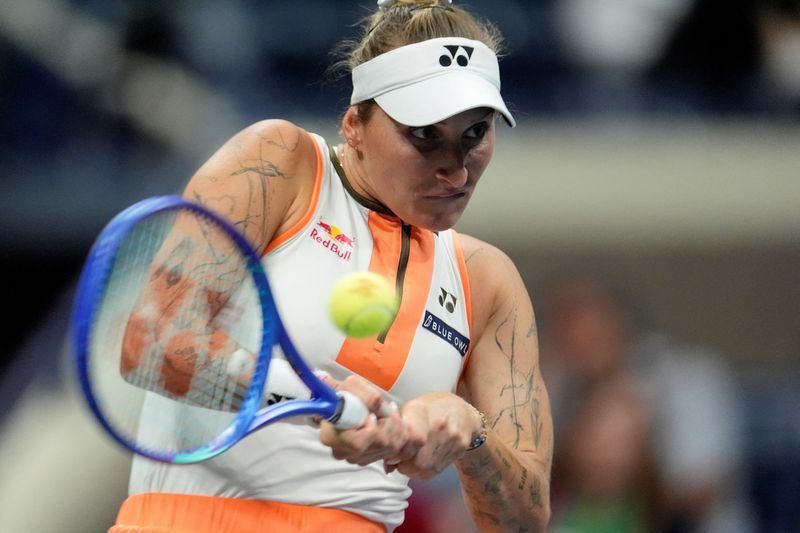
The suspension of former Wimbledon champion Marketa Vondrousova for four years has reopened fundamental questions about how tennis balances anti-doping integrity with player welfare and privacy rights. The International Tennis Integrity Agency announced the ban on Monday following the Czech player's refusal to provide a sample during an out-of-competition test at her home in December, triggering swift criticism from the Professional Tennis Players Association about the fairness and transparency of the sport's testing regime.
Vondrousova's case carries particular resonance because she has never tested positive for any banned substance. The 26-year-old explained in April that the late evening visit from a doping control officer at 8:15 p.m. represented an invasive breach of her privacy at a vulnerable moment, pushing her to what she described as a breaking point after months of physical and mental strain. Her refusal to comply was rooted partly in legitimate safety concerns, stemming from a 2016 knife attack on fellow Czech player Petra Kvitova at her home—an incident that would understandably shape any athlete's caution about unexpected visitors at their residence.
The PTPA's response highlighted the apparent inconsistency in how tennis has applied its anti-doping rules to different players. High-ranked competitors including Jannik Sinner and Iga Swiatek have faced considerably lighter consequences for positive test results, creating a perception that the system may operate with different standards depending on a player's prominence. The association's formal statement suggested that imposing a four-year ban on an athlete who has never tested positive, while others with actual positive results received shorter suspensions, warrants serious reconsideration of how the sport enforces its regulations. The PTPA explicitly stated that while it supports rigorous drug testing to maintain clean competition, players must have meaningful input into the rules governing their participation.
This dispute reflects a broader tension within professional tennis between the sport's commitment to anti-doping compliance and the legitimate privacy concerns of its athletes. Since aligning with the World Anti-Doping Agency code, tennis has adopted uniform standards applied across all sports, theoretically ensuring consistency and fairness. However, the implementation of these rules has proven controversial, particularly regarding the timing, location, and circumstances of out-of-competition tests. Last year, the PTPA took the unprecedented step of filing a lawsuit against tennis's governing bodies, alleging that random drug testing programmes violated fundamental player privacy rights.
The International Tennis Integrity Agency has defended the suspension through its CEO Karen Moorhouse, emphasising that testing decisions are based purely on facts and evidence rather than a player's ranking, nationality, or commercial value. She acknowledged that testing creates genuine discomfort and adds pressure to athletes already operating under intense professional scrutiny, yet argued this burden is necessary to protect competitive fairness. Moorhouse noted that the independent tribunal which reviewed Vondrousova's case upheld the principle that unpredictable testing at any time and location is fundamental to detecting performance-enhancing drug use and preserving the integrity of professional tennis.
Women's safety during testing represents a distinct concern that Vondrousova's case has brought into sharper focus. The timing and location of out-of-competition tests, particularly when conducted at players' residences during evening hours, create vulnerability for female athletes who may reasonably fear unexpected visitors. Moorhouse responded by explaining that ITIA procedures incorporate specific safeguards: all testers are professionally trained, the gender of testing witnesses matches the player being tested, and testers carry identification that can be verified through multiple methods. She stressed that both player and tester welfare receive careful consideration in the agency's protocols.
The distinction between refusal to comply with a doping test and actual doping violations has become central to this controversy. Tennis rules treat failure to submit to testing almost identically to testing positive for prohibited substances, treating refusal as an admission of wrongdoing rather than merely non-compliance with procedure. This approach differs subtly but significantly from systems that might distinguish between confirming guilt through a positive result and establishing guilt through procedural non-compliance. Vondrousova's legal position remains strong because she retains the right to appeal to the Court of Arbitration for Sport, where she can challenge both the factual foundation and the proportionality of the four-year suspension.
Vondrousova's absence from professional competition since January due to shoulder injury further complicates the severity of her punishment. While sidelined by physical injury, she now faces a four-year competitive ban that extends far beyond her current incapacity. This timing raises questions about whether the suspension functions as a proportionate sanction or as an effective career terminator, particularly given her relatively young age and prior achievements as a major champion. The player's circumstances differ markedly from cases involving older competitors or those already in career decline.
For Malaysian and Southeast Asian tennis, this dispute matters considerably because it signals how international sporting governance operates and the mechanisms available to athletes contesting authority decisions. The region's tennis development programmes depend on access to global competition and ranking systems governed by bodies like the ITIA. If those bodies are perceived as operating with insufficient athlete input or inconsistent standards, it affects confidence in the system's legitimacy. Young players aspiring to reach professional levels need assurance that anti-doping rules will be applied fairly and transparently.
The PTPA's advocacy for greater athlete voice in anti-doping governance reflects a broader movement toward more democratic decision-making in international sports. Rather than seeking to weaken testing or lower standards, the association argues for collaborative rule-making that incorporates player perspectives on privacy, safety, and proportionality. This approach acknowledges that rules gain legitimacy and compliance when those affected by them help shape them. Tennis has an opportunity to demonstrate that tough anti-doping standards and genuine athlete participation in governance can coexist.
Moorhouse's emphasis that unpredictable testing is essential represents the ITIA's core position, and this argument has scientific merit. However, the agency might strengthen public confidence by exploring whether testing protocols could achieve equal anti-doping effectiveness while addressing legitimate privacy and safety concerns. Options might include transparent communication about testing procedures, advance notice of testing windows, or adjusted protocols for testing at residences during unusual hours. Such modifications would not compromise testing integrity while demonstrating responsiveness to athlete concerns.
Vondrousova's case will likely influence how tennis approaches anti-doping governance for years ahead. Whether the Court of Arbitration for Sport upholds, modifies, or overturns the suspension, the broader questions about player rights and procedural fairness will persist. Tennis stands at a crossroads where it must choose between defending anti-doping rules through pure enforcement authority or legitimising those rules through collaborative governance. The sport's response to this challenge will determine not only Vondrousova's future but also how professional tennis retains the trust and participation of its athletes.