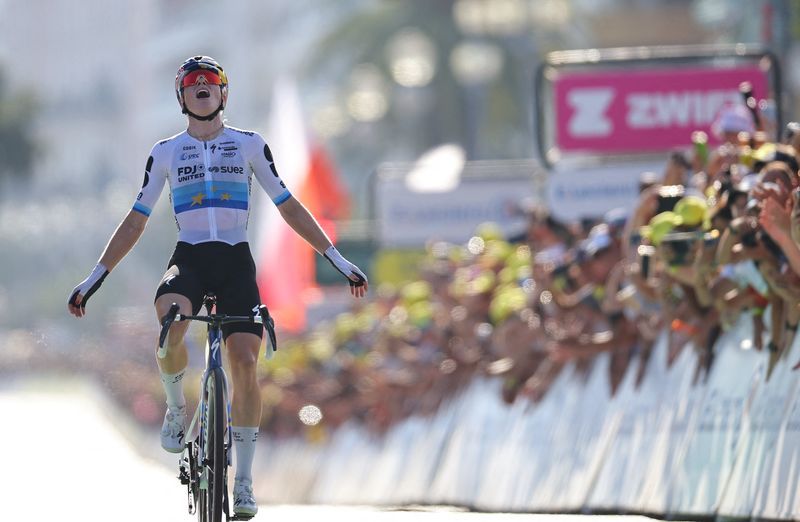
Demi Vollering of FDJ United-Suez claimed the overall lead at the Tour de France Femmes with a powerful stage eight triumph on Saturday, snatching the yellow jersey from Polish competitor Kasia Niewiadoma-Phinney ahead of Sunday's decisive final stage. The Dutch cyclist's aggressive performance on the 171.9-kilometre mountain route from Sisteron to Nice demonstrated her resilience and tactical acumen, particularly her decisive acceleration on the steep Chemin de l'Arieta climb with just six kilometres to navigate to the finish line. Vollering's breakthrough move came as a swift response to disappointment from the previous day's Mont Ventoux stage, where she had conceded over a minute to her main rival.
The drama surrounding stage eight extended beyond the racing itself. Defending champion Pauline Ferrand-Prevot of Visma-Lease a Bike withdrew before the stage began due to illness, removing one of the race's most formidable contenders from contention at a critical juncture. Her absence fundamentally altered the complexion of the competition heading into the finale, though Vollering's performance suggested the outcome might have been similar regardless. The Dutch rider's ability to recover from adversity and deliver under pressure represents a defining characteristic that has kept her in contention throughout the race, marking her fifth time wearing the coveted yellow jersey since the Tour began.
Vollering's tactical brilliance unfolded across the crucial final kilometres. Having positioned herself strategically as the peloton approached the Arieta climb, she unleashed her acceleration at the precise moment when her rivals appeared most vulnerable. The decisive nature of her move created sufficient separation from both Niewiadoma-Phinney and Italy's Elisa Longo Borghini to ensure victory, despite the technical demands of the descent toward Nice's finish. This combination of timing, strength, and tactical awareness showcased why she remains among Europe's elite female cyclists, capable of competing across varied terrain and weather conditions.
Italian rider Longo Borghini, representing UAE Team ADQ, claimed second place through a tight sprint finish ahead of Niewiadoma-Phinney, adding another layer of complexity to the overall standings. The Polish rider's third-place finish meant relinquishing her overall lead, a particularly frustrating outcome given her strong positioning and performance through most of the mountainous stage. The slender margin separating the top contenders heading into Sunday's finale sets up a tantalizing conclusion to the race, with only eight seconds separating the current leader from her nearest challenger.
The competitive dynamics of stage eight sparked immediate controversy regarding team tactics and sportsmanship. Niewiadoma-Phinney publicly criticized FDJ United-Suez's approach, alleging that teammate Celia Gery deliberately blocked her path into the barriers at a crucial moment during the Arieta climb. The Polish rider characterized the incident as deliberate interference that forced her to temporarily cease pedalling, fundamentally disrupting her rhythm at precisely the moment when maintaining position proved most critical. Niewiadoma-Phinney expressed her displeasure in unsparing terms, suggesting the tactical maneuver represented unsporting conduct rather than legitimate racing strategy.
Vollering's response to her stage victory emphasized the psychological dimensions of multi-day cycling competition, where emotional resilience and mental fortitude prove as important as physical capacity. She acknowledged the disappointment of losing substantial time on Mont Ventoux but highlighted the necessity of mental reset and renewed determination when facing subsequent stages. Her philosophy of living day-by-day in stage racing, rather than dwelling on setbacks, demonstrates the mindset required to compete at the highest professional level. The Dutch cyclist recognized that everything remained theoretically possible until the final stage concluded, though obtaining the yellow jersey represented significant psychological advantage.
The stage win provided Vollering with crucial bonus seconds beyond the time differential achieved through her superior climbing and descending. These bonus points, awarded to stage winners and top finishers in elite cycling competitions, expanded her margin over Niewiadoma-Phinney to eight seconds in the general classification. Such seemingly small time advantages carry enormous psychological weight during the final days of prestigious stage races, where every second becomes magnified through constant monitoring and analysis by teams and media. Vollering's emphasis on starting Sunday's finale in yellow suggested genuine confidence despite the competitive closeness of the overall standings.
The drama unfolding at the Tour de France Femmes reflects the sport's continued evolution and increasing competitiveness among professional female cyclists. The race has developed into a genuine grand tour capable of attracting and retaining elite talent throughout multiple weeks of gruelling competition. The quality of racing demonstrated across stage eight, combined with the tactical sophistication and fierce competition, underscores how far women's professional cycling has progressed. Mediterranean locations like Nice provide spectacular backdrops for racing that combines technical descending challenges with dramatic climbs that reward pure climbing ability and tactical awareness.
Looking toward the final stage, the narrow margin separating contenders ensures that Sunday's racing around Nice will likely deliver decisive action. Vollering's achievement in securing the yellow jersey with one day remaining represents a critical but incomplete victory. The conclusive stage presents opportunities for significant time gains or losses, depending on terrain characteristics and tactical positioning. Teams have invested entire weeks of effort to position their leaders favorably, and the finale will determine whether their strategies ultimately succeeded. For regional cycling enthusiasts across Southeast Asia, the Tour de France Femmes continues demonstrating that elite-level women's racing deserves the same attention and respect accorded to its male counterpart.

