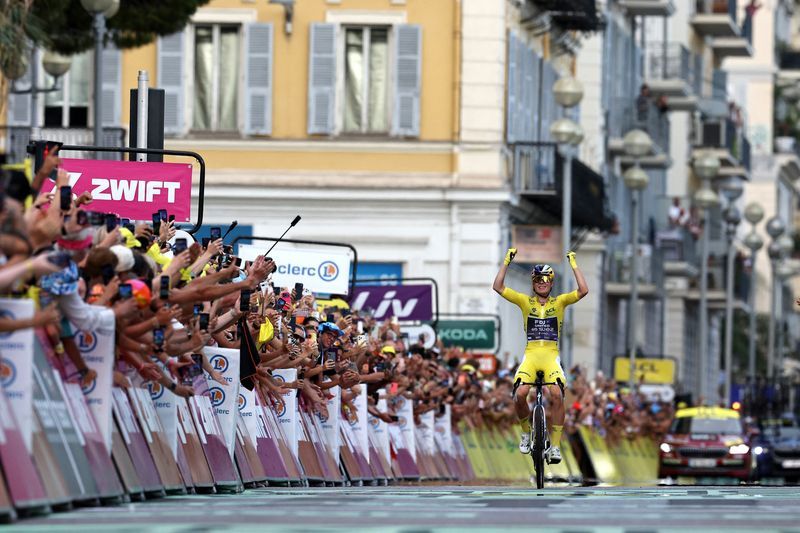
Demi Vollering of the Netherlands has claimed her second Tour de France Femmes title, capping a dominant campaign with a masterful display of racing on the concluding stage held near Nice on Sunday. The 29-year-old FDJ-Suez rider crossed the finish line ahead of Spain's Paula Blasi to seal overall victory with a margin of one minute and 18 seconds over her nearest challenger, Katarzyna Niewiadoma-Phinney of Poland, while Italy's Elisa Longo Borghini rounded out the top three.
Vollering entered the final 99.2-kilometre stage holding a slender eight-second advantage over Niewiadoma-Phinney, who had briefly claimed the leader's yellow jersey the previous day. Rather than merely managing her position over the rolling terrain around Nice, the Dutch champion orchestrated an aggressive campaign that underscored her standing as one of the sport's most complete riders. Her decisive move came on the fourth and final climb of the Col d'Eze, where she launched a telling attack that left Niewiadoma-Phinney unable to respond, ultimately extending her overall buffer significantly by the time she reached Nice.
The victory represents the latest major achievement for Vollering, whose palmarès have grown increasingly impressive over recent seasons. Beyond claiming the Tour de France Femmes crown twice, in 2023 and now 2025, she captured the Giro d'Italia Women in 2026, demonstrating her capacity to perform across different grand tour formats. Her back-to-back La Vuelta Femenina titles in 2024 and 2025 further underscore her consistency at cycling's highest level, establishing her among the most dominant stage racers of the contemporary era. These achievements have positioned her as the clear leader of the women's cycling landscape, much as her male counterparts compete for similar honours.
In the aftermath of her triumph, Vollering reflected on the emotional weight of her victory, articulating the personal significance of finally winning a grand tour while wearing the yellow jersey—a symbolic moment she had not yet experienced despite her previous Tour victory. Her comments revealed the mental resilience required to execute such a demanding strategy on the race's most critical day, acknowledging both her individual determination and the collective effort that enabled her success. She specifically referenced Celia Gery, a teammate who had endured a difficult night, illustrating how modern professional cycling depends upon the coordinated efforts of entire support structures rather than individual performances alone.
Vollering's articulation of her team-first mentality reflects broader shifts within women's professional cycling, where organisational support and tactical sophistication have increasingly mirrored the infrastructure surrounding the men's sport. Her emphasis on pursuing victory with both humility and pride suggests an awareness of the responsibility carried by cyclists who compete at the sport's apex, particularly as women's cycling continues to gain prominence and investment. The emotional connection she drew between personal ambition and collective endeavour resonates with the values increasingly emphasised within women's professional sports, where athletes acknowledge their dependence upon coaching staff, medical professionals, and teammates rather than presenting themselves as solitary champions.
Statistically, the margin of victory underscores Vollering's technical superiority over her rivals during this particular grand tour. Her final one-minute-and-18-second advantage proved decisive enough to withstand any last-minute tactical shifts, yet close enough to demand absolute concentration throughout the race's three weeks. Blasi's second-place finish on the final stage, arriving one minute and four seconds behind Vollering, demonstrated that the Dutch rider's supremacy extended beyond her primary rivals, as even strong stage racers could not match her finishing acceleration. Niewiadoma-Phinney's third-place stage finish, combined with her second-place overall classification, confirms her status as a legitimate contender for major honours, though the gap separating her from Vollering suggests the champion operated at a distinctly elevated level throughout the event.
Vollering's success adds another chapter to the expanding narrative of women's professional cycling, which has experienced substantial growth in sponsorship, media coverage, and spectator interest over the past decade. Her dominance across multiple grand tours and one-week races establishes a template for success that transcends any single event or format, positioning her as a generational talent whose career will likely extend considerably beyond the 2025 season. Within the context of Southeast Asian cycling development, her achievements demonstrate the globalised nature of the sport and the standards against which emerging regional talents must measure themselves as they aspire toward professional careers in Europe.
The men's Tour de France, concluded in July, saw Tadej Pogacar of Slovenia secure his fifth title and third consecutive victory, matching the record previously held by other cycling greats. This parallel success at the sport's highest levels emphasises the growing symmetry between men's and women's professional cycling, where comparable prize purses, broadcast rights, and media attention increasingly reflect market demand for elite-level women's racing. Pogacar's achievement in the men's race provides a useful comparison point for evaluating Vollering's accomplishment within the broader cycling calendar, as both represent performances by riders at the peak of their capabilities competing against the world's strongest opponents.
Looking forward, Vollering's repeated success at the Tour de France Femmes raises questions about which rivals might emerge to challenge her hegemony and whether the growing competitive depth within women's cycling will produce athletes capable of consistently defeating the Dutch champion. The presence of strong competitors like Niewiadoma-Phinney and Longo Borghini suggests the field possesses quality, yet none have demonstrated sufficient consistency across grand tours to systematically challenge Vollering's superiority. Her continued evolution as a racer, combined with her apparent commitment to competing at the Tour, suggests she will remain the favourite for future editions barring injury or unexpected form decline. For Malaysian cycling enthusiasts and aspiring professionals, Vollering's career trajectory illustrates both the opportunities available within international professional cycling and the exceptional talent level required to achieve sustained success at cycling's most prestigious competitions.

