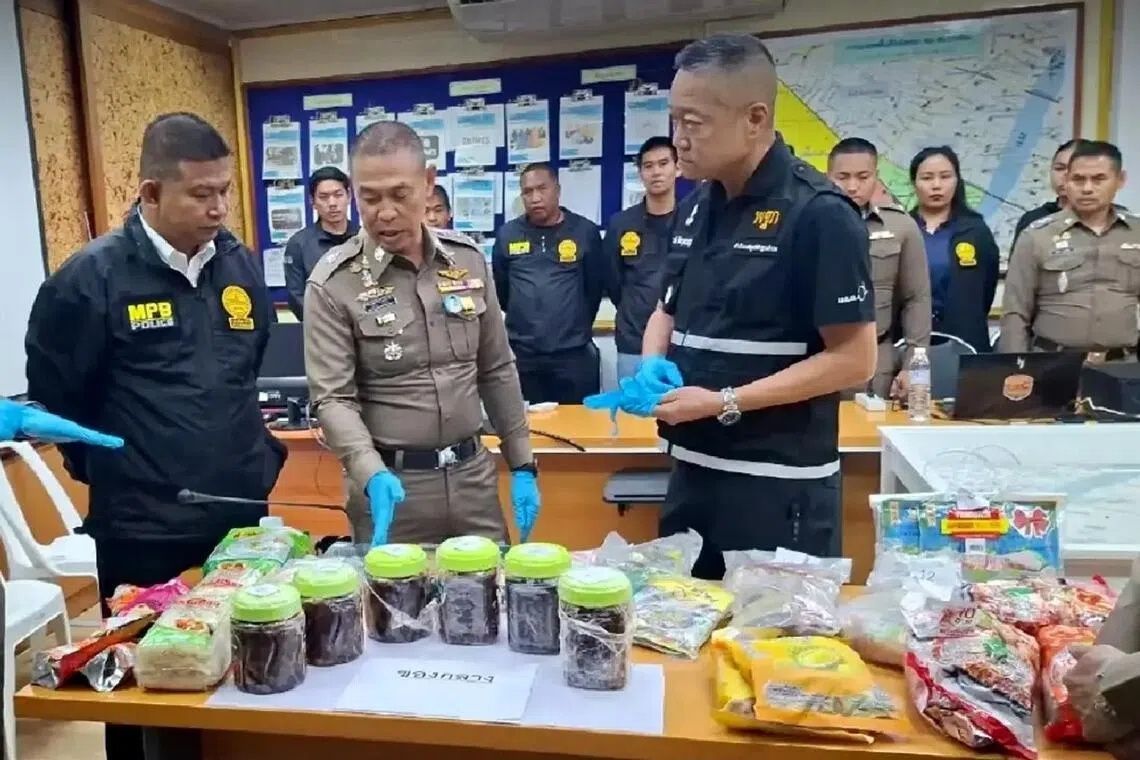
Bangkok police have uncovered an international methamphetamine trafficking network that exploited Thailand as a crucial transit corridor to deliver illicit drugs to Japan, using the cover of food products in a sophisticated concealment strategy. The Metropolitan Police Bureau announced findings of the investigation on July 17, revealing how Vietnamese operatives directed the scheme from Hanoi while employing multiple layers of intermediaries across borders to obscure the supply chain. The discovery underscores a troubling pattern where organised crime networks treat Southeast Asia as a permeable zone for narcotics movement, particularly when legitimate trade channels can be weaponised to transport contraband.
The investigation originated when a courier transporting jars of tamarind paste suspected something amiss with a shipment destined for Tokyo. After contacting authorities on July 13, the individual allowed inspectors to examine the cargo, which felt disproportionately heavy for its apparent contents. Further scrutiny revealed six foil-wrapped packages secreted within the jars, with subsequent laboratory analysis confirming the presence of more than two kilogrammes of crystal methamphetamine, known colloquially as ice. This discovery brought to light a criminal enterprise that had apparently operated with sufficient discretion to evade detection through multiple previous transactions.
What distinguishes this case is the deliberate structural design aimed at fragmenting the trafficking chain into disconnected segments. Vietnamese nationals operating from Thailand's territory allegedly recruited delivery riders through anonymous Facebook accounts, tasking them with collecting packages from residences occupied by Vietnamese nationals scattered throughout the country. These couriers then handed materials to separate Thai intermediaries contracted specifically for overseas transportation duties. By inserting multiple handoff points and creating geographical and personal separation between each stage, network organisers sought to complicate any investigative thread that law enforcement might pursue backward toward those directing operations.
Police lieutenant-general Siam Boonsom, commissioner of the Metropolitan Police Bureau, worked alongside police major general Chaiya Phetpanya, commander of Metropolitan Police Division 7, and investigators from Bang Yi Khan Police Station to piece together the operation's architecture. Their examination of financial flows proved particularly revealing, exposing how payments and operational expenses moved through a bank account registered to Sompong, a Thai national initially detained in connection with the network. Vietnamese participants allegedly withdrew cash sums ranging from 20,000 to 50,000 baht at irregular intervals, subsequently departing Thailand for Vietnam shortly after each transaction—a pattern seemingly designed to minimise individual exposure to arrest while rendering the financial trail fragmented and opaque.
The strategic use of withdrawal cycles and rapid cross-border movement suggests sophisticated understanding of law enforcement investigative techniques. By rotating personnel and maintaining short operational windows within Thai territory, the network reduced the likelihood that surveillance would capture comprehensive evidence linking individuals to sustained involvement. Similarly, the reliance on anonymous social media accounts for recruitment insulated higher-level organisers from direct contact with ground-level operatives, creating authentication challenges for investigators attempting to establish command hierarchies and decision-making authority within the enterprise.
Police have initiated formal legal proceedings against four individuals, including Sompong, who has categorically denied involvement in the scheme. Three Vietnamese nationals face arrest warrants relating to their alleged participation in money withdrawals, anonymous account operation, or directional roles within the trafficking structure. Investigators believe additional persons beyond these four individuals contributed to the operation, though precise numbers remain uncertain as the inquiry progresses. The incomplete closure of the investigation reflects broader investigative challenges when transnational organised crime networks segment operations across multiple jurisdictions and leverage cultural or linguistic barriers that complicate information-gathering.
Investigators also identified Sompong's girlfriend as potentially possessing knowledge of the operation, though she was not formally named in any arrest warrant. This tentative assessment demonstrates how law enforcement recognises that trafficking networks often encompass individuals with partial awareness or circumstantial involvement, yet establishing sufficient legal grounds to charge such persons presents evidentiary hurdles. The decision to examine her possible participation separately suggests authorities view her role as secondary, though certainly meriting further scrutiny as the case evolves.
This incident resonates particularly with regional security officials, as it exemplifies vulnerabilities endemic to Southeast Asian logistics and trade systems. Thailand's geographic position as a natural hub for regional commerce, combined with established transportation networks and border infrastructure, creates structural conditions that criminal enterprises exploit. The tamarind paste concealment method, while novel in specific application, reflects broader patterns where trafficking organisations adapt to customs procedures by embedding contraband within legitimate commodity shipments that attract minimal inspection suspicion.
For Malaysia and other Southeast Asian nations, the case underscores mutual threats posed by transnational drug networks. Vietnamese organised crime groups have demonstrated capability to coordinate cross-border operations spanning multiple countries, with Malaysia's own geographical position and busy ports making the nation similarly vulnerable to similar schemes. The involvement of Thai nationals as willing participants also suggests that recruitment of local facilitators across the region remains straightforward for well-resourced criminal enterprises offering financial incentives.
The sophistication displayed by this network—from financial compartmentalisation to recruitment methodology to concealment technique—indicates that Asian narcotics trafficking has evolved beyond opportunistic small-scale operations into professionally organised enterprises. The concentration of direction in Hanoi while execution disperses across Thailand and Japan reflects the operational maturity that regional authorities must increasingly confront. Greater intelligence sharing between ASEAN nations, enhanced training of customs and transport security personnel, and targeted financial investigations remain essential responses to such evolving criminal architectures.

