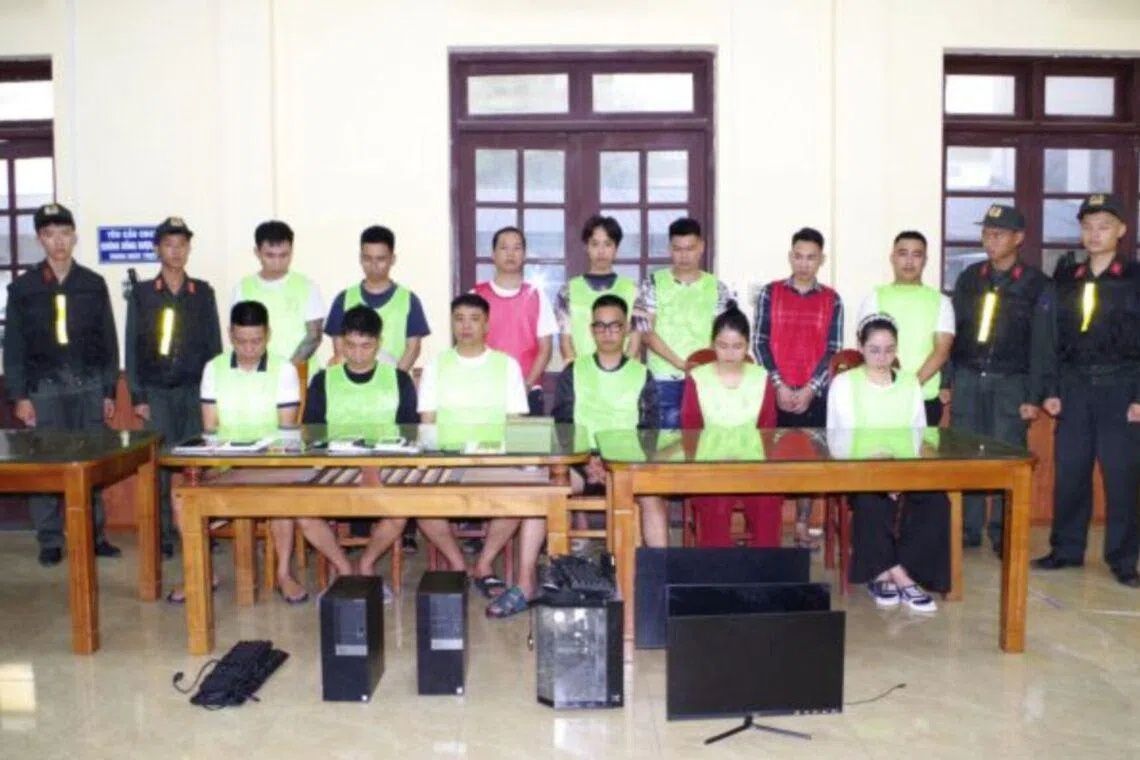
Police in Vietnam's northern Ninh Binh province have successfully broken up an international cybercrime operation responsible for defrauding more than 500 victims of approximately 250 billion dong, equivalent to RM39.2 million. The operation led to the arrest of 12 suspects, with authorities identifying two alleged masterminds, Nguyen Van Cuong, 28, and Nguyen Van Phuong, 34, as orchestrating the criminal enterprise. The investigation revealed a sophisticated and sprawling network that exploited victims through a combination of technological deception and social engineering, marking a significant success for Vietnamese law enforcement in combating cross-border digital crime.
What distinguishes this particular fraud ring is its highly organised structure and the deliberate recruitment and transportation of Vietnamese nationals to Cambodia, where the operation was physically based. This geographical separation between the fraudsters and their victims in Vietnam created additional operational challenges for investigators and allowed the criminals to operate with a degree of insulation from direct law enforcement oversight. The organised nature of the enterprise, with clearly defined roles and responsibilities among members, suggests a level of professionalism and business-like structure more typical of major criminal organisations than amateur scammers. This hierarchical approach enabled the network to scale operations and manage a large volume of simultaneous fraudulent schemes targeting multiple victims.
The sophistication of the technical and social tactics employed by the ring demonstrates how online fraud has evolved far beyond simple phishing emails or basic impersonation attempts. Members systematically created counterfeit websites and mobile applications designed to closely mimic authentic platforms operated by Vietnamese government agencies and established financial institutions. By replicating the visual design, user interface elements, and language of legitimate organisations, the fraudsters significantly increased the likelihood that unsuspecting victims would enter sensitive information or authorise transactions on these fake platforms. This approach exploits the natural tendency of users to trust familiar-looking digital interfaces and the difficulty ordinary people face in distinguishing subtle visual differences between authentic and fraudulent applications.
Beyond technical deception, the network employed an impressive range of impersonation tactics that leveraged the authority of official positions. Members posed variously as police officers, public prosecutors, judges, bank employees, and tax officials—individuals whose apparent authority would prompt rapid compliance from victims experiencing unexpected contact. This psychological manipulation capitalised on the natural anxiety that citizens feel when confronted by representatives of law enforcement or tax authorities, often inducing them to provide personal information or transfer money without carefully verifying the legitimacy of the request. The specific selection of these authority figures demonstrates a calculated understanding of which official personas would be most effective at generating compliance and fear among Vietnamese victims.
The network deployed multiple distinct fraud scenarios, each tailored to exploit different psychological vulnerabilities and circumstances. Fake recruitment schemes promised employment opportunities to desperate job seekers, while fraudulent investment proposals leveraged widespread interest in finance, securities markets, and cryptocurrency investment. Romance scams targeted emotional vulnerabilities by building manufactured relationships, and social media account hijacking enabled criminals to exploit victims' existing trust networks by impersonating friends and contacts. This diversified approach to fraud maximised the potential target population, since different scenarios appealed to people with varying circumstances, motivations, and concerns. The breadth of schemes also meant that the network could continue generating victims even if particular approaches became less effective or more widely publicised.
One particularly elaborate variant involved impersonating military personnel to target commercial entities. Members would contact shops and businesses purporting to represent armed forces units placing large orders for supplies or equipment. Having established this false business relationship, the fraudsters would then persuade the merchants to purchase additional goods on their behalf, with promises of reimbursement. The victims would be directed to transfer deposits or advance payments to bank accounts controlled by the criminals, who naturally never delivered the goods or reimbursed the merchants. This variation is especially insidious because it exploits both the commercial incentives of business owners and their natural inclination to comply with requests from military institutions, which carry significant authority and social status in Vietnamese society.
Investigations determined that the fraudulent operation had been active since October 2024, during which period members successfully defrauded approximately 500 individuals across Vietnam. The scale and speed of this theft—accumulating over RM39.2 million in roughly six months—underscores both the efficiency of the operation and the substantial number of vulnerable individuals susceptible to these schemes. For Malaysian readers and regional observers, the case highlights how transnational crime networks exploit gaps between national jurisdictions, using Cambodia as a base to target victims in Vietnam while potentially threatening citizens across Southeast Asia through similar operations. The relatively rapid accumulation of such vast sums indicates that these criminals were operating with considerable success and that many victims may not have immediately reported their losses or recognised they had been defrauded.
Authorities have initiated formal criminal proceedings against six of the arrested suspects, charging them with fraudulent appropriation of property and placing them in temporary detention pending trial. Procedural measures have been applied to the remaining six suspects as investigations continue to develop evidence and establish their specific roles within the network. The differentiated treatment likely reflects varying levels of culpability, with those charged being assessed as having the most substantial roles in executing the frauds. The ongoing investigation is being expanded to identify additional members of the network who may have escaped the initial dragnet, suggesting that the 12 arrests may represent only a portion of the total criminal enterprise.
Beyond the arrests, authorities are pursuing aggressive asset recovery procedures to seize and freeze funds connected to the operation. This multi-pronged approach—combining criminal prosecution, asset seizure, and fund freezing—is essential for both disrupting the immediate criminal enterprise and potentially recovering compensation for victims. The viability of asset recovery will be complicated by the transnational nature of the crimes, the likelihood that proceeds have been moved across borders, and the potential use of cryptocurrency or other difficult-to-trace financial instruments. Nevertheless, the systematic approach being taken suggests that Vietnamese law enforcement is committed to pursuing this case to the fullest extent possible and using it as a precedent for combating similar operations in the future.
For Malaysia and the broader Southeast Asian region, this case serves as an important reminder of the evolving threat posed by sophisticated transnational cybercrime networks. The increasing prevalence of such operations, particularly those based in Cambodia or other regional locations, represents a growing vulnerability for citizens throughout the region. The case demonstrates that protecting oneself requires vigilance against authority impersonation, skepticism toward unexpected contact from officials or investment opportunities, and careful verification of the authenticity of digital platforms before entering sensitive information. As these criminal networks become more organised and technologically advanced, governments and citizens across Southeast Asia must develop correspondingly sophisticated defences, including international cooperation mechanisms that enable rapid information-sharing and coordinated law enforcement responses across borders.

